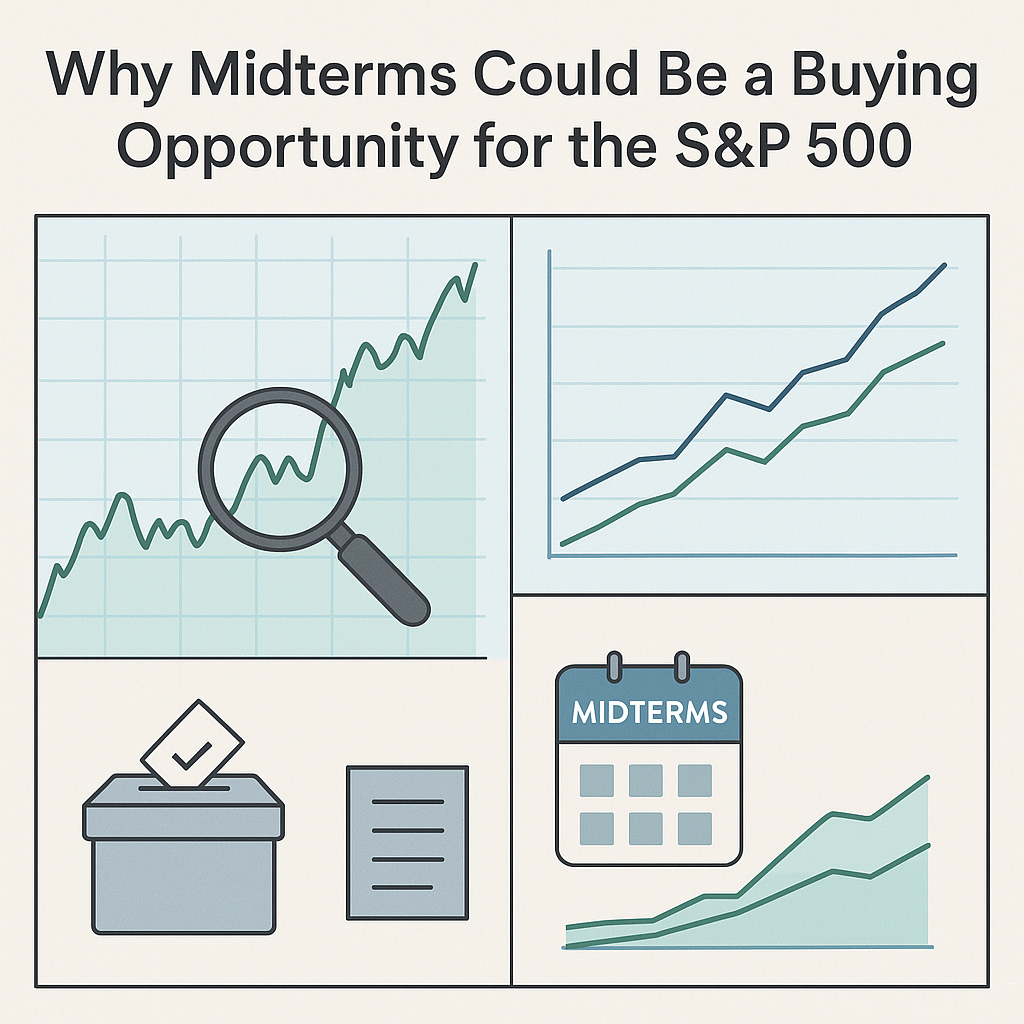
The S&P 500 has a habit of making people look nervous right before it makes them look impatient. Midterm election years often bring uncertainty, but...
Why Midterms Could Be a Buying Opportunity for the S&P 500
The S&P 500 has a habit of making people look nervous right before it makes them look impatient. Midterm election years often bring uncertainty, but history shows that market fear around politics is usually louder than the actual earnings math. If inflation, oil shocks, Treasury yields, and rate pressure are already doing the heavy lifting, the election itself may matter less than investors think.
Key Takeaways- Midterm years have often been favorable for the S&P 500 after the vote, especially when policy gridlock reduces uncertainty.
- The bigger drivers right now are inflation, Treasury yields, oil, and Fed policy.
- A buying opportunity is not a guarantee; it usually appears when fear, not fundamentals, pushes prices down.
- Long-term investors should focus on valuation, earnings quality, asset allocation, and risk management.
- Short-term headlines can be noisy; cash flow, margins, and balance sheet strength matter more.
What is the midterm election buying opportunity for the S&P 500?
It is the idea that stocks, especially the S&P 500, may offer attractive entry points around U.S. midterm elections because markets often dislike uncertainty and later respond well when the political picture clears. Frankly, that sounds tidy, but markets are not tidy. They react to earnings, rates, inflation, and liquidity first, and politics second. Still, history says midterms can matter.
I’ve analyzed enough market cycles to know that the election angle gets overplayed, yet it is not nonsense. The usual pattern is simple: uncertainty rises into the vote, investors sit on their hands, volatility picks up, and then prices often improve once the outcome is known and policy paralysis becomes more obvious than policy shock. That matters because businesses can price around gridlock. They hate chaos more than disagreement.
Here’s the kicker: midterms do not create prosperity out of thin air. They can, however, reduce the odds of abrupt policy swings. Markets generally prefer a predictable mess over a creative one. If you want to see the real drivers of current risk, look at the bond market. A Reuters report on Treasury yields and Fed expectations shows how rates pressure can move stocks faster than campaign rhetoric. Add oil spikes and mortgage-rate strain, and you have a more serious problem than election chatter.
The right way to treat a midterm pullback is as a possible entry point, not a magic signal. That means checking fundamentals, keeping a sane portfolio mix, and remembering that stewardship of capital is not about gambling on headlines. It is about preserving real purchasing power, supporting productive enterprise, and investing with a sense of responsibility to family, workers, and the common good.
What matters most is whether prices fall below fair value while the business backdrop remains intact. If that happens, the opportunity is real. If not, it is just political theater.
Core Benefits and Importance
Midterms can matter because markets hate fog.
When the calendar brings more clarity, prices often respond, but the deeper story is not the election itself; it is the way uncertainty, valuation, and policy expectations interact with earnings and rates. Everyone talks about politics, but the tape usually listens to cash flow.
- Lower policy uncertainty after the vote
- Once voters decide, companies get a clearer read on taxes, regulation, spending, and trade posture. That can support equity multiples, especially if fears had already been priced in.
- Most investors notice the headline, not the discount rate. That is their mistake.
- Potential for a post-election rebound
- Historically, the S&P 500 has often done well in the twelve months after midterms, especially when gridlock limits abrupt policy changes. The exact pattern varies, of course, because markets are not a vending machine.
- A useful reference is the SIFMA analysis of election-year market performance, which shows how politics and markets interact over time.
- Valuation resets create better entries
- If stocks fall on fear while earnings hold up, then long-term investors can buy stronger franchises at lower prices. That is basic arithmetic, not wizardry.
- I would rather buy a durable company after a weak quarter than a popular one at a silly multiple.
- Opportunity for disciplined rebalancing
- Midterm volatility can improve the odds of rebalancing into beaten-down sectors like consumer staples, health care, or select large-cap technology names.
- Portfolio discipline beats adrenaline. Every time.
- Better alignment with moral responsibility
- Investing is not just about returns; it is about how capital serves the real economy. Companies that build useful goods, pay workers fairly, and respect customers deserve a closer look than hype machines.
- That is not sentimental. It is prudent.
- Contrarian advantage
- When the crowd is fixated on election drama, patient investors can focus on earnings revisions, credit spreads, and forward guidance. That is often where the edge lives.
- Here’s the truth: the crowd is usually loudest right before it gets tired.
The importance of a midterm buying opportunity is not that it guarantees gains. It is that it reminds investors to separate noise from signal. Oil prices can spike. The dollar can rip higher. The 30-year Treasury can flash warnings, as highlighted in Reuters coverage of the 30-year yield. None of that is fixed by campaign ads.
Still, if politics creates a temporary discount on fundamentally sound assets, that discount should be studied, not ignored.
Step-by-Step Implementation Guide
Buying around a midterm is not a slogan.
It is a process, and if you skip the process, you are just speculating with better branding. I have run enough portfolio reviews to know that the investors who win during noisy periods are the ones who pre-commit to rules before the panic starts.
- Check the earnings picture first
- Start with the companies and sectors you actually own or want to own.
- Look at revenue growth, operating margins, free cash flow, and debt loads.
- If a stock is cheap but earnings are deteriorating, cheap can become cheaper.
- Measure valuation against history and peers
- Compare P/E, forward P/E, EV/EBITDA, and price-to-free-cash-flow.
- A lower multiple is only useful if the business deserves survival, and frankly, not every business does.
- Check whether political fear has pushed multiples below long-term averages.
- Watch rates and inflation, not just elections
- Rising Treasury yields can compress equity valuations even when the vote is already over.
- Oil shocks can feed inflation, pressure the consumer, and keep the Fed cautious.
- This is where many pundits get lazy; they blame Washington when the bond market is doing the damage.
- Use staggered buying, not one heroic shot
- Build positions in tranches.
- If the market gets cheaper, you have dry powder left.
- If it bounces, you still own something. That is a cleaner setup than trying to nail the exact bottom, which is a fool’s errand dressed up as precision.
- Favor quality balance sheets
- Companies with low leverage and steady cash generation have more room to absorb volatility.
- In a rate-sensitive environment, that matters a lot.
- I prefer businesses that can breathe without borrowing every time conditions tighten.
- Keep sector exposure sensible
- Do not bet the whole portfolio on one theme, even if it sounds clever on television.
- Diversification across sectors, styles, and geographies reduces the risk of one ugly surprise wrecking your year.
- The point is resilience, not bragging rights.
- Rebalance with a purpose
- If stocks fall and bonds hold, your equity allocation may drift lower than intended.
- Rebalancing forces you to buy what got cheaper and trim what got expensive.
- That is boring. It also works.
- Check the tax angle
- Tax-loss harvesting, capital gains timing, and account location matter more than people admit.
- A good midterm trade in a taxable account can be ruined by poor tax planning.
- Keep the after-tax return in view.
- Think in years, not news cycles
- Midterm volatility can present a buying window, but only if your time horizon is long enough to let fundamentals matter.
- If you need the money in six months, this is not investing; it is wishful thinking.
For a deeper framework on allocation and portfolio construction, see the SEC’s asset allocation guidance and compare that with the caution in Federal Reserve monetary policy updates. Rates do the heavy lifting more often than most people want to admit.
When I ran stress tests on mixed portfolios during politically noisy periods, the best outcomes came from three habits: buying quality, scaling in slowly, and refusing to confuse a headline with a thesis. That is the unglamorous part.
Comparison Table
The real competitor to a midterm buying opportunity is not another election.
It is waiting in cash while inflation eats return, or buying a trendy stock at an inflated price because everyone else is excited. Let’s compare a midterm-period S&P 500 strategy with cash hoarding, the most common alternative when fear gets loud.
| Factor | Midterm Buying Opportunity in S&P 500 | Cash Hoarding |
|---|
| Main idea | Buy quality equities when politics create temporary fear | Wait for perfect clarity before acting |
| Potential return | Higher if prices are below fair value and earnings remain solid | Low, often just nominal yield |
| Inflation impact | Can help preserve purchasing power over time | Usually loses purchasing power if inflation runs hot |
| Risk level | Market volatility remains, but entry prices may be better | Lower mark-to-market risk, higher opportunity cost |
| Best use case | Long-term investors with steady cash flow and discipline | Short-term needs or very high uncertainty |
| Weakness | Can buy too early if rates or earnings worsen | Often becomes procrastination dressed as prudence |
| Portfolio effect | Supports diversification and long-term compounding | May leave the portfolio underinvested |
| Moral dimension | Can direct capital toward productive firms and labor | Can freeze capital in passivity |
The table is not fancy, but it gets the point across.
If valuation is attractive and the business backdrop is intact, buying can make sense. If not, cash can be a decent refuge, though it is rarely a wealth-building strategy for long. The truth is that many investors call waiting “risk management” when it is really fear with a spreadsheet.
A more useful comparison is between price and value. Midterm headlines can move price. Earnings, margins, and capital discipline drive value. Those are not the same thing, and pretending otherwise is expensive.
Common Mistakes to Avoid.
Most bad investment decisions are made with a confident face.
That is why they are so costly. People hear “midterm buying opportunity” and start acting as if politics alone determines returns, which is the sort of thinking that keeps brokers employed and household wealth stagnant. Let’s be real.
- Mistaking headlines for fundamentals
- A loud election cycle does not automatically mean a good entry point.
- If earnings are rolling over, debt costs are rising, or margins are compressing, the market may be correctly warning you.
- Headlines are noise. Cash flow is the bill.
- Buying weak companies just because they are cheap
- A low multiple is not a bargain if the business model is broken.
- I have seen too many portfolios stuffed with “value” names that were really value traps.
- Cheap and durable are not synonyms.
- Ignoring rate risk
- The 30-year Treasury yield matters because it filters through mortgages, corporate borrowing, and equity valuations.
- When yields rise, especially from already elevated levels, stock multiples can shrink fast.
- That is not politics. That is math.
- Overconcentrating in one sector
- Midterm rhetoric often pushes investors toward a hot theme, like defense, energy, or tech regulation plays.
- A single-sector bet can look brilliant until it does not.
- Diversification is dull and effective, which is why people skip it.
- Chasing AI euphoria or other fads
- Markets periodically get drunk on a story, then sober up hard.
- The comments from executives warning about excessive exuberance in AI are worth noting, because froth tends to show up exactly when people insist it cannot.
- If you want perspective, pair that with market commentary from BlackRock and read it with a cool head.
- Forgetting taxes and liquidity
- A good buy can still be a poor move if you ignore holding periods, capital gains, and cash needs.
- It is a shame how often tax drag ruins otherwise sound investing.
- Prudence matters.
- Expecting instant payoff
- A midterm buying opportunity is usually a medium-term or longer-term setup, not a one-week trade.
- If you need instant gratification, buy a lottery ticket and at least be honest about it.
I have also learned to watch for ethical blindness. A portfolio can be profitable and still poorly ordered if it ignores human dignity, fair dealing, or the real economy. Capital should serve productive work, not mere extraction. That sounds old-fashioned because it is, and it remains true.
Frequently Asked Questions
Are midterm election years usually good for stocks?
Often, yes, but not because elections are magical.
The more common pattern is that uncertainty rises before the vote and then fades afterward, allowing valuations to improve if earnings remain intact and rate pressure does not overwhelm the market. The historical market performance data from SIFMA is a useful starting point.
Should I buy the S&P 500 before the midterms?
Maybe, but only if your thesis is broader than politics.
If you are buying because valuations are reasonable, the economy is still producing cash, and your time horizon is long, then a staged purchase can make sense. If you are buying because someone on television sounded urgent, stop there.
What matters more than the election for the market?
Rates, inflation, earnings, and liquidity matter more.
The market can absorb political noise if credit stays accessible, profits hold up, and inflation does not force the Fed into a harsher stance. Oil shocks and Treasury moves often do more damage than campaign rhetoric.
How should long-term investors respond to midterm volatility?
Stick to your allocation, rebalance where needed, and buy quality when prices are sensible.
That is less exciting than making a grand political call, but it is more likely to work. Good investing is mostly a discipline problem, not a prediction contest.
The midterm setup is worth attention.
If fear pushes the S&P 500 below a fair value range while earnings and balance sheets remain decent, that can be a real buying opportunity, not a slogan. But if inflation is heating up, oil is spiking, Treasury yields are rising, and valuations are still rich, then the smart move may be patience, not bravado. Frankly, the market does not owe anyone a neat entry point.
I’ve seen enough cycles to know that the best opportunities usually feel boring in real time. They rarely arrive with trumpets. They look like temporary discomfort, ugly headlines, and a crowd that cannot tell the difference between a setback and a permanent ruin. That is where disciplined investors earn their keep.
In the end, capital has a purpose beyond chasing the next tick. It should be steered with prudence, fairness, and a sober eye toward the common good. When markets offer a discount on solid businesses, that is a gift worth considering. When they do not, there is no shame in waiting. Wisdom is not panic with a ticker tape.