Why Debt-Free Americans Get Denied Credit: Thin Files, Scores, and Smart Fixes
Debt-free households can still be denied credit, even with high incomes and healthy savings. Lenders assess credit history as well as ability to repay, and a sparse or outdated file can leave an automated system with too little evidence. A rejection does not prove someone is bad with money; it may mean the lender cannot confidently score the file.
The mismatch is easy to see. The reported national credit card balance reached $1.29 trillion, up 67% since early 2021, while millions of adults may have files that are too thin or outdated to generate a standard score. Those figures describe different things: one is outstanding debt, the other is a gap in usable credit history. Neither says that every borrower should take on debt.
Jade Warshaw, co-host of The Ramsey Show, has argued that credit scores measure how a consumer may earn a bank money, not a person’s wealth or character. Credit specialist Micah Smith has likewise described how a debt-free young adult can be hard for a lender to assess when the file offers little recent repayment activity. There is a practical tension here, but it is not a reason to borrow blindly. The useful question is how to show reliable financial behavior without paying unnecessary interest or taking risks just to satisfy a scoring model.
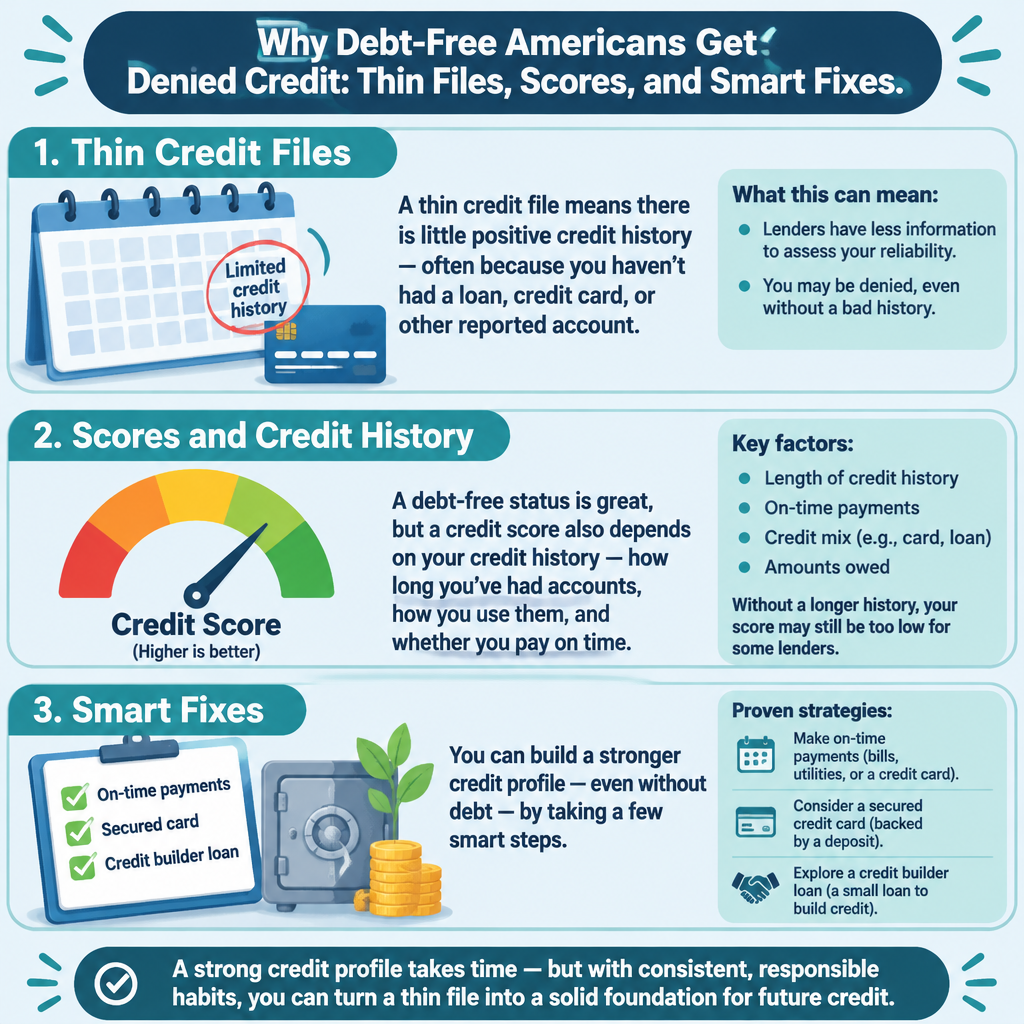
What Is a Thin Credit File, and Why Can It Lead to Denial?
A thin credit file contains too few credit accounts, too little reported history, or too little recent activity for a lender or scoring model to assess confidently. A stale file is one with accounts that have not reported meaningful activity for some time. These terms do not mean the person has missed payments. They mean the available record may be limited.
Credit reports generally record details such as whether a person pays credit accounts on time, how much of a revolving limit is in use, how long accounts have been open, and whether new accounts or applications have appeared. The exact factors and their weight depend on the scoring model. FICO explains the main categories used in its scores in its guide to what goes into a FICO score. Income is not a factor in the score itself, though a lender may consider income, expenses, and other information separately when reviewing an application.
That distinction matters. A six-figure salary can help show that a borrower has the means to make payments, but it does not create a payment history inside a credit file. Likewise, a large savings balance may strengthen a household’s finances without appearing as evidence of repayment on a conventional credit account. A score is a narrow measurement, not a full account of someone’s financial life.
The CFPB’s widely cited study found that roughly 26 million adults were credit invisible, while another 19 million had files that could not be scored under the definitions used in that study. Those older estimates are not identical to more recent counts of people with thin or stale files; definitions, dates, and data sources differ. Still, they show that limited credit records are not a rare edge case. The CFPB explains the categories in its study of credit invisibles.
A lender may deny an application for several reasons, including a thin file, a high debt-to-income ratio, recent applications, an account error, or a policy that does not fit the applicant’s profile. Automated decisions can use information from credit bureaus and the lender’s own records, so an instant result does not reveal exactly what drove the decision. Frankly, treating every denial as proof that the applicant needs to borrow more is poor analysis. Start with the stated reasons and the actual reports.
Why Credit History Matters—and What It Does Not Prove
A usable credit history can make routine financial tasks easier. It may help a lender assess an application for a credit card, car loan, or mortgage. It can also provide evidence of how someone has managed credit over time. That evidence is useful to lenders, but it is not a verdict on whether a person is responsible, wealthy, or wise.
Here is the kicker: being free of debt can be a strong financial position, while having no recent credit activity can still leave a lender with fewer facts. Those statements are not contradictory. A household can have low expenses, a substantial emergency fund, and no interest payments, yet lack the account history a particular bank wants to see. The credit system rewards documented borrowing behavior, not every form of financial prudence.
The reported $1.29 trillion in U.S. card balances, a 67% rise from early 2021, deserves context. The New York Fed’s Household Debt and Credit data track aggregate balances and delinquencies; a national total does not show that each borrower is overextended, nor does it establish that debt-free consumers should take on a balance. A high total and a large number of thin files can exist at the same time because the figures describe separate groups and measures.
There are practical benefits to having a well-maintained file. A lender may be able to price and review an application more readily, and a borrower may have more options when seeking credit. But a score is not a substitute for checking the loan’s interest rate, fees, repayment schedule, or effect on a monthly budget. Approval at an unattractive price is not a financial win.
Most importantly, you do not need to carry a balance to demonstrate card use. If you use a card, pay the statement balance in full by the due date to avoid interest on ordinary purchases, subject to the card’s terms. Interest-bearing debt solely to raise a score is an expensive and unnecessary strategy. A sound plan treats money as a resource to steward carefully: protecting household stability and making room for work, family, and the common good matters more than pleasing a scoring model.
How to Build or Repair a Credit File Without Borrowing Recklessly
- Check all three credit reports before applying again. Start by confirming that accounts, balances, and personal details are accurate. A report can contain a mixed file, an account that belongs to someone else, or an incorrect payment status. Use the official free-report channel at AnnualCreditReport.com. A score and a credit report are different: a report shows account information, while a score is a calculation based on selected data. Do not assume a bank’s app shows every bureau or every detail.
- Read the lender’s adverse-action notice. If an application is denied, the lender generally must provide the reasons or explain how to obtain them. Look for specific issues, such as limited history, high utilization, recent inquiries, or information from a named bureau. If the explanation is vague or appears inconsistent, ask the lender for clarification and check whether the report supports it. The CFPB says that credit decisions based on complex algorithms still require meaningful adverse-action explanations in its guidance on adverse-action notices.
- Dispute errors, not accurate history. Contact the credit bureau and, when appropriate, the company that supplied the information. Keep copies of letters, screenshots, and confirmation numbers. A dispute will not erase accurate late payments or remove a legitimate account simply because it is inconvenient. Give corrections time to appear before submitting several new applications.
- Choose one useful way to add positive history. If a credit card fits your budget and habits, consider a low-fee or secured card from a reputable issuer. A secured card usually requires a refundable deposit that sets the credit limit, but terms vary. Use it for a small planned purchase, such as a recurring bill you already pay, and pay the statement balance in full. Confirm that the issuer reports to the major credit bureaus. Do not apply for several cards at once just to see what sticks.
- Consider other routes only after checking the terms. Some lenders may consider rent, utility, or banking data, but reporting and acceptance vary. A credit-builder loan can add installment history, yet it may include fees and ties up money while payments are made. Ask how payments are reported, what the total cost is, and whether the account will help with the specific future application you care about. A product that advertises credit building is still a financial product, not a favor.
- Keep the routine boring. Pay on time, keep card balances low relative to limits, and avoid unnecessary applications. You do not have to carry a balance from month to month. A low utilization ratio can matter when a score is calculated, but the reported balance may depend on when the issuer sends information to the bureau. Paying before the statement closes may reduce the reported balance; it is an optional tactic, not a requirement for responsible card use.
- Apply with a purpose and a sensible timeline. If you expect to seek a mortgage or car loan, ask prospective lenders which bureaus and scoring approaches they use and what documentation they need. Do not open accounts simply because a salesperson says they will improve your score. When I assess a financial plan, I start with the household’s goal, cash flow, and ability to repay—not the score alone. Credit is one tool; it should not become the project.
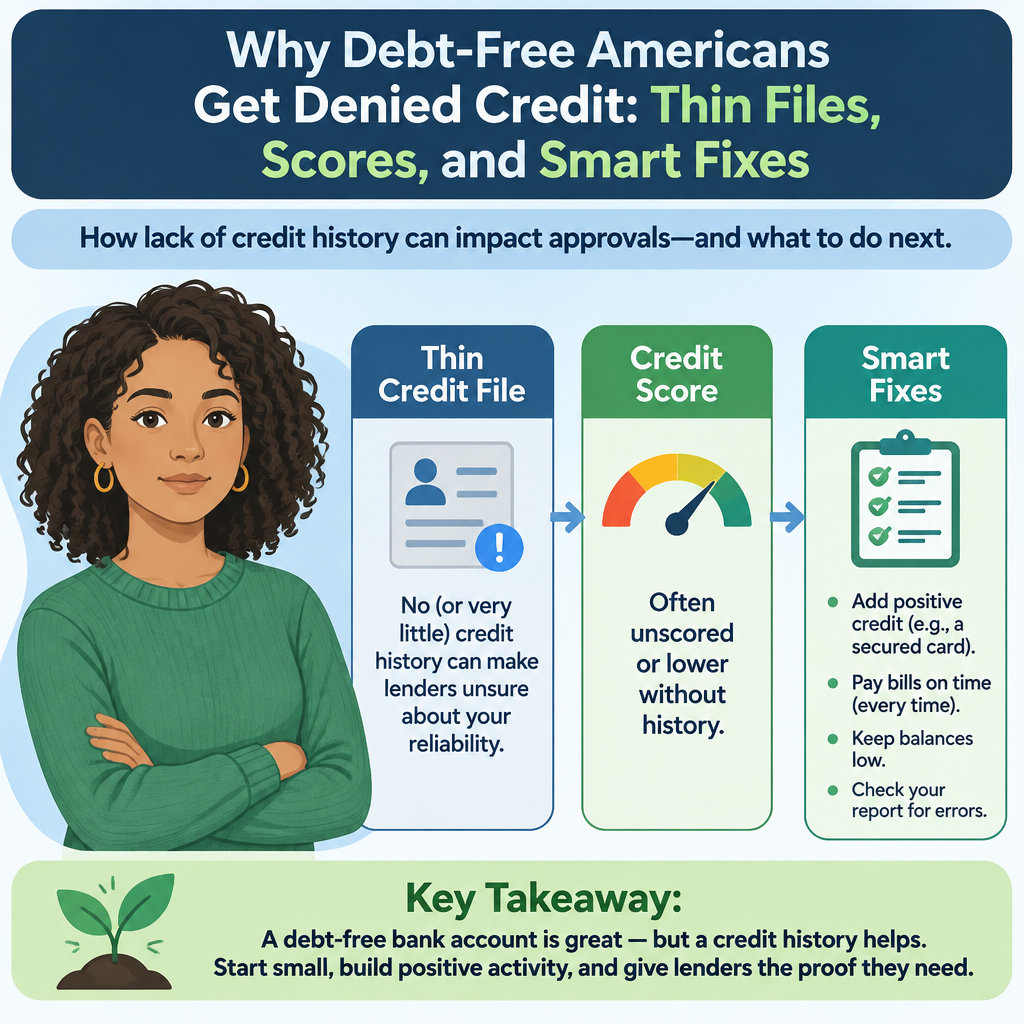
Debt-Free Thin File vs. Established Credit File
An established credit file is the relevant comparison for a debt-free applicant: it gives lenders more reported account history to evaluate. It does not require someone to carry a costly balance. The following comparison separates what a file can show from what a household may actually be worth. The estimate of roughly 25 million people with thin or stale files is broad and should not be read as a count of debt-free applicants; the group includes different financial situations.
| Factor | Debt-free person with a thin or stale file | Person with established, well-managed credit |
|---|
| Reported payment history | Limited recent account data may leave more uncertainty | More account history can show payment patterns over time |
| Income and savings | May be strong, but are not themselves a credit score | May be strong or weak; the file alone does not prove wealth |
| Likely application challenge | Some automated systems may lack enough history to score or approve | Lenders may have more information, though approval is never guaranteed |
| Need to carry a balance | No; paying interest is not required to build a payment record | No; an established history does not require revolving debt |
| Risks to manage | Unnecessary applications or opening products without checking fees | High utilization, missed payments, and taking on debt beyond budget |
| Better next step | Review reports, ask for denial reasons, add one suitable account if useful | Maintain on-time payments and borrow only when the terms and purpose fit |
Neither column guarantees approval. A lender may weigh income, existing obligations, down payment, collateral, employment, application details, and its own risk limits. Mortgage underwriting is not identical to credit-card underwriting, and one company’s decision does not predict every other company’s decision. An established score can help with an application, but it cannot make an unaffordable loan sensible.
For the debt-free applicant, the aim is not to imitate households carrying large balances. It is to make accurate, limited evidence available if credit access is important. For the established borrower, the aim is not to keep accounts active at any cost. Both groups should judge products by their full cost and use, not by a number that only covers part of the picture.
Common Mistakes to Avoid
Mistake 1: Assuming income automatically produces a high score. It does not. Income can matter in the lender’s broader ability-to-repay assessment, but it is separate from the score itself. If you earn well and have little reported history, ask whether the lender accepts other documentation rather than assuming your salary failed to register.
Mistake 2: Paying interest to prove you can borrow. Carrying a balance is not a badge of financial maturity. Pay the statement balance in full when possible, and do not treat finance charges as a fee for score improvement. If a card’s annual fee or other charges outweigh its useful features, choose another approach or skip the product.
Mistake 3: Applying to a string of lenders after one denial. Multiple applications can create additional hard inquiries and may make a file look more active in a way that does not help. Some loan-shopping models group certain inquiries made within a defined period, but the rules vary by scoring model and credit product. Do not assume every inquiry will be treated as one. First find out why the application failed.
Mistake 4: Opening several buy now, pay later accounts casually. These products differ in how they report accounts and payments, and reporting practices can change. Some providers report activity to credit bureaus; unpaid balances or missed payments may also have consequences. The CFPB’s report on buy now, pay later products describes market practices and consumer risks. A cluster of short-term loans can complicate budgeting even when each purchase looks small. Read the terms before you tap to pay.
Mistake 5: Closing an old card without checking the effect. Closing an account can affect available credit and utilization, depending on the rest of the file; the exact scoring effect varies. On the other hand, keeping a card with an annual fee, fraud risk, or temptation to overspend may not be worth it. Compare the actual cost and practical effect. There is no rule that an old account must be kept forever.
Mistake 6: Treating the score as a measure of virtue or wealth. A score is a lending tool built from credit-related information. It does not measure emergency savings, generosity, investment skill, job security, or whether someone lives within their means. Warshaw’s criticism—that bank profitability and personal financial health are not the same thing—is a useful warning, though a credit score can still serve a practical role. The mistake is confusing a narrow tool with a complete financial assessment.
Mistake 7: Trusting a promised quick fix. Be wary of companies that guarantee a score increase, urge you to dispute accurate information, or suggest taking on an account without explaining the costs. Legitimate credit repair cannot make correct negative information disappear. A calm review of reports, one suitable account if needed, and consistent payments usually beats a pile of products marketed as shortcuts.
Frequently Asked Questions
Can I get a credit card with no credit history?
Yes, but approval depends on the issuer and your application. A secured card, student card, or entry-level product may be an option, although eligibility, fees, deposits, and reporting differ. Check whether the issuer reports to the major credit bureaus and read the rates and terms. If you are denied, use the lender’s notice to identify the reason before applying elsewhere. Do not assume a high income guarantees approval, and do not pay a large fee merely because a company promises to create a score.
Does carrying a credit-card balance help my score?
No. You do not need to pay interest or carry a balance from one billing cycle to the next to establish a payment record. Use a card within your budget and pay the statement balance by the due date, provided the account terms allow you to avoid interest that way. Keeping reported utilization low may help some scores, but the balance reported on a particular date can differ from the amount you owe after making a payment. The sensible target is reliable payment and manageable spending, not debt for its own sake.
Will a debt-free lifestyle hurt my credit score?
Not by itself. Having no debt does not automatically damage a score, and a person with active accounts paid in full can have a credit history without carrying balances. The challenge arises when there are too few accounts or too little recent information for a model to produce a score or for a lender to judge the file. If you do not need to borrow, there is no universal requirement to take out debt. If future access matters, consider a low-cost way to establish a limited record.
What should I do after an instant loan or card denial?
Read the adverse-action notice, obtain and review your credit reports, and check for errors or unexpected accounts. Ask the lender questions if the reason is unclear. Dispute inaccurate information with the relevant bureau and information provider, then allow time for any correction to post. Before another application, compare the lender’s requirements with your actual financial situation. An instant denial can feel personal, but the useful response is to identify the specific obstacle rather than submit repeated applications or borrow simply to prove a point.
Final Thought
A credit file is a record, not a biography. It can help a lender estimate risk, but it cannot capture the whole balance sheet or the discipline behind a debt-free household. A thin file can create a real obstacle when someone needs a card, car financing, or a mortgage; pretending the scoring system does not matter is not practical. Pretending it measures everything is no wiser.
The sensible response is measured. Check what the bureaus report, ask the lender for the reason behind a rejection, correct factual errors, and decide whether a small, manageable credit account serves a real need. If you choose to use one, pay on time and avoid interest where possible. If you decide that borrowing is unnecessary, do not let a marketing message turn that choice into a supposed financial failure.
The reported growth in card balances and the existence of millions of thin or stale files point to a system that favors visible credit behavior, not a universal rule that every adult should borrow. Keep an emergency reserve. Compare costs. Protect your household’s ability to meet obligations. Financial responsibility is shown through the choices that preserve stability and serve legitimate needs—not through borrowing for the sake of a score. A healthy credit profile can be useful. It is still only one part of a healthy financial life.