Why Bond Yield Spikes Can Warn of Financial Trouble Before Markets Break
Sharp rises in bond yields can expose weaknesses in banks, companies, and investment portfolios before those weaknesses become obvious in share prices. Yields are not a crystal ball, and a move higher does not guarantee a crisis; but fast, large increases can reduce bond values, raise borrowing costs, and strain balance sheets built for cheaper money. That is why investors watch both the size and speed of yield moves.
A market headline can make the argument sound simple: yields jump, balance sheets crack, and a blowup follows. The real sequence is messier. Bond prices may fall first; accounting treatment, collateral rules, investor withdrawals, and funding costs then determine whether those losses remain manageable or spread. I focus on those links, because treating every rise in yields as a crisis signal is as careless as ignoring the risk entirely. The practical question is not whether yields moved, but who must absorb the move, how quickly, and with what cash available.
What Are Bond Yield Moves, and Why Can They Matter?
A bond yield is the return an investor receives based on a bond’s price, coupon payments, and time to maturity, subject to the terms of the security and the issuer’s ability to pay. In ordinary market trading, a bond’s price and its yield move in opposite directions: when investors demand a lower price for an existing fixed-coupon bond, its yield rises. The relationship is straightforward; the consequences are not.
Suppose an institution owns longer-term bonds paying fixed interest. If market yields rise, newly issued bonds may offer better returns, making the old bonds less attractive. Their market value falls. The size of that decline depends partly on duration, a measure of how sensitive a bond’s price is to yield changes. Longer-duration bonds usually lose more value than shorter-duration bonds when yields rise by the same amount. Credit quality, cash flows, and changing market conditions also matter.
That price decline does not automatically become a realized loss. An investor able to hold a sound bond to maturity may still receive the promised payments, assuming the issuer does not default and the security’s terms are met. But “we can hold to maturity” is not a magic phrase. A bank, fund, or company that needs cash today may have to sell at the current market price, pledge assets as collateral, or find another source of financing. That is where liquidity pressure can turn a paper loss into a balance-sheet problem.
The Federal Reserve’s discussion of financial stability is useful because it looks beyond a single asset price and considers vulnerabilities such as leverage, funding risk, and the ability of households and businesses to meet obligations. See the Federal Reserve Financial Stability Report. For market data, investors can track the 10-year Treasury constant-maturity rate at FRED, but a chart alone will not tell you which institution is exposed or how it is funded.
Here’s the kicker: yields can rise for different reasons. Investors might expect stronger growth, higher inflation, larger government borrowing, or a change in central-bank policy. Those explanations have different implications for earnings, credit quality, and valuations. A gradual rise alongside healthy income growth is not the same animal as a disorderly jump that catches leveraged borrowers and lenders unprepared.
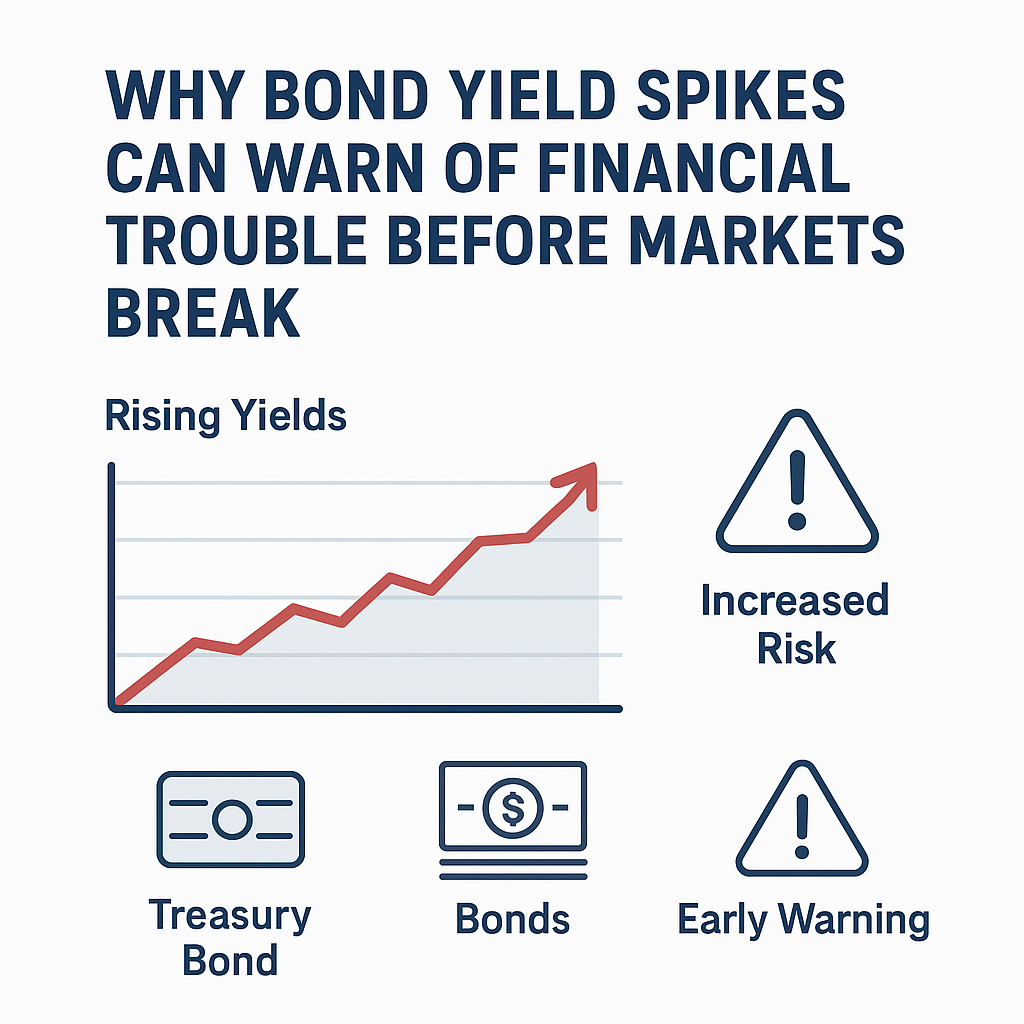
Why Yield Spikes Can Threaten Balance Sheets
Bond-yield jumps matter because they affect several parts of a balance sheet at once. Asset values may decline, funding costs may rise, collateral may become less valuable, and customers or investors may demand cash. Each link can be manageable in isolation. Combined, they can create a squeeze.
- Valuation losses: Existing fixed-rate bonds can lose market value when yields increase. The effect is larger for longer-duration securities, all else equal. A holder with strong capital and stable funding may absorb that decline; one facing withdrawals may not have the same luxury.
- Higher borrowing costs: Businesses that borrow at floating rates, or need to refinance soon, can face larger interest bills. That leaves less cash for wages, investment, suppliers, and debt repayment. A company with modest debt and strong cash flow may cope; a highly leveraged company with thin margins may not.
- Collateral pressure: Lenders may ask borrowers to provide more collateral when asset values fall or market risk rises. If cash and liquid assets are scarce, meeting that demand can force asset sales at poor prices.
- Deposit and investor behavior: Customers may move money toward higher-yielding alternatives, while fund investors may seek redemptions. A business model relying on stable, low-cost funding becomes vulnerable when that funding proves less stable than assumed.
- Refinancing risk: A borrower may appear healthy while cheap debt remains outstanding. The test comes when that debt matures and must be replaced at current rates. Maturity schedules matter; headline debt totals alone can conceal the timing of the problem.
The failure of Silicon Valley Bank showed how interest-rate exposure and funding structure can interact. The Federal Reserve Bank of San Francisco’s account explains that a concentrated depositor base and rising rates contributed to the bank’s difficulties; the lesson is not that every bank with bond losses will fail, but that liquidity and confidence can change the result. Read the San Francisco Fed analysis of Silicon Valley Bank’s failure.
Most commentary fixates on the yield level. I also look at how quickly it moved, where the exposure sits, and whether the organization’s funding can survive a rough quarter. A bank with long-term assets, short-term liabilities, and concentrated depositors has a different risk profile from a pension fund with planned cash flows and a long investment horizon. The same market move can be painful for one and tolerable for another.
There is a human cost behind the jargon. When a company’s financing becomes unaffordable, workers, suppliers, and communities can feel the damage before investors finish arguing over valuation. Responsible stewardship means assessing risk not only as a line on a portfolio statement, but as a set of obligations to people who depend on institutions to act prudently.
How to Read Yield Moves Without Overreacting
Yield data can help investors assess risk, but it needs context. A sharp move is a prompt to investigate, not an instruction to sell everything. Start with the market move itself, then examine who is exposed, how that exposure is financed, and whether the potential loss threatens the ability to meet obligations.
- Separate the level from the speed. Compare the current yield with its recent range and examine the size of the move over days, weeks, and months. A steep, abrupt change can create more strain than the same change spread over a longer period, because institutions have less time to adjust. I would not call a market break based on one chart or one dramatic news alert.
- Ask why yields are rising. Look at inflation expectations, central-bank communication, economic data, government borrowing, and credit conditions. If yields rise because growth is improving, some companies may benefit from stronger demand even as financing costs climb. If yields rise amid sticky inflation and tighter credit, the combination can be harder on borrowers.
- Check duration and interest-rate exposure. Identify the approximate maturity and duration of fixed-income holdings. Review whether the portfolio uses derivatives or other hedges, what those hedges cost, and whether they cover the exposures that matter. A hedge can reduce one risk while creating another, including collateral calls or basis risk.
- Map refinancing dates. For a company or fund, list major debt maturities and estimate the effect of refinancing at higher rates. The question is not merely “How much debt?” It is “When is it due, what rates can the borrower afford, and what cash flow supports repayment?”
- Test liquidity, not just solvency. Solvency asks whether assets exceed liabilities over time; liquidity asks whether cash is available when bills come due. Stress-test withdrawals, margin calls, redemptions, and reduced access to wholesale funding. An institution can own valuable assets and still face a near-term cash problem.
- Review concentration and correlation. A portfolio may hold many securities yet rely on the same interest-rate assumption, sector, or funding source. Diversification means spreading risks that do not all fail together; simply owning more tickers is not enough.
- Match the plan to your time horizon. A household investing for decades may have no reason to trade a diversified portfolio because Treasury yields rose this week. Someone saving for a home deposit next year should care more about cash availability and short-term volatility. Asset allocation should reflect actual needs, not a prediction about tomorrow’s market.
- Choose in advance what would change your view. Set sensible review points: a material deterioration in credit quality, a cash-flow shortfall, a change in investment goals, or a portfolio allocation outside its planned range. This reduces the temptation to make a costly decision during a noisy news cycle.
When I review a portfolio, I start with its purpose, cash needs, and risk capacity—not with a forecast pretending to know the next move in rates. That is less exciting than calling a market top. It is also more useful. An investor who needs funds soon should not rely on a long-duration bond fund as a cash substitute merely because both appear under “fixed income.”
For background on the mechanics of bonds and their risks, the U.S. government’s Investor.gov guide to bonds explains common bond features and risks in accessible terms. No guide can replace checking a specific bond’s maturity, credit quality, price, and role in your overall portfolio.
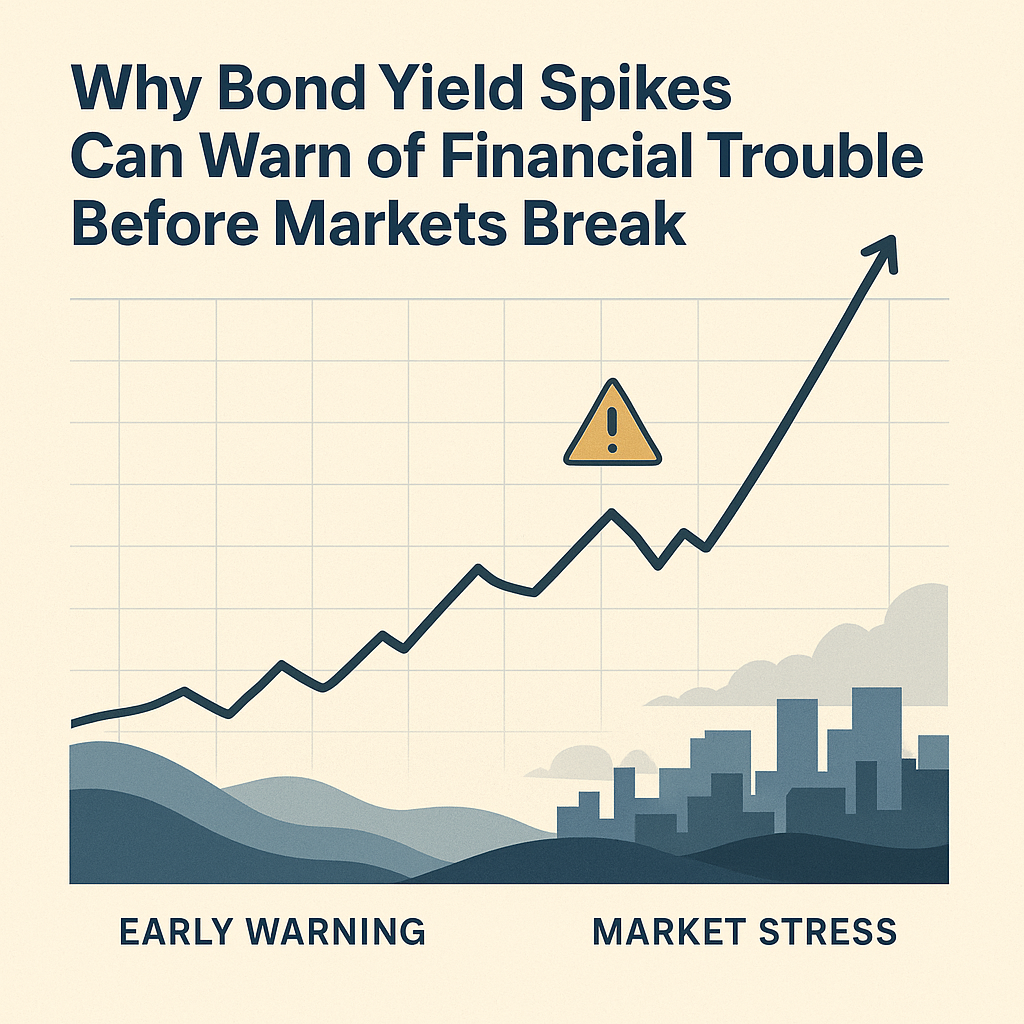
Bond Yields Versus Stock-Market Volatility: Which Is the Better Warning?
There is no single best warning light. Bond yields and equity volatility measure different things, and each can be misleading when viewed alone. Yields help show the price of borrowing and the market’s required return on debt. Stock volatility reflects the size and frequency of share-price movements, often responding quickly to fear, earnings surprises, and changing expectations. The comparison below is qualitative; it is not a claim that either measure predicts every downturn.
| Signal | What it measures | What it may reveal | Main blind spot | Best use |
|---|
| Sharp bond-yield rise | A change in the return demanded on bonds; existing bond prices generally move in the opposite direction | Pressure on bond valuations, borrowing costs, refinancing, and collateral | Does not show who holds the risk or whether the move is orderly | Examine duration, debt maturities, funding, and liquidity |
| Stock-market volatility | The size of share-price fluctuations, often represented by volatility indexes or realized price swings | Rapid changes in investor expectations and risk appetite | Can spike briefly without damaging a borrower’s ability to pay | Gauge market stress alongside fundamentals and credit data |
Bond signals often connect more directly to financing costs and fixed-income valuations. Equity volatility can move faster and make the headlines, but a sharp stock-market selloff does not necessarily mean banks or companies have lost access to funding. Conversely, a calm share market can obscure a slow accumulation of debt and duration risk. The warning lights do not have to flash together.
Frankly, both measures become more useful when combined with credit spreads, default rates, bank funding conditions, and company cash flows. A rise in government yields may push down bond prices, while a widening spread between corporate and government bonds can indicate investors demand extra compensation for credit risk. A stable yield level can also coexist with fragile borrowers if the underlying debt load is excessive.
A useful framework is to ask three questions. First, what changed in the price of risk? Second, which institutions or households are exposed? Third, can they absorb the change without forced sales or missed payments? This framework is less neat than a single red-or-green market gauge. It is closer to how financial stress actually travels.
The Bank for International Settlements discusses financial conditions and vulnerabilities in its Annual Economic Report. Such material is valuable for understanding broad financial risks, but investors still need to distinguish system-wide trends from the specific risks in a particular fund, bank, or company. A broad warning can tell you to look closer; it cannot do the looking for you.
Common Mistakes to Avoid
The first mistake is treating every yield increase as a crisis forecast. Rates can rise because investors expect stronger growth or demand compensation for inflation. Those conditions can still hurt bond prices, but they may support some corporate revenues. Context matters. A headline that leaves out the cause, speed, and market segment is a poor basis for a portfolio decision.
Another mistake is confusing an unrealized loss with a harmless loss. A bond’s quoted value can fall while the holder continues receiving payments, but that distinction only helps if the holder can keep the asset, the issuer remains able to pay, and the bond fits the investor’s time horizon. If cash is needed early, selling may lock in the loss. If collateral terms change, the holder may face pressure even without choosing to sell.
Investors also underestimate duration risk. A bond fund does not have a guaranteed maturity date for the investor in the way an individual bond does. Its holdings mature and are replaced over time, so the fund’s share price can continue to respond to rate moves. “Bonds are safe” is not a complete risk assessment; credit, interest-rate, inflation, and liquidity risks all deserve attention.
A fourth error is looking at debt totals without the repayment calendar. Two companies can owe the same amount and have very different risk. One may have strong recurring cash flow and years before refinancing; the other may face a large maturity soon, weak profits, and lenders asking for higher rates. Maturity walls and interest coverage tell more than debt headlines alone.
Finally, investors can turn a warning into a prediction and then trade as if the prediction were fact. Markets often price expected rate changes before they occur, and yields can reverse quickly. Selling after a sharp move, buying a fashionable hedge, or shifting an entire portfolio to cash may create costs and tax consequences without solving the underlying problem.
I am skeptical of advice that says either “ignore the noise” or “get out now.” Both are slogans, not risk management. Review your asset allocation, keep short-term spending money aligned with its purpose, and avoid leverage you cannot withstand. If your situation is complicated, a qualified financial professional can help assess cash needs, taxes, and risk capacity. The aim is not to eliminate uncertainty; it is to avoid letting one market move dictate a decision that should have been planned earlier.
Frequently Asked Questions
Do rising bond yields always cause a stock-market crash?
No. Higher yields can reduce the value of existing bonds and raise borrowing costs, but they do not automatically cause a crash. The effect depends on why yields rose, how quickly they moved, how much leverage is present, and whether borrowers and financial institutions can handle higher costs. Stronger growth can support some company earnings even while yields rise. Treat the move as information to investigate, not a forecast by itself.
Why do bond prices fall when yields rise?
An existing bond’s coupon is generally fixed. If newly issued bonds offer higher yields, investors may pay less for older bonds with lower coupons. The price adjusts until the return available to a buyer is more competitive, subject to the bond’s maturity, credit risk, and other features. Longer-duration bonds tend to be more sensitive to rate changes than shorter-duration bonds.
What should investors check when yields jump?
Check the reason for the move, its speed, and the exposures in your own portfolio. Review duration, credit quality, debt maturities, liquidity needs, concentration, and any leverage or hedging arrangements. Then compare those risks with your investment horizon and cash requirements. A dramatic chart does not tell you whether you personally need to trade.
Are bonds still useful in a diversified portfolio?
They can be, depending on the investor’s goals, time horizon, and risk tolerance. Bonds may provide income and can play a role in balancing a portfolio, but they are not free of risk. Interest-rate changes, inflation, credit deterioration, and liquidity pressures can all affect results. Choose bonds for a clear purpose, and understand what the specific holding can and cannot do.
Final Thought
Bond yields deserve attention because they sit close to the plumbing of finance: the cost of borrowing, the value of collateral, and the return investors demand for lending money. When yields leap, institutions with long-duration assets, short-term funding, thin capital, or heavy refinancing needs can come under pressure. That is the sensible point behind warnings that yield moves may precede balance-sheet trouble.
But a warning is not a verdict. The same rise in yields can reflect different economic forces, and the same bond loss can be manageable for one holder and dangerous for another. Investors should resist both complacency and drama. Check the balance sheet, funding structure, cash flows, maturities, and ability to withstand a period of stress. Then decide whether the exposure fits your own goals.
Good investing is often plain work: diversify across genuine sources of risk, keep liquidity for known needs, avoid borrowing against assumptions that may not hold, and rebalance according to a plan. The point is not to guess every turn in the market. It is to steward capital with care, remembering that money supports real obligations—retirement income, payroll, education, homes, and productive work. Markets will keep moving. A sound process gives you a better chance of meeting those obligations without being pushed around by every sharp yield chart.