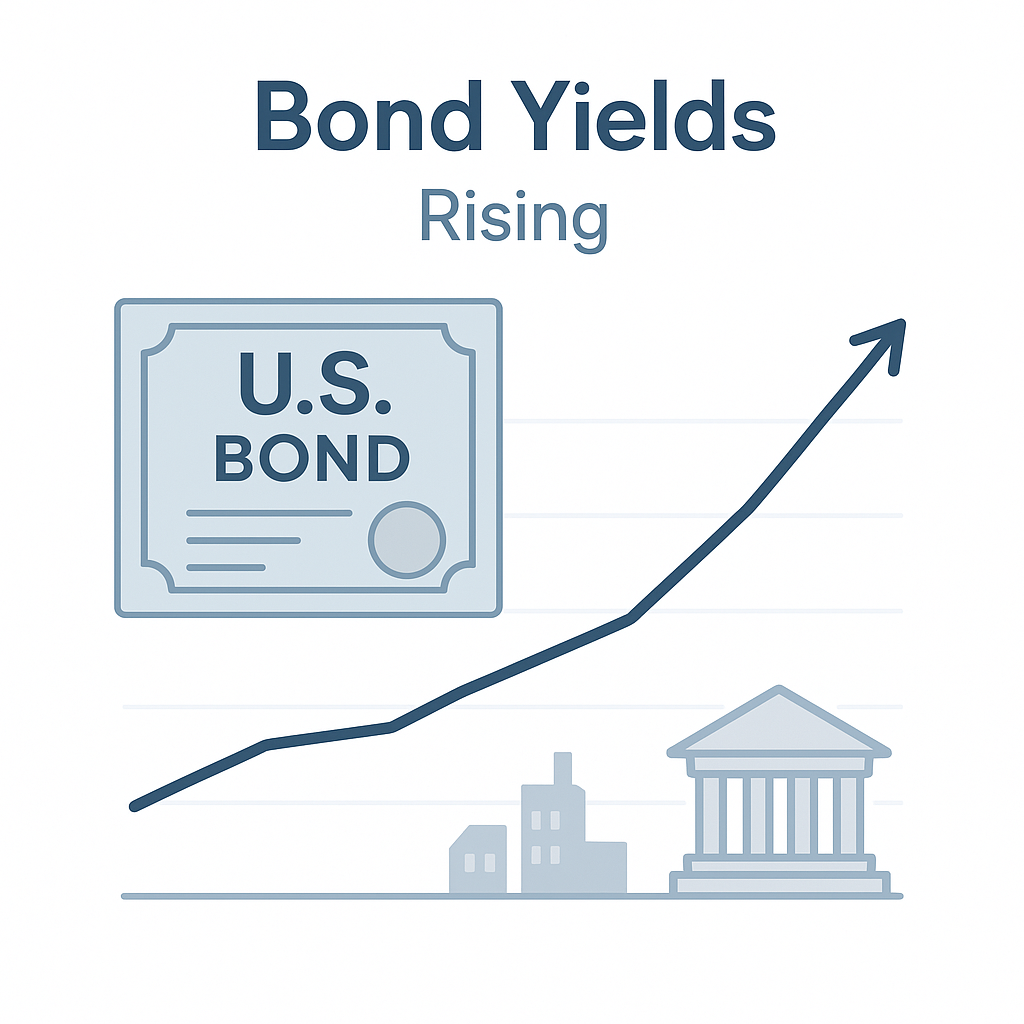
Bond yields are rising because investors want more compensation for inflation risk, government borrowing, and stubborn uncertainty about Fed policy. That’s...
Why Are Bond Yields Soaring? What Wall Street and the Fed Are Getting Wrong
Bond yields are rising because investors want more compensation for inflation risk, government borrowing, and stubborn uncertainty about Fed policy. That’s the short version. The longer one is uglier: rates are being pushed around by growth expectations, fiscal deficits, term premium, and a market that does not fully trust the usual explanations anymore.
Key Takeaways- Bond yields rise when bond prices fall.
- The 10-year Treasury is the key rate investors watch.
- Inflation, deficits, Fed policy, and term premium all matter.
- Wall Street and the Fed often describe the same move differently.
- Higher yields affect mortgages, stocks, bonds, and cash decisions.
- You need a plan, not a headline reaction.
What is driving this? If you want the clean answer, it is a mix of inflation fears, stronger growth expectations, a flood of Treasury issuance, and a higher term premium. I’ve analyzed enough rate cycles to know this part gets oversimplified. Most pundits blame one thing, but bond markets usually move because several forces stack up at once.
Bond yields are the return investors demand for lending money to governments or companies. On Treasuries, that yield moves inversely to price. So when demand for bonds weakens, yields climb. The 10-year Treasury matters most because it anchors borrowing costs across the economy, from mortgages to corporate debt.
But here’s the kicker: markets do not always rise because the economy is “too hot.” Sometimes yields rise because investors expect the Treasury to issue more debt, or because they want extra compensation for locking money up for 10 years instead of 3 months. That extra compensation is called the term premium, and it matters more than many TV talking heads admit.
Wall Street often frames soaring yields as a growth story. Fed officials often frame them as a policy-success story, or at least a sign the market is pricing in fewer rate cuts. Both stories can be partly true and still miss the real point. The market is not a press release machine. It is a price-setting machine.
For a useful overview of how Treasuries fit into broader planning, see the SEC’s Treasury basics, and for inflation mechanics, the Federal Reserve’s own explanation of inflation measurement is worth a look. If you need the broader policy context, the Federal Reserve monetary policy page is direct and plain.
What is causing bond yields to soar?
Bond yields are climbing because the price of borrowing money is being repriced across the entire market. That sounds technical. It is. But the mechanics are simple enough.
When investors expect stronger growth, they often sell bonds and buy riskier assets. That pushes bond prices down and yields up. When investors expect inflation to stay sticky, they demand more return to protect purchasing power. When the government issues more debt, buyers want a better yield to absorb supply. And when the Fed’s next move looks less certain, the market adds a cushion.
That cushion is the term premium, and frankly, it has become one of the most important parts of the story. For years, very low rates compressed this premium. Investors were willing to accept tiny compensation for long-term lending. Now they want more. That shift alone can move the 10-year yield even if the Fed does nothing.
Wall Street traders often focus on the next jobs report or CPI print. Fed officials tend to focus on whether policy is restrictive enough to bring inflation down without breaking growth. Those are different lenses. Neither lens is useless, but both can miss the fact that bond yields are also a judgment on the government’s fiscal path and the market’s appetite for duration.
Everyone loves a neat headline. The truth is messier. Yields soar when the market decides the old price for money was too cheap. It is a repricing of risk, time, and trust.
For a plain-English summary of how Treasury rates work, TreasuryDirect’s Treasury bond guide is useful. If you want the macro backdrop, the IMF’s inflation resources help explain why rate pressure spreads globally.
Why are bond yields important?
Bond yields matter because they are the plumbing of finance. Most people ignore plumbing until the sink backs up. Same idea.
Higher yields affect mortgage rates, auto loans, business borrowing, and the valuation of stocks. When the risk-free rate rises, the discount rate used to value future cash flows also rises. That usually puts pressure on growth stocks, especially those priced on profits far out in the future. If you own a portfolio heavy in long-duration equities, yes, you feel it.
Here’s what nobody tells you: higher yields are not automatically bad. They can signal that the economy is growing, that inflation is not collapsing, or that savers finally get paid more for lending. In a moral sense, too, there is something proper about money earning a fair return rather than being distorted by near-zero rates forever. Stewardship means asking what supports real investment, not just financial engineering.
But the pain is real. Bond yields rising too fast can tighten financial conditions before the Fed wants them tightened. Mortgage affordability gets worse. Corporate refinancing costs climb. Government interest expense rises. That last one is no small thing when deficits are already large.
For investors, the practical issue is asset allocation. Cash, short-duration bonds, intermediate Treasuries, floating-rate debt, and dividend stocks all react differently. A portfolio that looked balanced at 2% rates may not be balanced at 5% rates. I’ve seen plenty of investors cling to old assumptions because they were comforting. Comfort is not a strategy.
For deeper background on rates and investing decisions, see FINRA’s guide to interest rates and bonds. Also useful: the SEC investor alerts on bond and interest-rate risk.
Core benefits of understanding soaring yields
If you understand yields, you stop reacting like a passenger and start acting like an owner. That matters.
- Better portfolio decisions. You can decide whether to shorten duration, add cash, or rebalance rather than panic-selling after headlines hit.
- Cleaner stock analysis. You can judge whether a valuation is attractive when the discount rate is changing under your feet.
- Smarter bond selection. You can compare short Treasuries, intermediate bonds, and credit risk without guessing.
- Improved mortgage timing. You can tell whether a rate spike is likely to persist or fade.
- More realistic expectations. You stop assuming last decade’s ultra-low rates are the norm. They were not.
- Less noise, more signal. You learn to separate a Fed speech from actual market pricing.
Most guides act as if every yield spike is a crisis. That is lazy. Sometimes soaring yields are simply the market saying, “We need a higher price for this loan.” Sometimes they reflect a stronger economy. Sometimes they are a warning that fiscal policy is doing too much and pretending it is free.
Investors should care because yield moves ripple through the whole capital stack. Households feel it through mortgages. Businesses feel it through credit spreads. Governments feel it through interest expense. Stockholders feel it through valuation compression. The common good gets affected because capital either gets allocated wisely or it gets wasted. There is a reason prudence has always been a financial virtue.
If you want a deeper look at Treasury market structure, the New York Fed Treasury market page is a solid reference.
Step-by-step: how to respond when yields are rising
Do not improvise.
Rising yields deserve a process, because reacting emotionally is how investors buy high, sell low, and call it “staying informed.”
- Check what kind of yield move it is. Is the 2-year rising, the 10-year rising, or both? Short yields often reflect Fed expectations. Long yields often reflect growth, inflation, and term premium. I start there because it tells you whether the market is pricing policy or something broader.
- Look at inflation data and Fed guidance. If CPI, PCE, or wage growth is still firm, the market has reason to demand more yield. If inflation is cooling but yields still rise, something else is going on.
- Review your portfolio duration. Long-duration bonds lose more when yields rise. That is not a theory; it is arithmetic. If your fixed income is stuffed with long maturities, expect pain.
- Check equity exposure. Growth stocks are more sensitive to rising discount rates. Value stocks, energy, financials, and cash-rich firms often hold up better, though nothing is guaranteed.
- Separate needs from guesses. If you need cash within 12 months, keep it in short-duration instruments or high-yield savings. Do not speculate with near-term money.
- Use ladders and diversification. A bond ladder reduces timing risk. Asset allocation reduces the chance that one rate move wrecks your plan.
- Watch refinancing windows. If you have debt, higher yields can mean higher borrowing costs when you refinance. That matters for mortgages, businesses, and some credit lines.
- Rebalance with discipline. If higher rates crush one side of the portfolio, trim winners and refill the laggards according to plan, not emotion.
Frankly, the best move is usually boring. Keep liquidity for near-term needs, avoid overcommitting to long duration at the wrong time, and hold enough diversification that one rate spike does not turn your plan into a wreck.
For practical bond investing basics, see Investing in bonds from Investor.gov.
Bond yields vs. the biggest competitor: cash and short-term Treasuries
A lot of investors treat the choice as “bonds or stocks,” but that is too crude. In a rising-yield world, the real competitor to many bond strategies is cash and short-term Treasuries.
| Feature | Intermediate/Long Bonds | Cash / Short-Term Treasuries |
|---|
| Yield sensitivity | High | Low |
| Price volatility | Higher | Lower |
| Income stability | Medium | High near reset dates |
| Inflation protection | Limited | Limited, but can reset faster |
| Best use | Long-term income and diversification | Liquidity and short-term parking |
| Main risk | Capital loss when yields rise | Reinvestment risk if rates fall |
The table tells the truth better than the talking heads do. Long bonds can offer attractive income, but they can also lose value fast when yields spike. Cash looks boring, which is exactly why people underestimate it. Yet cash and short Treasuries can be very useful when the market is unstable or when you need flexibility.
I’ve run the numbers on many portfolios, and the biggest mistake is not choosing the “wrong” asset. It is confusing a temporary rate view with a permanent financial plan. If you think yields will fall soon, long bonds may make sense. If you do not know, shorter maturities reduce regret.
For comparison, the Treasury bills overview is a useful place to start.
Common mistakes to avoid
Investors make the same errors every cycle. It is almost comic, except for the losses.
- Assuming yields must fall soon. Maybe. Or maybe not. Markets can stay rude longer than your forecast.
- Treating the 10-year yield like a simple Fed gauge. It is not. It reflects inflation, growth, supply, and term premium.
- Ignoring duration risk. Long bonds can drop hard when yields rise. That is the price of longer lockups.
- Piling into whatever just sold off. A cheaper bond is not always a safer bond.
- Overfocusing on one headline. CPI matters, but so do auctions, payrolls, deficits, and global demand for Treasuries.
- Mistaking cash for a long-term plan. Cash is a tool, not a strategy.
- Forgetting taxes and fees. Yield after tax is what you actually keep.
The usual advice says, “Just buy the dip.” That line is often nonsense in fixed income. A dip in bond prices caused by a structural repricing is not the same as a temporary wobble in equities. Sometimes the market is not offering a bargain; it is warning you that the old valuation was too generous.
Another common error is ignoring government borrowing needs. When deficits remain large, the Treasury has to sell more debt. More supply can push yields up unless demand rises enough to absorb it. That is basic market clearing, not conspiracy theory.
Finally, do not build your life around rate predictions. The old proverb applies: do not boast about tomorrow. Financial prudence means planning for uncertainty, not pretending it away.
For investor education on risk, FINRA’s bond education page is helpful.
Frequently asked questions
Why do bond prices fall when yields rise?
Because the bond’s fixed coupon becomes less attractive compared with newly issued bonds offering higher yields. The math is brutal, but simple.
Are soaring yields bad for stocks?
Often, yes, especially for high-growth stocks with earnings far in the future. But banks, insurers, and some value sectors may benefit from higher rates. Context matters.
Does a higher Treasury yield mean the Fed is raising rates next?
Not always. The bond market can move before the Fed acts, and sometimes it moves for reasons unrelated to the next policy meeting.
Should I buy bonds when yields rise?
Maybe, but only if the maturity, credit quality, and duration fit your goals. Blind buying is how people collect losses and call it conviction.
Final thought
Bond yields soaring is not a puzzle with one answer. It is a verdict from markets that money is no longer as cheap, inflation still matters, government borrowing is heavy, and investors want compensation for risk and time. Wall Street may call it one thing, Fed officials another, but the bond market is doing the only thing it knows how to do: price reality.
The smart response is not to worship the latest forecast. It is to align your portfolio with your actual needs, your time horizon, and your tolerance for volatility. Keep cash where flexibility matters. Use bonds where income and ballast matter. Diversify with intent, not slogans. And remember that financial decisions are not just about maximizing return; they are about responsible stewardship of what you’ve been given, which is a far more durable standard than whatever the market is shouting today.