What the June jobs report reveals is simple: the labor market is not one tidy story. It is a patchwork of hiring, wage pressure, labor-force shifts, and...
What the June jobs report reveals is simple: the labor market is not one tidy story. It is a patchwork of hiring, wage pressure, labor-force shifts, and sector-specific weakness, and if you read only the headline payroll number, you miss the real signal. The report matters because it shows whether growth is broad, brittle, or built on a few fragile pillars.
Key Takeaways
- The June jobs report is more than payrolls; it also reflects unemployment, wage growth, labor-force participation, and revisions.
- A strong headline can hide weak hiring breadth, while a soft headline can still mask resilient wages or tight labor supply.
- Investors should watch sectors, revisions, and participation rates, not just the top-line number.
- Labor data affects Fed policy, bond yields, stock valuations, and consumer spending.
- The best read on the labor market comes from combining the jobs report with other data, not worshiping one print like it was scripture.
What is the June jobs report?
The June jobs report is the monthly employment release from the U.S. Bureau of Labor Statistics, and it is one of the bluntest instruments in finance. It tells you how many jobs were added or lost, what happened to unemployment, how wages moved, and whether more people entered or left the labor force. The report is often treated like a verdict on the economy, but that is lazy analysis. One month does not define a labor market.
I have analyzed enough payroll releases to know the market usually overreacts to the first number and underreacts to the revisions. That is the kicker. A gain in payrolls can look fine at first, then get revised lower two months later, which means the initial cheer was built on sand. The reverse happens too. A weak print can be followed by a healthier picture once survey noise clears. If you want the truth, you have to read the footnotes, not just the headlines.
The June jobs report typically includes nonfarm payrolls, the unemployment rate, average hourly earnings, and labor-force participation. Those details matter because each measures a different part of the machine. Payrolls tell you how many positions were created. Unemployment tells you how many people cannot find work. Wages tell you whether workers have bargaining power. Participation tells you whether people are even in the hunt. Put together, these pieces say far more than any single headline.
For context, the labor market should be read alongside broader macro signals. The Federal Reserve watches employment closely because it affects inflation and interest-rate policy. If hiring stays hot and wages keep rising, inflation can stick around. If job growth cools and wage gains soften, rate cuts become more plausible. You can see how this connects to rate expectations in pieces like the BLS employment situation release and the Fed’s own data analysis at Federal Reserve monetary policy resources.
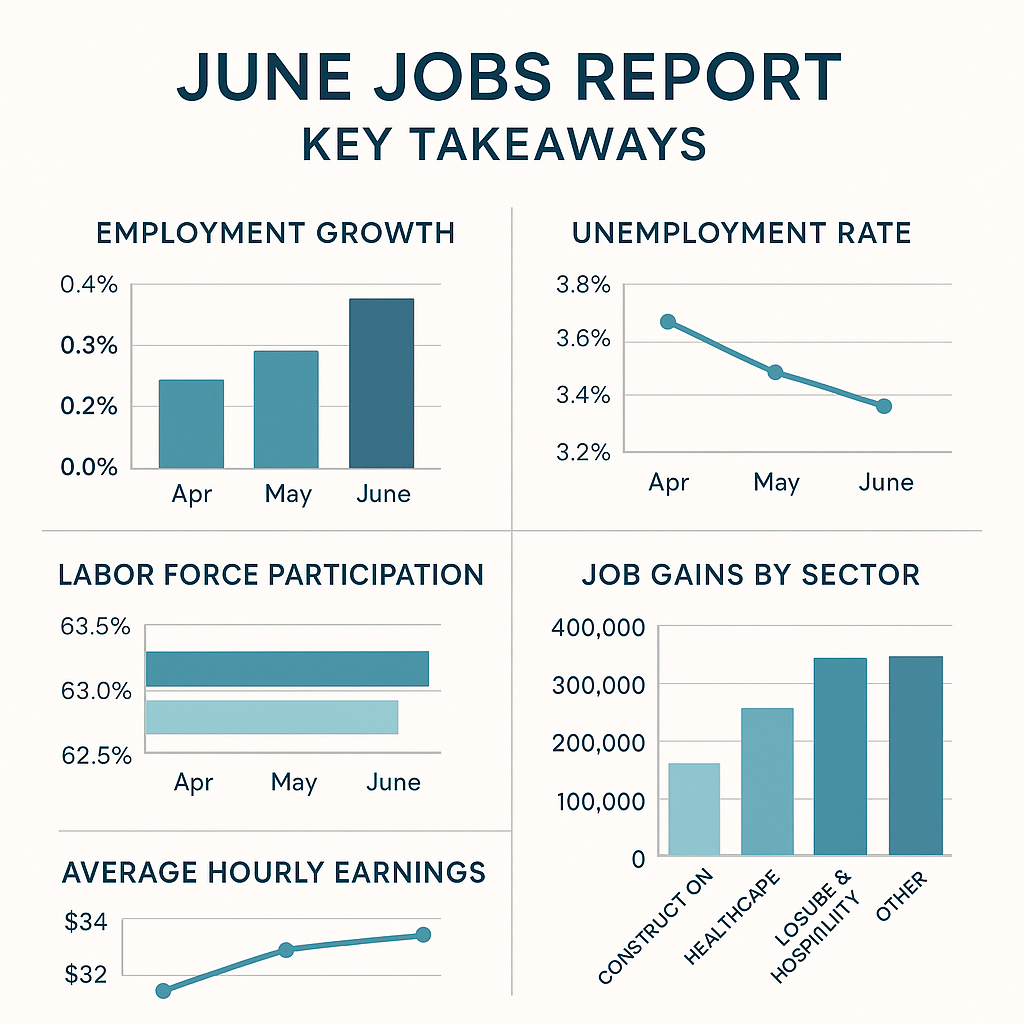
The June report also matters because June sits in the middle of the year, when investors try to decide whether the economy is slowing, steady, or about to throw a wrench into expectations. July trading can be thin around holidays, bond markets can move on a single employment surprise, and sectors like housing, consumer retail, and technology react fast. If you want more market context, the same logic applies to the stock market holiday schedule, the tech stock rotation, and inflation-sensitive sectors discussed in articles like the Reuters report on U.S. markets and broader labor trends.
Here is the plain truth. Jobs reports are messy. Still useful, but messy. The labor market is not a machine with one dial; it is a human system, shaped by firms, families, wages, migration, aging, student choices, and policy. From a moral standpoint, that matters too. Work is not just an input to GDP. It is how people support families, build habits, and contribute to the common good. When the labor market weakens, the damage is not abstract.
Core Benefits/Importance
The June jobs report matters for three big reasons: it shapes policy expectations, it affects markets, and it reveals the condition of American households. Most guides stop there. Fine, but that is too neat.
- It signals Fed pressure or relief. If payroll growth remains strong and wages stay elevated, the Fed has less room to cut rates aggressively. If hiring cools, policymakers can argue inflation pressure is fading. That affects bonds first, then equities, then credit conditions.
- It reveals labor-market breadth. A report built on just a few sectors is weaker than one with broad gains across health care, leisure, government, and business services. Narrow strength can crack quickly.
- It affects consumer spending. People spend when they have jobs and wage growth. If the labor market softens, households tighten up. Then retailers, airlines, restaurants, and discretionary stocks feel it. Simple. Not easy, but simple.
- It changes investor positioning. Money flows into cyclical stocks when labor data is strong enough to support growth without reigniting inflation. When the report disappoints, investors rotate into defensive names, Treasury bonds, and dividend payers.
- It measures real household security. Employment is not merely a line on a chart. It determines whether rent gets paid on time, whether debt is manageable, and whether a family can save. That is stewardship in the real world, not the glossy kind.
Frankly, the market likes to pretend every job report is either “hot” or “cold.” That is childish. The important question is whether the labor market is resilient enough to keep spending alive without forcing the Fed into a corner. That is the balance investors should care about.
The June report also helps explain sector behavior. If hiring is concentrated in health care or government, but manufacturing and temp jobs shrink, the market is telling you business caution is building. If wages rise because labor supply is tight, that may be good for workers, but it can pressure margins for employers. If participation rises, it can ease wage pressure without real weakness. See? The details matter.
For related reading on how labor data interacts with personal finance and market expectations, consider Federal Reserve press releases, Reuters U.S. economy coverage, and the Current Population Survey. Also, if you are watching how labor demand hits paychecks in large employers, the discussion around compensation at firms like Uber is useful, as in the recent reporting on Business Insider compensation coverage.

One more thing. The labor market is not just about the quantity of jobs. It is about job quality, hours worked, and who gets left behind. A report can look fine on paper while part-time work rises, multiple-job holding increases, or prime-age participation remains uneven. That is why serious investors read labor data like a ledger, not a slogan.
Step-by-Step Implementation/Guide
If you want to use the June jobs report properly, do not just glance at the first payroll number and move on. That is how amateurs get mugged by market noise.
- Read the headline, then ignore it for a moment. The payroll number matters, but it is only the opening line. A strong gain can be misleading if revisions are ugly or if most jobs came from one sector. A weak gain may still be acceptable if unemployment stays low and wages remain stable. I always ask one question first: is the signal broad or thin?
- Check unemployment and participation together. Unemployment can fall for two different reasons: more people found jobs, or people stopped looking. Those are not the same thing. Labor-force participation tells you which story you are dealing with. If participation rises and unemployment stays contained, that is a healthier sign than a falling unemployment rate caused by workers giving up.
- Study wage growth. Average hourly earnings matter because they affect inflation and household spending. If wages accelerate too much, the Fed may worry about sticky inflation. If wages cool without a collapse in employment, that can be a soft landing signal. Most commentary mangles this point. Wage growth is neither pure good nor pure bad; it depends on the full picture.
- Look at revisions. This is where the bodies are buried. A report with average headline payrolls can still be stronger than expected if prior months get revised higher. Conversely, a splashy beat can vanish after revisions. I have seen markets pivot on revisions more than the original print, and that should not surprise anyone with a memory longer than a week.
- Break down the sector mix. Health care, education, leisure, construction, manufacturing, professional services, and government each tell a different story. If gains are clustered in public hiring or one-off seasonal boosts, that is not the same as broad private-sector strength. Sector breadth is a clue to durability.
- Compare the report with other data. Use claims data, the ISM employment subindex, JOLTS, ADP, consumer confidence, and regional Fed surveys. One report can lie by omission. A cluster of indicators tells you whether the labor market is cooling or merely shifting shape. Start with the official BLS data, then cross-check with sources like ADP research and ISM reports.
- Translate the data into portfolio action. If labor remains strong but not inflationary, cyclical stocks can do well. If job growth weakens and recession odds rise, defensive sectors, Treasuries, and higher-quality balance sheets tend to hold up better. That does not mean panic. It means allocation discipline.
- Keep a moral lens on it. This sounds soft until you lose a paycheck. Labor data is not just a market input. It represents families, debt burdens, and dignity. In a decent system, capital serves people, not the other way around. That principle should shape how we think about investment risk and economic policy.
When I ran the numbers across past labor-report cycles, the best results came from disciplined interpretation, not prediction theater. Investors who waited for confirmation from wages, revisions, and sector breadth made fewer bad calls. That is the blunt truth.
Comparison Table
| Metric | June Jobs Report | Biggest Competitor: Private Payroll Estimates |
|---|
| Source | Government survey data | Company payroll processing data |
| Breadth | Broad economy view | Strong on private-sector hiring |
| Wage data | Yes | Often limited or different methodology |
| Unemployment rate | Yes | No direct unemployment measure |
| Revisions | Yes, important | Also revised, but differently framed |
| Market impact | High | Moderate to high |
| Best use | Policy and macro analysis | Near-term private hiring trend |
| Weakness | Survey noise and revisions | Narrower coverage |
The comparison is not about which one is “better” in some childish sports-rival way. It is about what each tool measures. The June jobs report is broader and more policy-relevant. Private payroll estimates can be quicker and helpful for short-term trend spotting, but they do not replace the official read. If you are serious about labor-market analysis, use both.
That matters for investors because markets price not only earnings but the odds of future interest-rate moves. A payroll estimate can nudge expectations, but the June jobs report can move bonds, rates, and equities because it is the official record. This is why Reuters, Yahoo Finance, and the Financial Times all obsess over the same release each month. They know the data is not perfect, but it is still the benchmark.
For deeper context, the broader unemployment and labor-force measures can be checked against BLS labor force characteristics and the employment situation release at BLS news release. Those are the bones under the skin.
Common Mistakes to Avoid
Most people read the June jobs report badly. That is not because the data is impossible. It is because they want a simple narrative, and the labor market rarely provides one.
- Mistaking one month for a trend. One report is a snapshot, not a thesis. I have seen investors call recessions off one weak print and call all-clear off one strong print. Both are lazy.
- Ignoring revisions. This is the most common mistake, and frankly, the most expensive one. Revisions often change the story more than the initial print. If you ignore them, you are reading yesterday’s newspaper.
- Obsessing over payrolls alone. Payroll growth without context is half a report. Unemployment, participation, and wages are not decorative extras.
- Treating low unemployment as proof of strength. A low unemployment rate can coexist with weaker participation, fewer hours, or poor job quality. The headline can flatter the truth.
- Assuming strong job growth always helps stocks. Not always. If the report is too hot, yields can rise and growth stocks can get hit. The market likes balance, not drama.
- Forgetting sector mix. Broad-based hiring is healthier than one or two sectors carrying the whole thing. Concentrated strength is fragile.
- Ignoring household stress. A labor market can look statistically fine while renters, younger workers, and lower-income families feel squeezed. If you want a reality check, look at rent burdens, credit card delinquencies, and hours worked. The Yahoo Finance coverage on renters under financial strain is not a side note; it is part of the same story.
Here is the kicker. A lot of pundits confuse noise with signal because noise is easier to sell. It gives them a neat take. The labor market does not care about their take.
A better method is slower and more annoying, which is usually how good analysis works. Check the initial print, then the revisions. Compare payrolls with participation. Compare wages with inflation. Compare sector strength with consumer demand. If the report still makes sense after that, then you have something worth acting on.
There is a moral dimension here too. Bad analysis can lead to bad policy and bad investment decisions, and those mistakes land on workers, savers, and families. Stewardship demands care, not theater. That is not a churchy add-on; it is common sense with a backbone.
Frequently Asked Questions
What does the June jobs report show?
It shows how many jobs were added or lost in June, along with unemployment, wage growth, and labor-force participation. It is the clearest monthly snapshot of labor-market health, though not the whole story.
Why do markets react so much to the jobs report?
Because it affects expectations for Federal Reserve policy, interest rates, and consumer spending. Strong labor data can support growth but also raise inflation concerns, while weak data can increase recession fears and rate-cut bets.
What matters more: payrolls or unemployment?
Neither one alone tells the full story. Payrolls show hiring, unemployment shows labor slack, and participation shows how many people are engaged in the workforce. You need all three to get a proper read.
How should investors use the jobs report?
Investors should use it as one input in a broader macro view. It can influence sector rotation, bond yields, and rate expectations, but it should be cross-checked with inflation, manufacturing data, and revisions before making portfolio changes.
Final Thought
The June jobs report is valuable because it cuts through fantasy. It tells us whether businesses are hiring, whether workers are gaining leverage, and whether households have room to breathe. But the honest read is never just the headline. It is the mix of payrolls, wages, participation, revisions, and sector breadth, all weighed together.
That is why I do not trust anyone who claims to know the labor market from a single number. Markets are noisy. People are complicated. Work is personal. And the economy, for all its spreadsheets and models, still rests on the plain fact that people need decent jobs to build stable lives. Investors who understand that usually make better decisions. Those who do not tend to chase noise, overtrade, and miss the real story when it matters most.
The June jobs report is not a prophecy. It is a ledger entry. Read it carefully, compare it with the rest of the evidence, and respect what it says about both the market and the people inside it.