A Fed rate hike changes the price of money. Borrowing gets dearer, savings yields may improve, bond prices often fall, stock valuations can get squeezed, and...
What a Fed Rate Hike Means for Your Money, Investments, and Retirement
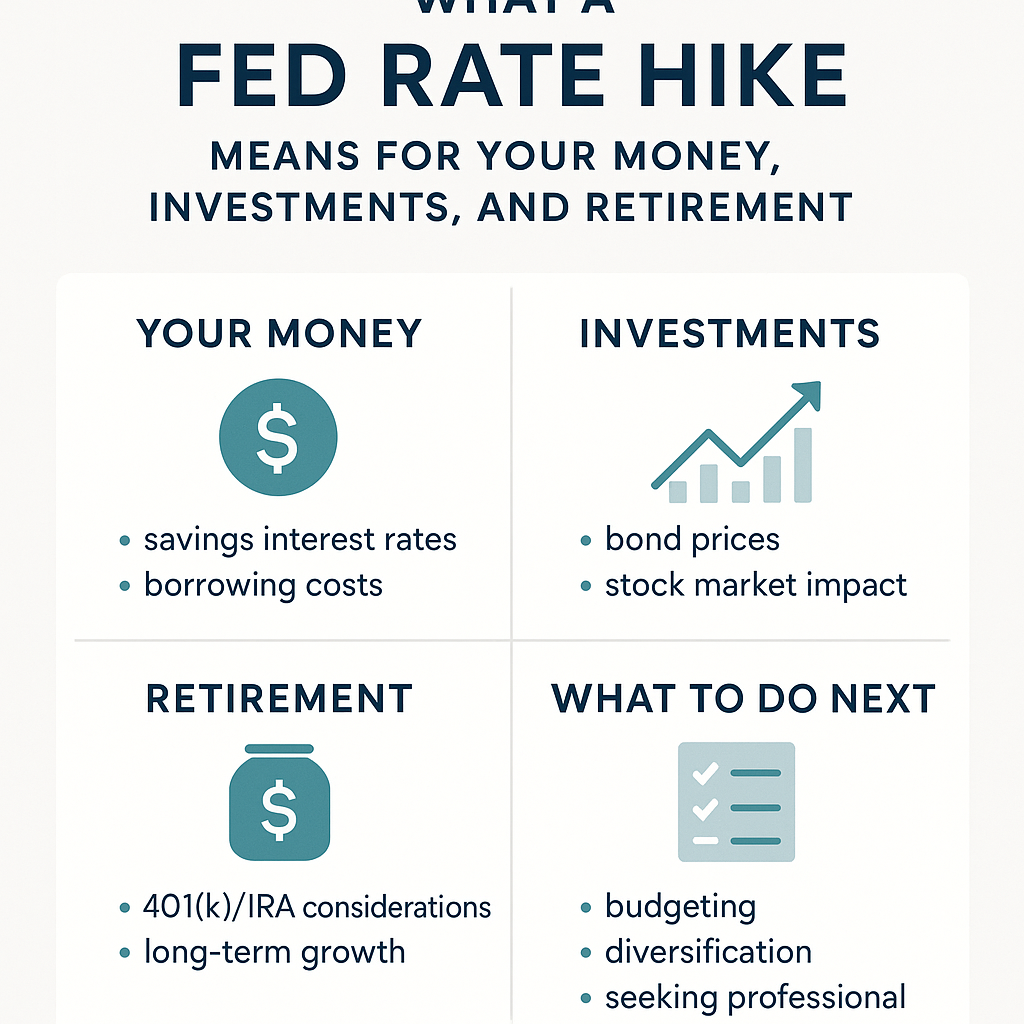
A Fed rate hike changes the price of money. Borrowing gets dearer, savings yields may improve, bond prices often fall, stock valuations can get squeezed, and retirees feel the effects through cash flow, income, and portfolio value. The impact is not uniform, which is why simplistic advice usually misses the mark.
Key Takeaways
- Fed rate hikes raise short-term borrowing costs and usually tighten financial conditions.
- Cash and savings accounts may pay more, but existing bonds can lose value.
- Rate-sensitive stocks, real estate, and growth names often face pressure.
- Retirees need to watch sequence-of-returns risk, income gaps, and debt costs.
- Asset allocation, liquidity, and discipline matter more than headlines.
What is a Fed rate hike?
A Fed rate hike is the Federal Reserve raising the federal funds rate, which is the overnight lending rate banks charge one another. That sounds abstract until you see the bill. Credit cards, mortgages, auto loans, business credit lines, and even the yields on savings accounts all feel it, though not always at the same speed or intensity.
The Fed uses rate hikes to cool inflation and slow excess demand. When money becomes more expensive, people tend to borrow less, spend a bit less, and save a bit more. That is the theory. In real markets, the effects are messier, because corporate earnings, consumer balance sheets, debt maturities, and psychology all interfere. Frankly, central banking is not a clean machine.
I’ve studied enough portfolios to know this much: investors often confuse the headline rate with the full set of financial conditions. The federal funds rate matters, but so do Treasury yields, credit spreads, bank lending standards, and expectations for future cuts or hikes. A single move from the Fed can ripple across the bond market, equities, real estate, and retirement income plans. If you want the simple version, fine: higher rates make money cost more.
If you want the useful version, you need to think in terms of duration, leverage, and cash flow. A retired household living off dividends and bond coupons experiences rate hikes differently than a young worker with a variable-rate loan and a 401(k). That is why anyone selling one-size-fits-all advice is either lazy or trying to sound smarter than they are.
For a broader market context, it helps to read how the Fed frames policy in its own words at the Federal Reserve’s monetary policy page, and to compare that with consumer-level effects in reporting like Yahoo Finance’s coverage of what a Fed rate hike means for your bank accounts, loans, and investments. The point is not to worship the Fed. The point is to understand the plumbing.
Core benefits and importance
Rate hikes are unpleasant, but they can still serve a purpose. The Fed is not trying to make life harder for sport, despite what some market commentators imply when they are staring at red candles on a screen.
Here’s why this matters.
- Inflation control. Higher rates can reduce inflation by cooling demand and discouraging speculative borrowing. That protects purchasing power over time, which matters for workers and retirees alike. A dollar that holds its value is not a trivial thing.
- Better cash yields. Savings accounts, money market funds, and short-term Treasury bills often improve when rates rise. For people holding too much idle cash, that is a real improvement, not a miracle, but real enough.
- More disciplined investing. Higher rates punish sloppy leverage and speculative fever. That usually forces a market reset, and resets are annoying, but they can restore some sanity to asset prices.
- Improved income options. Retirees and conservative investors may find more attractive yields in short-duration bonds, CDs, and Treasury ladders. That can reduce the pressure to chase junky yield in risky places.
- Stronger spending decisions. When borrowing is expensive, households often reconsider impulse purchases and oversized debt. That is good for balance sheets, even if it cramps consumer enthusiasm.
The contrarian bit is this: rate hikes are not automatically bad for investors. Most people think “higher rates equal lower returns” and stop thinking there. That is sloppy. Some banks can benefit from wider net interest margins. Short-term fixed income can become more appealing. Companies with little debt and real pricing power can hold up better than people expect.
That said, I’m skeptical of the cheerful spin you sometimes hear from Wall Street. Yes, there are winners. But the losers are often the ones with the most leverage, the weakest cash flow, or the poorest planning. The common good angle matters here too: sound money and honest pricing are not just market conveniences; they support ordinary households trying to save, work, and plan responsibly.
For more on retirement implications, see how Fed hikes affect retirees and their money. And if you want the practical side of portfolio design, read the SEC’s explanation of asset allocation, because diversified portfolios tend to behave better when rates move.
Step-by-step guide: how to respond to a Fed rate hike
You do not need to predict every Fed move. You need a plan that survives them.
That is the whole trick.
- Review your debt first. Variable-rate debt gets expensive faster than people expect. Credit cards are usually the worst offender, followed by adjustable-rate loans and floating-rate credit lines. If I ran your household budget, this is where I would start, because a 20% card balance is a guaranteed drag no matter what the S&P 500 does.
- Build cash reserves. Higher rates make cash less pointless, which is nice for once. Keep enough in a high-yield savings account, money market fund, or Treasury bills to handle emergencies and near-term spending. You do not want to sell long-term assets in a downturn just to pay a dentist or replace a furnace.
- Check bond duration. Long-duration bonds are more sensitive to rate increases. That is basic math, not market drama. If your fixed-income holdings are concentrated in long maturities, consider shortening the duration or using a ladder. I’ve seen too many investors hold bond funds with no idea that they were quietly loading up on interest-rate risk.
- Stress test retirement income. Retirees should ask whether dividends, coupon income, and pensions cover spending needs if markets wobble. If the answer is “mostly,” good. If the answer is “I hope so,” that is not a plan. A margin of safety is a moral virtue as much as a financial one.
- Rebalance instead of reacting. A rate hike may push one asset class down and another up. Rebalancing forces discipline, which is usually boring and usually correct. Most people prefer excitement, which is why they underperform.
- Watch valuation pressure. Growth stocks often get hit when discount rates rise, because distant earnings are worth less in present-value terms. That does not mean all growth is doomed. It means you need to be selective, and price still matters.
- Use tax-efficient moves. If you need to trim positions, think about tax location and realized gains. The IRS does not care about your feelings, and neither do markets.
- Keep your time horizon honest. If your goal is five years away, do not act like you own a 30-year treasury in human form. Match assets to liabilities. That is what actual stewardship looks like.
When I analyze portfolios after rate hikes, the most durable ones usually share three traits: low leverage, enough liquidity, and sensible diversification across equities, fixed income, and cash. Not thrilling. Very effective. For more background on building a balanced mix, the SEC’s asset allocation basics are worth a look.
Comparison table: Fed rate hikes vs. holding cash too long
| Feature | Fed Rate Hike Environment | Holding Cash Too Long |
|---|
| Purchasing power | Inflation may cool over time | Inflation slowly erodes value |
| Savings yields | Often improve | Can improve, but idle cash can still underperform inflation |
| Bond prices | Existing long bonds may fall | Cash avoids price swings |
| Stock valuations | Often pressured, especially growth stocks | No market upside at all |
| Income generation | Better short-term yields may appear | Income may be minimal if cash sits in low-yield accounts |
| Risk profile | Higher rate risk, but also more discipline | Low volatility, but silent erosion |
| Best use case | Adjust portfolio, reduce leverage, seek yield carefully | Emergency reserves and near-term spending |
The comparison is blunt for a reason. Cash has a place, but too much cash for too long is just inflation wearing a fake mustache. On the other hand, rate hikes do not mean you should panic-buy bonds or dump equities at the first ugly headline. The better move is to match cash, bonds, and stocks to purpose.
That is where Treasury yield data and the Fed’s own rate information help separate noise from reality. It is less glamorous than market chatter, but vastly more useful.
Common mistakes to avoid
Most bad decisions in a rate-hike cycle come from fear, laziness, or both. That combination is expensive.
- Chasing yield blindly. People see higher rates and assume every bond or savings product is “safe enough.” Not true. Credit risk still matters. Junk with a bigger coupon is still junk if the issuer cannot pay.
- Assuming all stocks react the same way. They do not. Banks, insurers, utilities, REITs, and software companies can respond very differently. Sector exposure matters. Anyone who ignores that is just trading slogans.
- Ignoring floating-rate debt. This is the big one. Variable-rate loans can hurt quickly. If you carry them, review terms now, not after the statement arrives and ruins your mood.
- Overreacting to one Fed meeting. Monetary policy works with lags. The market often swings before the real economy does. Acting on one decision alone usually means you are mistaking noise for signal.
- Forgetting inflation’s role. Higher rates are often a response to inflation, not a random punishment. If prices are already running hot, keeping too much money in low-yield cash can still lose you ground in real terms.
- Neglecting estate and retirement planning. Rate changes affect annuities, bond ladders, Required Minimum Distributions, and spending plans. Retirees need to think in multi-year cash flows, not daily headlines.
I’ve analyzed enough portfolios to say this plainly: the worst mistake is trying to outsmart the Fed. Good luck with that. The second-worst mistake is doing nothing because “markets always recover.” Sometimes they do. That is not a strategy, just optimism with a bad haircut.
A better approach is to keep your portfolio aligned with your obligations, your risk tolerance, and your duty to provide for family and others who depend on your decisions. The Bible is not a market manual, but stewardship is not optional.
For practical retirement coverage, Yahoo Finance’s piece on how rate hikes affect retirees is a useful companion to the SEC’s guidance on retirement planning basics.
Frequently asked questions
How does a Fed rate hike affect mortgage rates?
A Fed rate hike can push borrowing costs higher, but mortgage rates are tied more closely to Treasury yields and market expectations than to the fed funds rate alone. Fixed-rate mortgages may not move in lockstep, while adjustable-rate mortgages can become more expensive faster.
Are savings accounts better during rate hikes?
Usually, yes, at least compared with periods of near-zero rates. Banks often raise savings and money market yields as the Fed tightens, though not always quickly or fully. Shop around. Loyalty to a weak savings rate is a strange hobby.
What happens to retirement portfolios when rates rise?
Bond values can fall, especially long-duration funds, while cash and short-term Treasuries may look better. Stocks may also reprice, particularly growth-heavy names. A diversified portfolio with sensible asset allocation tends to absorb the shock better than a concentrated one.
Should I move everything to cash during a rate-hike cycle?
No. That is usually a mistake. Cash protects principal in the short run, but inflation can erode it over time, and you lose the long-term growth engine of equities. Keep enough cash for safety, not so much that it becomes dead weight.
Final thought
A Fed rate hike is not a disaster by itself. It is a price signal, and price signals exist for a reason. They tell households, businesses, and investors that money now has a different cost, which means choices have consequences. That is annoying, but it is also healthy if it restores discipline.
The real question is not whether rates are going up or down. The real question is whether your balance sheet can take the hit without panic. Most people spend too much time guessing the Fed’s next move and too little time fixing their own structure. That is backwards.
When I look at the households that handle rate hikes best, they usually have the same habits: they keep liquidity, avoid stupid debt, diversify without pretending diversification is magic, and respect the future enough to prepare for it. Nothing flashy there. Just prudence.
And prudence is still the best investment habit around. If you want to be able to sleep at night, own assets that fit your life, your obligations, and your duty to act responsibly with what you have been given. That is the part the market can’t price.