Trump Backs Tim Cook for Nvidia CEO: What Investors Should Know
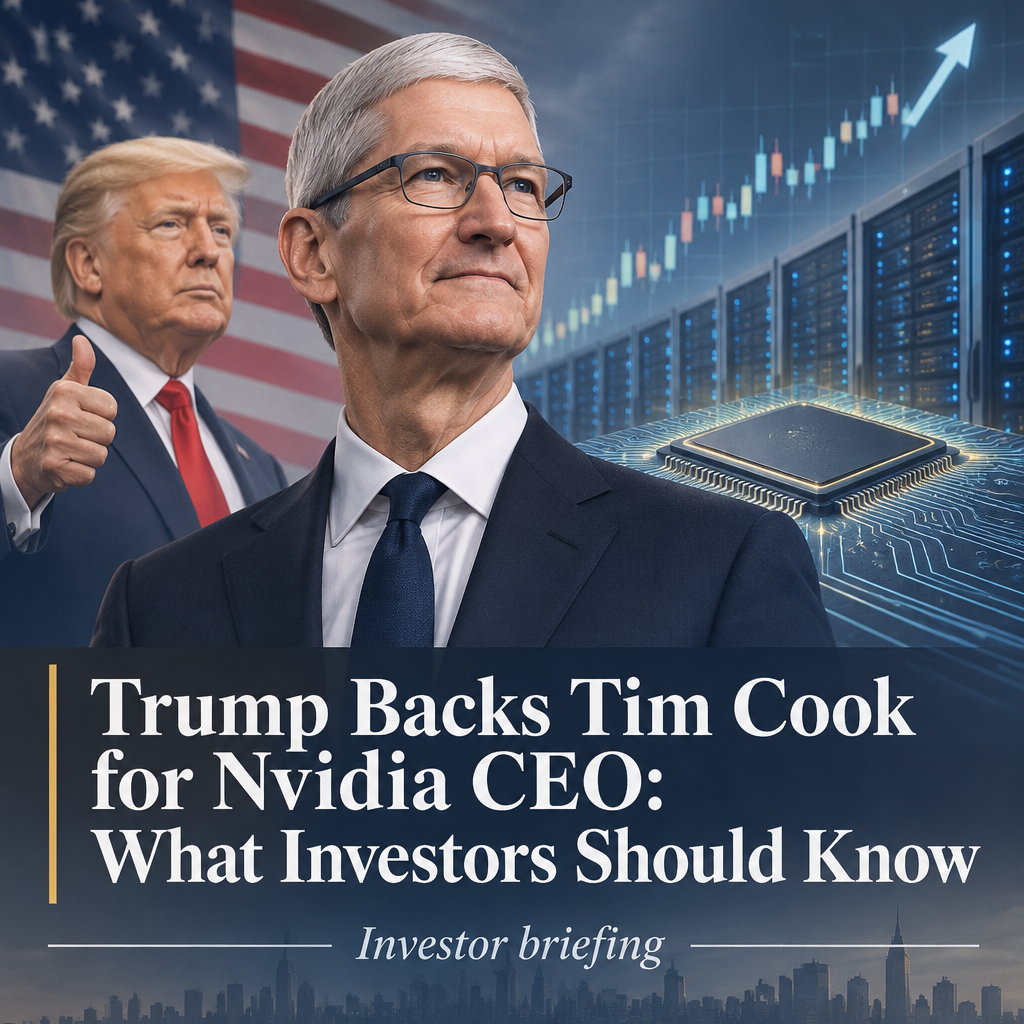
President Donald Trump called Tim Cook the only man suited to replace Jensen Huang at Nvidia after saying Huang had resigned. The account also reports that Nvidia named CFO Colette Kress interim CEO while its board considers candidates. Allegations surrounding Huang remain allegations; no public evidence described in the report establishes that Nvidia secrets were disclosed.
This is a corporate-governance story as much as a personality story. Nvidia co-founded by Huang in 1993 occupies a central place in the artificial-intelligence chip business, so investors naturally care who sets its strategy and manages its relationships with customers, employees, regulators, and suppliers. But a presidential endorsement is not a board appointment, a signed employment agreement, or proof that the proposed candidate wants the job.
The reported resignation and interim appointment deserve careful confirmation through Nvidia's official communications and filings. The account says the board is considering candidates from inside and outside the company, but it does not identify a shortlist or give a timetable. Until those details are confirmed, investors have more reason to check the facts than to guess at the next CEO's first move.

What Is Trump's Call for Cook to Lead Nvidia?
The reported event has three separate parts. Trump said Huang had resigned, endorsed Cook as his preferred successor in a Truth Social post, and praised both executives. Separately, the account says Nvidia appointed Kress, its chief financial officer, as interim CEO while the board searches for a permanent leader. Those details should not be collapsed into one claim: an endorsement is not a hiring decision, and an interim appointment is not necessarily a permanent succession plan.
Huang co-founded Nvidia in 1993 and became its defining executive over the decades that followed. The company is widely associated with graphics processors and, more recently, chips and systems used for artificial-intelligence computing. A change at the top could therefore affect questions of strategy, product execution, customer relationships, and the way the company communicates with governments. The basic facts about Nvidia's executives and governance can be checked on its leadership page and in its annual reports and proxy materials.
Cook is described in the account as having stepped down as Apple's CEO in September after 15 years in the role, and as now serving as Apple's executive chairman. The report gives no indication that he has sought the Nvidia position, been approached by Nvidia's board, or agreed to leave Apple. Apple's executive profile for Cook is a sensible place to verify his reported role, but it cannot establish whether he wants another chief executive job.
The reason given for Huang's reported resignation is especially sensitive. Reports described two alleged extramarital affairs, including a relationship with a Chinese businesswoman whom U.S. authorities reportedly suspect of spying for Beijing. The account says those allegations raised questions about possible targeting because Nvidia is strategically important amid U.S.-China tensions over advanced chips. It also states plainly that no public evidence has established that Huang disclosed confidential information or that the woman obtained Nvidia secrets. That distinction matters. Allegations can prompt legitimate security reviews, but they are not proof of misconduct or a breach.
Frankly, the first question for an investor is not whether Trump's proposed successor sounds famous. It is whether the reported changes are confirmed, who holds decision-making authority today, and what the company has disclosed about continuity. A corporate transition can be material; a social-media endorsement by itself is not a corporate filing.
Why Nvidia's Leadership Matters to Investors
Leadership matters when it changes decisions that affect a company's ability to compete, invest, and deliver products. A CEO can shape capital allocation, hiring priorities, research spending, customer commitments, and public communication. At a company like Nvidia, investors would also watch how leadership manages supply constraints, export rules, large customer relationships, and the pace at which new products reach the market. The title alone does not tell you whether any of those decisions will change.
The first benefit of a clear succession plan is operational continuity. Staff, suppliers, and customers need to know who can approve plans and speak for the company. A named interim CEO can help keep ordinary decisions moving while a board conducts a search. But the word interim should not be mistaken for a guarantee: investors need to learn what authority Kress has, how responsibilities are divided, and whether the board has explained its process. The account supplies the interim appointment but not those details.
The second issue is governance. A board should weigh the candidate's fit for the company's actual needs, not merely public recognition. Cook ran Apple for 15 years, according to the report, while Kress is Nvidia's CFO and was named interim CEO. Those are different kinds of experience. Leading a large technology business may involve transferable management skills, but the account provides no evidence that Cook has experience running Nvidia's chip-development and customer ecosystem. Nor does it establish that he would want the role. The board, not a political endorsement, must assess the fit.
The third issue is exposure to regulatory and geopolitical risk. Advanced chips sit inside policy disputes as well as commercial markets. A CEO's job includes helping the company comply with applicable rules and protecting sensitive information, while preserving lawful business relationships. Investors should not leap from a reported personal relationship to a conclusion about espionage or a security failure. The account explicitly says no public evidence establishes that confidential information was passed on. That is an important limit on what can responsibly be inferred.
Here's the kicker: a change at the top can matter without changing the investment case overnight. Nvidia's results still depend on demand, product delivery, competition, margins, customer spending, and the terms under which it can sell products. Leadership can influence those factors, but does not replace them. When I assess a succession story, I separate what could affect long-term execution from what is simply dramatic in the news cycle.
There is also a stewardship question. Companies controlling strategically important technology carry responsibilities to employees, customers, shareholders, and the wider public. That includes fair treatment, careful handling of information, and decisions that consider more than a short burst of market attention. Investors can support that standard by asking for clear governance and evidence-based disclosures, not by treating unproven allegations as settled fact.
How Investors Should Assess a Reported CEO Transition
A disciplined review starts with verification. Here is a practical sequence.
- Check the official record. Look for a company announcement, regulatory filing, or board communication that confirms the reported resignation and interim appointment. Nvidia's investor-relations page and the SEC's company filings page are better starting points than reposted commentary. If the claim is not in a filing yet, note that the detail is unconfirmed rather than filling the gap with assumption.
- Identify who is actually in charge. An interim CEO may have broad authority, limited authority, or duties shared with other executives. Read the company's explanation if it provides one. Check whether the board has described the search process and whether any leadership responsibilities have changed. The reported account does not spell out Kress's authority, so an investor should not invent a division of duties.
- Separate the allegations from established facts. The reported personal conduct and possible national-security concerns are serious, but the account does not establish that confidential information was disclosed or obtained. Ask what authorities or the company have formally stated, and distinguish an allegation, an investigation, a finding, and a proven violation. Those are not interchangeable labels.
- Assess the candidate against the company's needs. For each possible leader, examine relevant operating experience, strategic judgment, ability to retain talent, and record of communicating with investors. Cook's long tenure at Apple is part of his profile; Kress's reported role as Nvidia's CFO is part of hers. Neither fact alone answers whether a person is right to lead Nvidia. The board's stated reasons and the candidate's actual willingness matter.
- Return to the business. Read financial statements and company disclosures for changes in revenue, costs, cash generation, investment plans, customer concentration, or forward guidance. Nvidia's annual reports and proxy materials can help investors inspect business risks and governance rather than relying on a headline. The account provides no new financial results, valuation figures, or market-reaction data, so there is no basis here for claiming a precise effect on the share price.
- Review portfolio risk before trading. A leadership headline can create volatility, but volatility is not a valuation model. Consider how much exposure the company already represents in a portfolio, whether that exposure fits the investor's risk tolerance, and how diversified the rest of the holdings are. Avoid turning a single news item into an all-or-nothing bet. If a decision depends on a fact that remains unconfirmed, waiting for a disclosure may be more rational than racing to trade.
When I analyze an executive change, I want a short list of verifiable developments: an official appointment, a clear statement of duties, a credible transition timetable, and evidence that the company's operating plans remain intact or have changed. The process is less exciting than guessing who will get the office. It is also more useful.
Cook vs. Kress: What the Report Says
The strongest comparison available from the account is between the public figure Trump endorsed and the executive named interim CEO. This is not a ranking of their abilities. The reported facts are limited, and a board search may include other candidates from inside or outside Nvidia.
| Question | Tim Cook | Colette Kress |
|---|
| Reported position | Apple's executive chairman after leaving its CEO role | Nvidia CFO named interim CEO |
| Leadership detail in the account | Led Apple for 15 years | The account identifies her as Nvidia's CFO |
| Connection to Nvidia | No Nvidia role is reported | Current Nvidia executive, according to the account |
| Status in the reported succession | Trump endorsed him publicly | Serving as interim CEO while the board searches |
| Publicly reported interest | None stated | Interim appointment reported; permanent interest not stated |
| Key unknown | Whether he was approached or would accept | Scope of interim authority and whether she is a permanent candidate |
The table makes a basic point. Cook has an endorsement; Kress has the interim job, according to the account. Those are not equivalent forms of evidence. A public endorsement can affect attention and speculation, but the board controls the selection process. An interim appointment gives an executive an immediate operating role, but does not prove that the board will choose that person permanently.
Cook's executive history may be relevant to a board assessing leadership, but Apple's business and Nvidia's business are not interchangeable. A candidate would need to understand Nvidia's products, workforce, customer commitments, and strategic risks—or demonstrate a credible plan to lead the people who do. That is an assessment for the board, not something a headline can settle. The Apple profile provides background on Cook; Nvidia's leadership and proxy pages provide background on the company and its governance.
Kress's interim role may give the company a measure of continuity because she is already identified as its CFO. Still, the account does not report the details of her operating authority, her past responsibilities beyond the CFO role, or the board's view of her candidacy. Investors should resist filling those blanks with confident-sounding guesses. A responsible comparison keeps known facts in one column and open questions in another.
External candidates may also be considered, the account says, but it names none. That leaves the field open, not evidence of a particular choice. Until Nvidia communicates a permanent appointment, the useful question is whether its board runs a credible search and whether the interim leadership can maintain execution. Frankly, a famous name is no substitute for a disclosed plan.
Common Mistakes to Avoid
Treating Trump's endorsement as an appointment. A president can praise a candidate, but corporate authority belongs to the company's board and its established processes. The account says Trump endorsed Cook; it does not say Nvidia's board selected him. Investors who treat the post as a done deal are trading a conclusion that the reported facts do not support.
Assuming Cook accepted or wants the job. No interest from Cook is reported. His current role, as described, is executive chairman at Apple. An endorsement does not establish a private conversation, an offer, or an agreement. Until Cook or the companies confirm something, statements about his intentions are speculation.
Converting suspicion into proof. The reported concerns about a relationship with a woman suspected by U.S. authorities of spying for Beijing are serious. But the account says no public evidence has established that Nvidia secrets were disclosed or obtained. Repeating a suspicion as a proven security breach is inaccurate and unfair. Investors can take national-security risk seriously without declaring a verdict that has not been established publicly.
Assuming an interim title settles the future. Kress's reported interim appointment gives her the current role described in the account. It does not establish whether she will become permanent CEO, how long the search will take, or what the board's criteria are. A temporary arrangement can be stable, but investors should look for facts about its scope rather than infer them from the title.
Overweighting the headline and ignoring the business. A CEO change can affect long-range execution, but investors still need to examine revenue, margins, customer demand, costs, product plans, and competition. The provided account gives no quarterly figures or valuation analysis. A strong opinion about the shares built on missing data is not analysis; it is confidence wearing a business suit.
Confusing a market reaction with a lasting change in value. Prices may move sharply when news breaks, but a short-term move does not prove that long-term earnings prospects have changed by the same amount. Investors should compare the underlying facts with their existing view, not assume the first market response is correct. Keep position size, diversification, and personal time horizon in view. Let's be real: urgency is not evidence.
Frequently Asked Questions
Did Tim Cook agree to become Nvidia's CEO?
The account does not say that Cook agreed, was approached, or expressed interest. Trump publicly endorsed him, while Nvidia reportedly named Kress interim CEO and began considering candidates. Investors should treat Cook's potential appointment as speculation unless Nvidia, Cook, or an authorized representative confirms it. A public recommendation is not an employment announcement.
Who is leading Nvidia on an interim basis?
The account says Nvidia named CFO Colette Kress interim CEO on Thursday while the board searches for a permanent successor. It does not detail the scope of her authority, the duration of the interim arrangement, or whether the board is considering her for the permanent role. Those details should be verified through Nvidia's official communications and filings.
Is there public proof that Huang disclosed Nvidia information?
The account says no public evidence has established that Huang disclosed confidential information or that the woman involved obtained Nvidia secrets. Reports of allegations and questions about possible intelligence targeting should not be presented as proof of a security breach. Investors should distinguish what is alleged from what authorities or the company have established.
What should investors watch next?
Look for an official confirmation of the leadership changes, an explanation of interim responsibilities, and the board's process for choosing a permanent CEO. Separately, track Nvidia's business disclosures, including operating results, product plans, customer demand, and material risks. The account gives no share-price reaction or new financial figures, so those should not be guessed at or invented.
A leadership story is worth attention, not automatic action. Investors should wait for primary disclosures, keep allegations in their proper category, and judge the company by the evidence it provides about governance and operating performance. Nvidia's next CEO—whoever the board selects—will inherit a consequential business, but the name alone will not determine its results. Sound investing still depends on stewardship, careful verification, and a portfolio built to withstand uncertainty.
Sources for verification