P.F. Chang’s Turnaround: Jim Mazany’s Playbook for Restaurant Growth
P.F. Chang’s turnaround under CEO Jim Mazany is a case study in restaurant operations, not a publicly documented earnings story. Since taking over in November 2025, Mazany says the chain moved from 22nd to No. 3 in industry sales and traffic for two consecutive quarters, while resetting its culture, execution and growth priorities.
Key Takeaways- Mazany attributes the recovery to clarity, hospitality, employee engagement and consistent execution—not a wholesale reinvention of the brand.
- The reported jump in sales and traffic ranking is encouraging, but it does not reveal revenue, profit margins, comparable-store sales or cash flow.
- P.F. Chang’s is preparing to expand its restaurants, consumer packaged goods and fast-casual concepts; each requires separate financial discipline.
- The company’s people-first message matters operationally, but sustained results depend on staffing, training, guest satisfaction and sound capital allocation.
The company has more than 300 locations worldwide. Mazany, a restaurant veteran with 35 years in the business, took over after Brad Hill in November 2025 and says P.F. Chang’s recovery came sooner than some observers expected. The company is also preparing a 2026 holiday campaign, a seasonal menu and its first nationwide Christmas Day opening.
There are important limits to what those headlines tell us. The ranking claim, as reported, does not identify the comparison group or explain the precise measures behind it, and no financial statements or margin data are included here. That makes this a useful operating case study—not a complete investment assessment. The distinction matters: traffic can improve while costs rise faster, and expansion can add sales while weakening returns on capital.
What Is the P.F. Chang’s Turnaround?
A restaurant turnaround is a sustained effort to improve the guest experience and the economics of running the business. It usually involves several connected tasks: making the brand’s promise clear, improving service and food consistency, supporting employees, controlling costs and choosing growth projects that can earn an acceptable return. It is not simply a new menu, a celebrity campaign or a splashy opening.
Mazany’s stated approach starts with a belief that the chain did not need to become something else. In his account, the job was to help P.F. Chang’s regain confidence in what it already was, then make its teams clearer about what success looked like. That is a notable distinction. A struggling company can lose focus by trying to chase every trend, while a recognizable brand can often improve by doing its core work more reliably.
The reported business signal is substantial: Mazany said the chain rose from 22nd to No. 3 for industry sales and traffic for two consecutive quarters. That may indicate stronger demand and improved execution. But a rank is not a financial statement. Without a defined peer group, time period, measurement method and absolute figures, it cannot tell a reader how much sales increased or whether restaurant-level profitability improved.
Mazany’s background helps explain his focus on operations. He describes himself as someone who worked his way from the dishroom toward executive leadership, spending roughly 35 years in restaurant roles, including chef work. He later held leadership positions at Joe’s Crab Shack, SPB Hospitality, Rosa Mexicano, Yardbird and Shell Shack. That experience is relevant because restaurant economics are built in daily decisions: staffing a shift, preparing food consistently, handling a rush and fixing a service failure before it drives a guest away.
The technical demands are real. Food-service managers oversee schedules, supplies, customer service and budgets, among other responsibilities, as described by the U.S. Bureau of Labor Statistics. Mazany’s warning to learn frontline jobs before investing in or leading a restaurant is practical, not romantic. Knowing the work does not guarantee success, but ignorance of the work is an expensive way to begin.
Core Benefits and Importance
The first potential benefit is restored guest demand. When diners return, a restaurant may spread fixed costs such as rent across more meals and make better use of its kitchen and dining room. That is the appealing arithmetic. The caveat is that extra visits only help if the contribution from those meals exceeds the additional labor, food, delivery, marketing and service costs.
The second benefit is sharper operating focus. Mazany says he rallied teams around a clear definition of winning and encouraged people to take considered risks instead of playing safe. Clear priorities can reduce conflicting instructions, speed up decisions and help restaurant teams understand what leaders value. But slogans do not replace practical measures. Managers need to know whether the priority is faster service, fewer order errors, stronger repeat visits, better labor productivity or a mix of these—and how the measures fit together.
There is also a staff-retention argument. Restaurant work is demanding, and frequent turnover can mean repeated hiring and training costs, uneven service and added pressure on experienced employees. Mazany says he makes a point of recognizing people who do good work, while keeping accountability in view. Praise is useful when it is specific and fair. It has less value if schedules are unstable, training is weak or employees are asked to meet targets without adequate support.
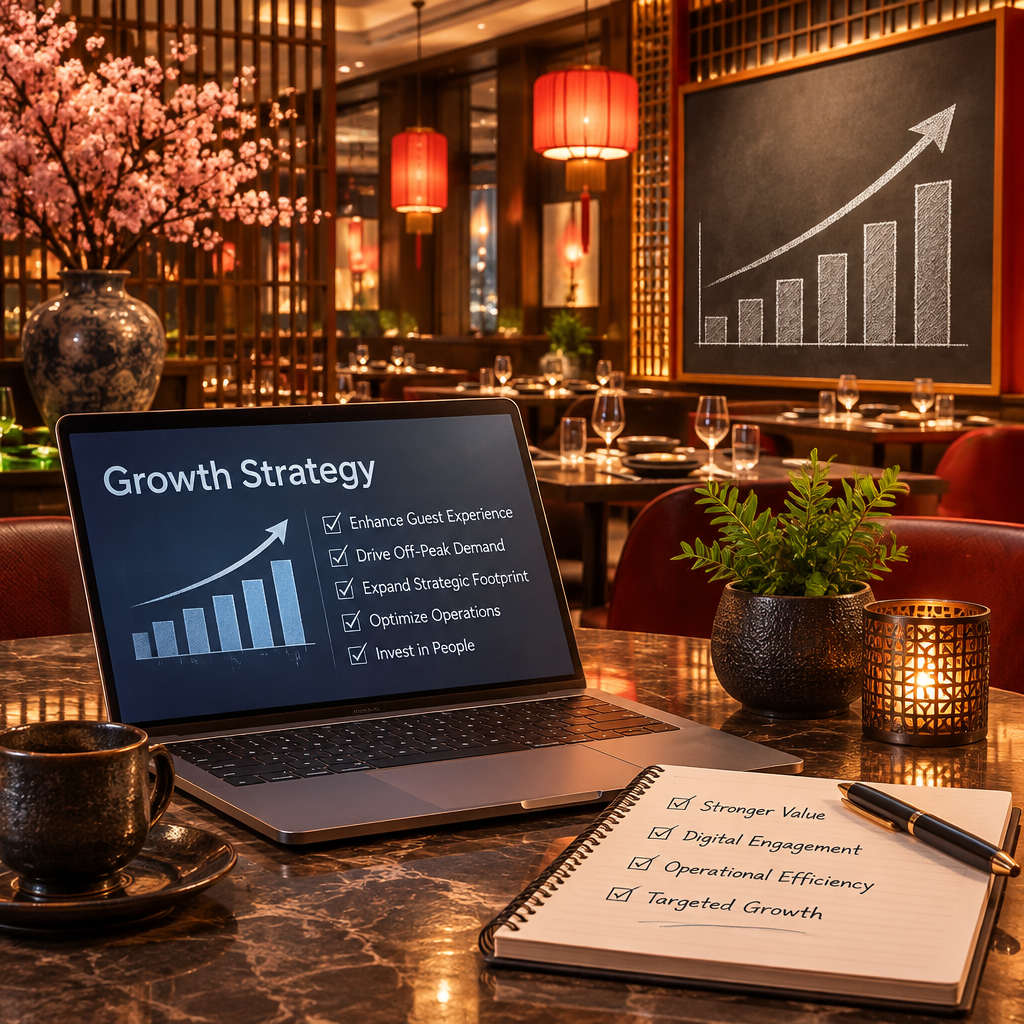
Third, a turnaround can improve the quality of future growth. P.F. Chang’s says it intends to expand domestically and internationally and develop consumer packaged goods and fast-casual concepts. A stronger operating base may give the company more confidence to test those options. Still, each one has a different cost structure. A full-service restaurant depends on dining-room labor and real estate; packaged food introduces manufacturing, distribution and retail relationships; fast-casual formats require a distinct service and site model.
Here’s the kicker: growth is not the same as value creation. Management should compare a project’s expected cash returns with its upfront investment, ongoing costs and risks. Business owners can use the Small Business Administration’s market research and competitive analysis guide as a starting point for assessing customer demand and competing offers, though it cannot substitute for company-level financial data.
Finally, a people-first approach has a moral as well as commercial dimension. A sound business respects the dignity of its workers, serves guests honestly and contributes responsibly to the communities where it operates. Mazany’s support for autism awareness and children’s hospitals gives his people-focused message a personal dimension. Good intentions are not a substitute for results, but results should not be measured by profit alone.
Step-by-Step: How to Assess the Turnaround
- Separate reported claims from verified financial measures. Start with what Mazany said: P.F. Chang’s moved from 22nd to No. 3 for industry sales and traffic across two consecutive quarters. Record the claim accurately and attribute it to him. Then ask what is missing: the comparison set, the ranking methodology, dollar sales, traffic counts and the basis for comparing periods. I would not turn a rank into a revenue-growth estimate without those details.
- Check guest demand and repeat behavior. Sales and traffic are related but not interchangeable. More visits can come from discounts or temporary marketing; stronger repeat business may point to a more durable change in guest satisfaction. Useful measures include comparable-store sales, visit frequency, average check, guest complaints and order accuracy. None is reported in the available account, so they remain questions, not conclusions.
- Examine restaurant-level costs. Higher sales can be offset by food inflation, wage pressure, waste, overtime, rent or promotional spending. Look for labor cost as a share of sales, food cost, occupancy cost and restaurant-level operating profit. A restaurant can be busier and less profitable if it relies on costly discounts or inefficient staffing. The U.S. restaurant industry’s operating conditions and cost pressures are discussed by the National Restaurant Association; its industry data are context, not proof of P.F. Chang’s own performance.
- Test whether culture changes show up in daily work. Mazany emphasizes recognition, accountability and giving his team room to take risks. Those ideas become meaningful when employees receive useful training, managers have authority to solve guest problems and leaders act consistently when mistakes happen. I would look for employee retention, promotion from within, guest feedback and service consistency—not just campaign language.
- Evaluate each growth bet on its own. New restaurants, international markets, packaged goods and fast-casual concepts should not be lumped together under one growth target. Each needs a clear customer, operating model, investment budget and measure of success. For a new location, that means estimating construction and opening costs, staffing, expected sales and payback time. For packaged goods, it means understanding production costs, shelf access and repeat purchases.
- Watch capital allocation after the recovery. Mazany says the chain has earned the right to focus on growth. That is an understandable leadership frame, but the test is whether growth earns a reasonable return without weakening existing restaurants. Compare proposed investment with expected cash flow, downside risks and competing uses of funds. A disciplined operator can say no to a project that looks exciting but fails the numbers.

Comparison Table: P.F. Chang’s and Fast-Casual Competitors
The available account does not name P.F. Chang’s biggest competitor or provide rival sales, traffic or profit figures. A precise company-versus-company ranking would therefore be guesswork. The table below compares P.F. Chang’s reported full-service turnaround with the fast-casual model it says it plans to enter; it does not claim that every competitor follows the same playbook.
| Measure | P.F. Chang’s reported position | Fast-casual competitor model | What the comparison can—and cannot—show |
|---|
| Core format | More than 300 global locations; an established restaurant brand | Generally built around quicker service and a simplified guest experience | Different formats can target overlapping diners, but the business models and cost structures differ. |
| Recent performance signal | Mazany says the brand moved from 22nd to No. 3 in industry sales and traffic for two consecutive quarters | No competitor ranking or period-specific result is reported | The P.F. Chang’s claim is encouraging, but there is no equivalent rival figure for a fair numerical comparison. |
| Growth plans | Domestic and international expansion, packaged goods and fast-casual concepts | Often emphasizes repeatable locations and streamlined service; specifics depend on the operator | Expansion potential should be assessed through unit economics, not format labels. |
| Key financial question | Can the recovery produce durable restaurant-level cash flow while supporting new projects? | Can a faster model sustain traffic, margins and consistent execution across locations? | Neither question is answered by sales rank alone. |
| Evidence still needed | Comparable-store results, margins, cash flow, investment costs and payback periods | Comparable data on the same measures and time periods | Without like-for-like information, a direct performance winner cannot be named. |
The table is intentionally restrained. The National Restaurant Association’s industry information can help frame broad conditions, but broad averages do not establish how one chain compares with another. To judge a competitor properly, use consistent definitions and matching periods. Comparing one company’s traffic claim with another’s revenue estimate is not analysis; it is apples versus a spreadsheet full of oranges.
Common Mistakes to Avoid
Treating rank as proof of profitability. A jump in sales and traffic rank is a positive signal, especially if it lasts across multiple quarters. But a ranking does not show absolute growth, restaurant margins, free cash flow or debt. It can also move because competitors weakened or the comparison group changed. Keep the attribution clear and wait for supporting measures before making a firm financial judgment.
Assuming a strong quarter proves a permanent turnaround. Two consecutive quarters are more persuasive than one, but still a short window. Restaurant demand can shift with seasonality, promotions, menu changes and local conditions. A durable recovery should hold across more than one trading period and should show up in repeat visits, comparable-store performance and operating results—not only a headline ranking.
Confusing publicity with customer loyalty. A holiday campaign featuring actor Harry Shum Jr. may attract attention, and a seasonal menu can give guests a reason to visit. The announced nationwide Christmas Day opening is also a significant change in the company’s stated plans. Yet advertising reach is not the same as profitable demand. The relevant questions are whether campaigns bring in incremental guests, whether those guests return, and whether sales cover the additional labor and operating costs.
Expanding before the existing model is stable. New locations and new formats can consume capital, management time and experienced staff. International growth adds local-market and supply-chain questions; packaged goods bring manufacturing and distribution requirements; fast-casual restaurants need their own service and site economics. A familiar brand does not make those risks disappear. Each bet should earn approval on its own merits.
Believing leadership must have every answer. Mazany says he prefers strong people around him and an environment where thoughtful risk-taking is allowed. That can be healthy. But empowerment without clear limits can create inconsistent decisions, while caution without room to improve can stall progress. Effective delegation pairs authority with training, shared standards and accountability for results.
Ignoring frontline work. Restaurant leadership is technical. A prospective owner who has never worked a shift may underestimate scheduling, food safety, inventory, service recovery and the pressure of a crowded dining room. The Bureau of Labor Statistics’ description of food-service management reinforces how broad the job is. Experience does not eliminate risk, but it makes the risks easier to see before money is committed.
Measuring only sales. A restaurant can increase revenue while putting more strain on staff or delivering uneven service. Keep a balanced scorecard: sales, guest satisfaction, labor and food costs, employee retention, cash flow and returns on invested capital. The exact measures should fit the business, but ignoring the people doing the work is both ethically thin and financially shortsighted.
Frequently Asked Questions
What changed at P.F. Chang’s under Jim Mazany?
Mazany says he focused on clarity, culture and execution rather than reinventing the brand. He describes setting a clearer definition of winning, encouraging teams to take considered risks and recognizing employees who perform well while maintaining accountability. He also credits renewed guest interest with the recovery. The available account does not include detailed financial statements, so the effect on margins and cash flow cannot be confirmed from the reported ranking alone.
How did P.F. Chang’s move from 22nd to No. 3?
Mazany said the chain rose from 22nd to No. 3 in restaurant-industry sales and traffic for two consecutive quarters after he became CEO in November 2025. The comparison group, exact ranking method and absolute figures were not reported. The claim should therefore be treated as an attributed performance statement, not as a fully explained financial measure.
Is P.F. Chang’s planning to expand?
Yes. Mazany said the company plans to grow its domestic and international footprint and develop consumer packaged goods and fast-casual concepts. Each initiative has different costs and operational demands. The company’s plans do not, by themselves, establish how many locations or products will launch, what they will cost or what returns they might generate.
Does the turnaround make P.F. Chang’s a good investment?
The reported improvement alone is not enough to answer that. A sound assessment would require current financial information, including sales trends, operating margins, cash flow, debt, planned capital spending and the returns expected from expansion. Investors should also confirm what information is available for the specific security or business interest they are evaluating. A stronger operating story can be encouraging, but it is not a substitute for valuation and risk analysis.
Final Thought
Mazany’s story is compelling because it centers on the work restaurants actually require. He began in a summer job, built experience across the business and now argues that leaders should understand their teams’ jobs before making major decisions. That is useful advice for would-be restaurateurs and established operators alike. Hospitality may look effortless from a dining-room table; behind it are hundreds of choices about people, timing, quality, costs and service recovery.
The reported sales and traffic ranking suggests P.F. Chang’s may have regained momentum, and its leaders are preparing to pursue new forms of growth. Those are meaningful developments, not proof that the business has solved every problem. The next test is whether guests keep returning, restaurants generate healthy cash flow and new investments strengthen the core rather than distract from it. The company has not reported the detailed financial measures needed here to answer those questions.
A disciplined turnaround balances ambition with stewardship. It treats capital as a responsibility, employees as people rather than line items, and guests as more than transactions. Mazany’s emphasis on hospitality and recognition points in that direction. The numbers will have the final say on whether the recovery lasts—but the way a company earns those numbers matters, too.