The Little Giant ladder recall covers more than 3.6 million ladders with Rapid Locks, a height-adjustment mechanism that can fail to engage fully and let the...
Little Giant Ladder Recall: Safety Steps, Refunds, and the Cost of Waiting
The Little Giant ladder recall covers more than 3.6 million ladders with Rapid Locks, a height-adjustment mechanism that can fail to engage fully and let the ladder retract. Little Giant and the CPSC report 39 lock-malfunction reports, 25 unexpected retractions, and 19 injuries. Owners should stop using an affected ladder and follow the recall instructions before climbing again.
Key Takeaways
- The recall includes 11 ladder makes and more than 130 models; prices reportedly ranged from $100 to $1,000.
- Little Giant says users should stop using an affected ladder until they receive and apply the supplemental warning labels as instructed.
- Check each Rapid Lock, follow the repair-kit guidance, and maintain the mechanism with lubrication as directed. Do not treat a warning label as proof that a faulty lock has been repaired.
- If a lock still does not work properly after evaluation, Little Giant says owners can choose a same or equivalent replacement ladder or a refund based on purchase date and depreciated value.
This is first a safety alert, not a shopping recommendation. Still, the remedy has a real household-finance angle: replacing a ladder can cost hundreds of dollars, while a fall can bring medical bills, lost work, and costs that no refund can neatly undo. The reported prices span $100 to $1,000, so identifying the exact model before making a money decision matters.
The company’s statement says it is sending repair kits to known users who reported Rapid Locks malfunctions. It also says warning labels and instructions address proper operation and lubrication. If you are unsure whether your ladder is affected, use the CPSC’s recall listings and Little Giant’s official website to check the model and current instructions rather than relying on a guess or an old receipt alone.
What Is the Little Giant Ladder Recall?
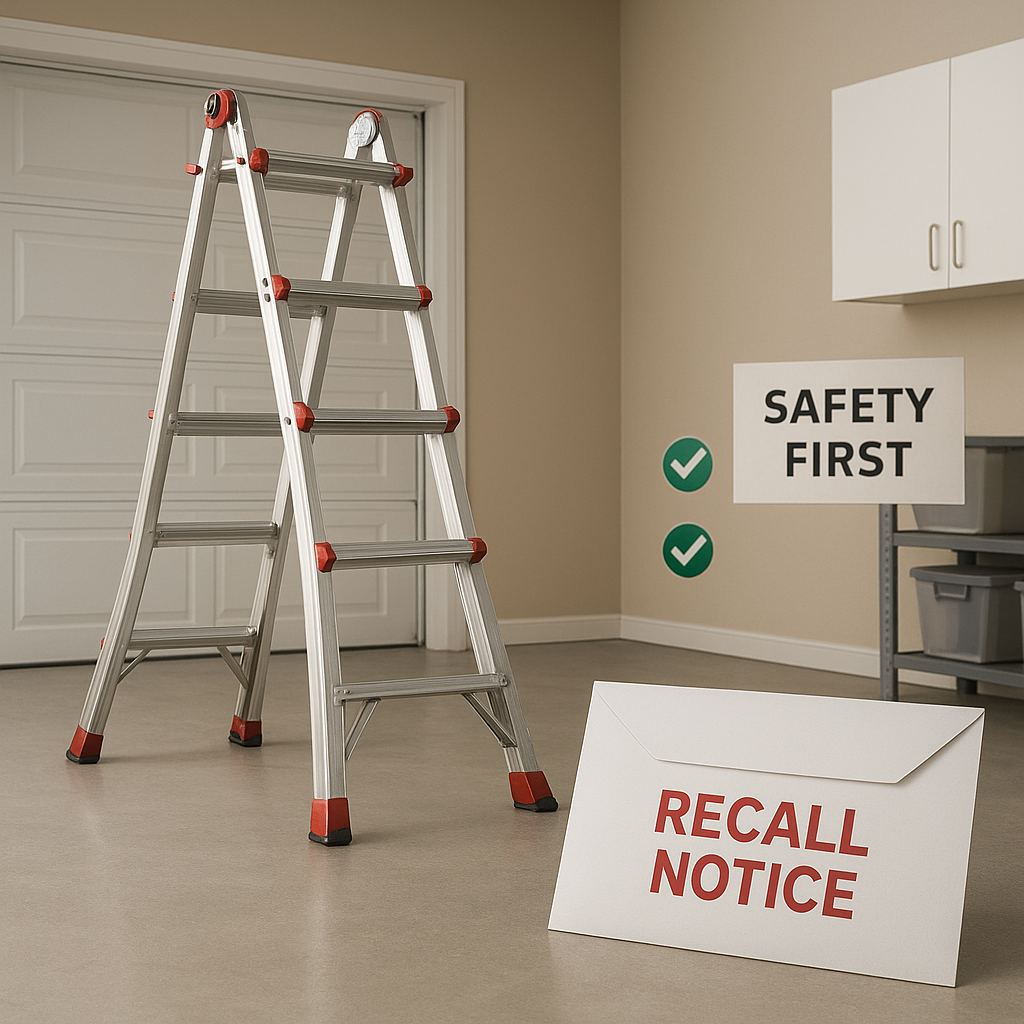
The recall concerns Little Giant ladders fitted with Rapid Locks. These locks are designed to fit into ladder rungs and help adjust the ladder’s height. The reported problem is straightforward and serious: a lock may not become fully engaged, allowing the ladder to retract while someone is using it. A ladder that appears set can still be unsafe if the locking mechanism has not seated correctly.
The scale is large. According to the recall information, 11 makes and more than 130 models are involved, with reported retail prices from about $100 to $1,000. That range makes model identification more than a formality. It helps an owner determine whether the ladder is part of the recall and gives useful context when considering the company’s replacement or refund option.
The reported counts should be read carefully. Little Giant received 39 reports of Rapid Locks not working properly. Twenty-five reports involved a ladder retracting, and 19 of those retractions resulted in injury. The reported injuries included three head-injury reports, covering traumatic brain injury, skull fractures, concussion, vision or hearing loss, and cognitive impairment. The company also received reports of joint or bone fractures, cuts, and bruising. These are reports, not a prediction that every affected ladder will fail.
That distinction is no reason to shrug. A lock failure can turn a routine household task into a fall, and a fall from height can cause harm far beyond a bruised ego or a damaged tool. The CPSC recall database is the sensible starting point for checking notices and product details; confirm the exact model and remedy with the company’s current recall instructions.
Little Giant’s stated response includes supplemental warning labels and guidance for operating and lubricating Rapid Locks. The company says owners with a lock that remains defective after evaluation can choose a replacement of the same or an equivalent model, or a refund. That refund may be based on depreciated value determined by purchase date; ladders bought within the previous 12 months may qualify for a refund up to the full purchase price. Those details are not the same as a blanket promise that every owner receives a full refund.
Why the Recall Matters to Your Household Finances
The obvious benefit of responding is reducing the chance of a preventable fall. The less obvious benefit is protecting the household budget from a risk that can grow quickly: medical care, transportation, time away from work, and the need to replace equipment can stack up. No reasonable cost calculation makes climbing a ladder with a suspect lock worth the gamble.
Here’s the kicker: the cheapest option today may be expensive later. Continuing to use a ladder because a replacement seems costly is false economy when the reported defect involves a mechanism intended to hold the ladder at its chosen height. The recall remedy may reduce the expense of replacing the product, but it does not make the ladder safe until the specified steps have been completed and the locks work as intended.
A refund also has a practical financial dimension. Little Giant says the amount may reflect depreciation and date of purchase, with a full purchase-price refund possible for ladders bought within the past 12 months. Keep the receipt if you have it, but do not assume a missing receipt settles the question; ask the company what purchase information it accepts and how it evaluates a claim. Record the model, serial or identifying marks, purchase date, and any communications.
Owners should also distinguish a recall remedy from a standard warranty claim. They may overlap in some cases, but their rules and coverage are not automatically identical. The Federal Trade Commission’s guide to federal warranty law explains warranty concepts; it does not replace the specific Little Giant recall terms. If a ladder failure caused an injury, keep medical records, photographs, receipts, and relevant correspondence, and contact an appropriate professional about your circumstances. Do not assume that a product remedy covers every injury-related expense.
There is a stewardship point here, without dressing it up. Tools are meant to serve people, not put them at needless risk. When a ladder is used by a household member, employee, or contractor, sharing the recall notice and taking the equipment out of service protects both human dignity and the people whose work depends on it.
Step-by-Step: What Owners Should Do
- Stop climbing on the affected ladder. Little Giant’s statement tells users to stop using the ladder until they have received and applied the warning labels included with the repair kit, following the enclosed instructions. Do not keep using it while waiting because it looks sturdy or has worked before. Past success does not show that a lock is fully engaged today.
- Identify the ladder precisely. Find the brand, model, and other identifying information on the product. Compare it with the recall details through CPSC recall listings and the company’s current guidance. With more than 130 models reportedly involved, matching only by brand is not enough. If a label is worn or missing, photograph the ladder and ask Little Giant how to identify it.
- Contact the company through an official channel. Use Little Giant’s official website or the contact details in its current recall notice. Explain whether a Rapid Lock has malfunctioned, retracted, or caused an injury, and ask what remedy and repair-kit instructions apply to your ladder. Keep a dated record of the contact, any reference number, and the answer. That small paper trail can save time later.
- Follow the repair-kit directions exactly. The company says the kit includes instructions, also available through a QR code on the ladder, for safe operation and lubrication of the Rapid Locks. Apply warning labels as directed and use only the specified maintenance procedure. A label is a warning and instruction aid; it is not itself proof that an internal fault has been fixed.
- Evaluate every Rapid Lock before any use. The recall instructions tell users to visually verify that all Rapid Locks are fully engaged before climbing. Follow the full evaluation procedure, not just a quick glance at one lock. If a lock does not function properly after the evaluation, do not climb. Ask Little Giant about the replacement or refund option described in the recall.
- Compare the offered remedy with the actual cost. Write down the model, purchase date, original price, and the proposed refund or replacement terms. The affected ladders reportedly ranged from $100 to $1,000, and a depreciated refund may not equal the amount needed to buy a new ladder. Ask how depreciation is calculated and whether the replacement is the same or an equivalent model. Get the response in writing if possible.
- Keep records and report serious events. Save the receipt, repair-kit paperwork, photographs, and company messages. If the ladder retracted or someone was hurt, document what happened and the date, and report it through the company’s process and the relevant safety reporting channel. Seek medical care for injuries; symptoms after a fall should not be dismissed to avoid a bill.
- Tell other users. A ladder may be borrowed, stored in a shared workshop, or used by someone who never saw the recall notice. Put it out of service in a way that makes the warning clear, and tell anyone who might reach for it. This is not excessive fuss. It is basic risk management.
For broader worksite ladder guidance, the OSHA ladder standard sets requirements for covered construction workplaces. It is not a substitute for the product-specific recall instructions, and household users should not assume every workplace rule applies to them. The useful lesson is simpler: use the equipment only as intended, inspect it, and respect a mechanism that is not working properly.
Comparison: Recall Remedy or Buying a Replacement Now?
The main alternative to pursuing the recall remedy is buying another ladder immediately. That may be appropriate if a safe ladder is urgently needed, but it can mean paying before learning whether a replacement or refund is available. The table uses only the details reported for the recall; it does not assume every owner qualifies for the same outcome.
| Decision point | Little Giant recall remedy | Buying a new ladder now |
|---|
| Immediate use | Stop using the affected ladder until the warning labels and instructions have been applied, and the locks have been evaluated. | A different ladder may meet an immediate need, but check its instructions and condition before use. |
| Up-front cost | The company describes a replacement or refund option if a lock still fails after evaluation. | The buyer pays the seller; the price depends on the selected product and is not specified by this recall. |
| Amount or value | Reported affected-ladder prices ranged from $100 to $1,000. A refund may be depreciated by purchase date; full purchase price may be available for purchases within the past 12 months. | No single price can be stated from the recall information. Compare the model, capacity, and intended use rather than price alone. |
| Best next step | Verify the model, follow the kit instructions, and ask the company how it assesses the remedy. | Avoid rushing into a purchase before checking whether the recall remedy addresses your situation. |
Frankly, neither column is a universal answer. A household that needs a ladder immediately may decide a replacement is worth buying, but it should still pursue any remedy it may qualify for. Keep the receipt for a new purchase and separate that expense from the old ladder’s recall paperwork. Do not count on being reimbursed for a new ladder unless the company confirms that in writing.
The right comparison is not simply refund versus sticker price. Consider the time spent waiting, the ladder’s intended use, whether the proposed replacement is suitable, and the household’s ability to pay upfront. A safe substitute may be worth the cost when work cannot wait, but no one should climb the recalled ladder just to avoid a temporary expense.
Common Mistakes to Avoid
Assuming the ladder is safe because it has not failed before. A lock that works on one occasion may still be incompletely engaged on another. The recall addresses a failure mode, not a guarantee that every affected product will fail at a predictable time. Follow the stop-use and evaluation instructions rather than relying on memory.
Checking only one lock. The company’s warning calls for visually verifying that all Rapid Locks are fully engaged. A ladder can have multiple locks, and a careful inspection should cover each one specified in the instructions. Do not substitute a quick pull or a casual glance for the stated procedure.
Treating the warning label as a repair. The supplemental labels communicate warnings and operating instructions. The company also discusses maintenance with lubrication, but a label alone cannot make a malfunctioning lock work. If a lock does not function correctly after evaluation, stop and ask about the replacement or refund option.
Continuing to use the ladder while waiting for a kit. Waiting is inconvenient. Falling is worse. Put the ladder aside and use a safe alternative, borrow appropriate equipment, or postpone the task; do not improvise a repair or rely on a makeshift support.
Expecting every owner to receive a full refund. The reported remedy is conditional. Little Giant says a replacement of the same or equivalent model or a refund is offered if the lock does not function properly after evaluation. Refund value may be depreciated according to purchase date, with a full purchase-price refund available for ladders bought within the prior 12 months. Ask about your case instead of assuming.
Ignoring records because the ladder is old. A receipt helps establish when and where the ladder was bought, but other product details and communications can also matter. Photograph labels, write down the model, and keep copies of the repair-kit instructions and company responses. Documentation is not glamorous; it is useful when the remedy depends on age or model.
Confusing a refund with compensation for an injury. The described recall remedy concerns a ladder replacement or refund. The details provided do not establish that the remedy pays medical bills, lost wages, or other injury-related costs. If an injury occurred, prioritize care and retain records; get advice suited to the facts rather than treating a product refund as a complete settlement.
Frequently Asked Questions
How many Little Giant ladders are included in the recall?
The recall covers more than 3.6 million ladders across 11 makes and more than 130 models, according to the recall information. Reported prices ranged from $100 to $1,000. Check the model against current CPSC and Little Giant information; the brand name by itself may not identify whether a particular ladder is included.
Can I keep using my ladder while I wait for the repair kit?
Little Giant says users should stop using the ladder until they have received and applied the warning labels included in the repair kit according to its instructions. Follow the recall directions and evaluate all Rapid Locks before climbing. If a lock does not function properly after evaluation, do not use the ladder; ask about the replacement or refund option.
Does every owner receive a full refund?
No. The company says an owner whose lock remains faulty after evaluation can choose a same or equivalent replacement ladder or a refund. The refund may be a depreciated value determined by purchase date. A full purchase-price refund may be offered for ladders purchased within the past 12 months. Contact Little Giant to confirm the terms for your model and purchase.
What should I do if a ladder retracted or someone was injured?
Stop using the ladder and seek medical care for injuries. Keep photographs, the product’s identifying information, receipts, medical records, and communications with the company. Report the malfunction through the relevant company and safety-reporting channels. A replacement or refund is not necessarily the same thing as payment for medical expenses or other losses, so get advice specific to the situation.
Final Thought
The sensible response is not complicated, but it does require follow-through. Take the ladder out of service, identify the model, read the current instructions, and check every Rapid Lock before considering another climb. If a lock remains faulty, ask Little Giant about the replacement or refund choice and keep a clear record of the answer.
There is no clever financial trick here. The ladder cost can be measured in dollars; the consequences of a serious fall cannot be reduced to a neat price tag. Owners should not spend money blindly, and they should not let the desire to avoid a replacement bill overrule a plain safety warning. Find out what the remedy actually covers, compare that with the cost of a safe alternative, and choose on verified facts.
I would treat this as a small household risk-management job: confirm the product, document the remedy, and keep other users informed. Good stewardship means caring for the resources a household owns and, more importantly, for the people who use them. A ladder is useful only when its locks do their job.