Tapping retirement money is not one decision. It is a sequence.
How to Tap a 401(k) With Minimal Taxes: Smart Withdrawal Rules, Pension Choices, and Retirement Income Moves
Tapping retirement money is not one decision. It is a sequence.
The real job is to draw income without handing extra cash to the IRS, while keeping the portfolio alive, the tax bill sane, and your options open. Most people focus on the monthly number and ignore the damage from bad timing, poor account order, and lousy withholding. That is how retirees get mugged by their own paperwork.
The smarter approach is plain enough: coordinate withdrawals, Roth conversions, Social Security timing, pension elections, and asset location so your money works with the tax code, not against it. I have analyzed plenty of retirement plans, and the winners usually do three things well: they plan distributions before age 73, they think in brackets rather than balances, and they treat income as stewardship, not a dare.
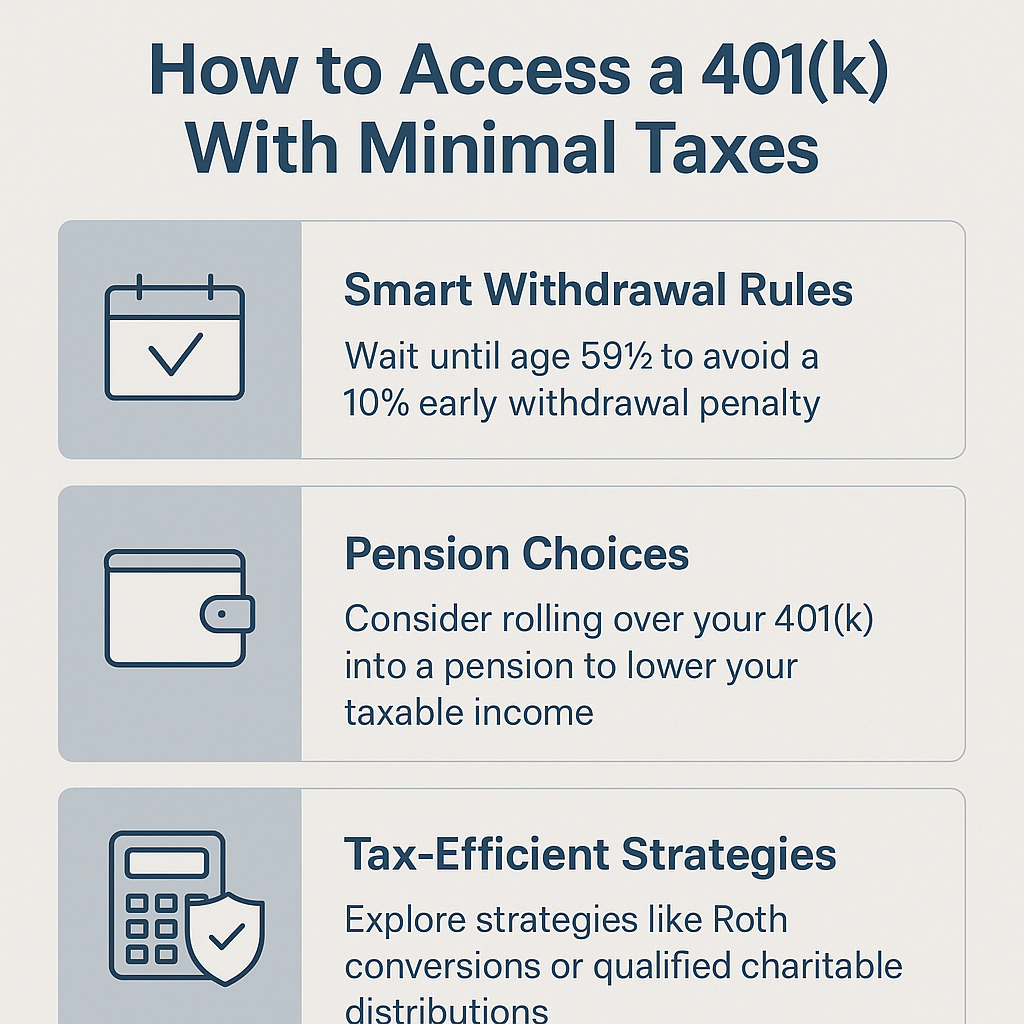
Key Takeaways- 401(k) withdrawals can be taxed very differently depending on whether they come from pre-tax, Roth, or after-tax sources.
- Required minimum distributions (RMDs) can raise taxable income later, so waiting until the last minute is usually dumb.
- Pension choices are irreversible in practice, so the higher monthly payment is not always the better deal.
- A $5.3 million portfolio can support early retirement, but only if spending, taxes, market risk, and college costs are handled with discipline.
- Good retirement planning is about cash flow, taxes, and longevity, not just chasing the biggest headline number.
What is tapping a 401(k) with minimal taxes?
It means taking money out of a 401(k) while legally reducing income taxes over your lifetime.
That sounds simple, because people love simple stories, but the rules are messy, the tax brackets are stacked, and the order of withdrawals matters more than most advisers admit. Pre-tax 401(k) money is ordinary income when withdrawn. Roth 401(k) money is usually tax-free if qualified. After-tax contributions can sometimes be split out more efficiently, depending on plan rules. The details matter. A lot.
Here’s the kicker: “minimal taxes” does not always mean “pay nothing this year.” Sometimes the best move is to deliberately realize some income now to avoid a bigger tax hit later. That can mean Roth conversions before RMDs begin, especially in years when income is lower. The IRS RMD rules are not optional, and once they start, they can push you into higher brackets, raise Medicare premiums, and make other income more expensive.
I’ve seen people hoard tax-deferred money as if the government forgot. It did not. Tax deferral is not tax escape. It is a loan with a repayment date.
So the question is not, “How do I avoid taxes?” The real question is, “How do I control when taxes hit, what rate I pay, and which account funds which goal?” That is asset allocation with a tax brain. It is also just common sense, which, frankly, is rarer than it should be.
For people near retirement, the main tools are these: strategic withdrawals from taxable, traditional, and Roth accounts; partial Roth conversions; pension timing; Social Security claiming strategy; and investment placement across the portfolio. The right mix depends on age, marital status, state tax, health, and spending needs. If you want a practical planning baseline, the Fidelity tax-smart withdrawal strategy gives a decent framework, even if you still need to tailor it.
The moral angle is not hard to see. Money is a tool, not a trophy. Stewardship means using what you have to support your household, avoid waste, and make room for the common good. A sound retirement plan should respect that order.
Core benefits of a tax-smart 401(k) withdrawal plan
The benefits are real.
1) Lower lifetime taxes
A good withdrawal sequence can reduce total taxes over decades, not just this year, and that matters because retirement tax brackets change with income, capital gains, and RMDs. Most people only compare tax bills in one year, which is a rookie mistake.
2) Better control over Medicare costs
Higher taxable income can increase Medicare Part B and Part D premiums through IRMAA. That penalty is not huge at first, then it bites harder than people expect. If you can manage taxable income before age 65 and after age 73, you may save more than a flashy investment move would.
3) More flexibility in bad markets
When stocks are down, you do not want to sell too much from the wrong bucket. A mix of cash, bonds, taxable assets, and Roth money gives you room to avoid forced selling. That is basic risk management, not wizardry.
4) Better estate outcomes
Roth assets and carefully managed taxable assets can be kinder to heirs than a large pre-tax balance with a giant tax bill attached. The old stretch IRA rules are gone for most heirs, so account type matters even more now.
5) Fewer costly mistakes
People who wait until age 73 to think about taxes usually discover they have been sleeping at the wheel. Starting early lets you smooth income and avoid bracket cliffs. It also gives you time to adjust before the tax code takes a bite.
6) Cleaner retirement spending
A tax-smart plan tells you how much you can actually spend after taxes, not just how much you can withdraw. That is the number that matters if you want stability.
Most guides talk as if “more income” is always better. It is not. A $1 of income inside the wrong bracket can cost more than the benefit it creates. The truth is, income is only useful when it fits the rest of the plan.
If you are balancing retirement with college costs, spouse needs, or a pension choice, the order of operations matters. The portfolio is not a pile of money. It is a system. Treat it that way.
Step-by-step guide to tapping a 401(k) with minimal taxes
The process should be deliberate.
1) Inventory every account and every tax bucket
List pre-tax 401(k)s, Roth 401(k)s, traditional IRAs, Roth IRAs, taxable brokerage accounts, HSAs, pensions, and any after-tax contributions. You cannot make a good withdrawal plan if you do not know what is in each bucket. That sounds obvious, but people skip it all the time.
2) Estimate your taxable income for the next 10 years
Include wages, pension income, dividends, interest, rental income, capital gains, Social Security, and future RMDs. Then model what happens if you retire early, sell a property, convert to Roth, or delay Social Security. I’ve run enough projections to say this: the future tax bill is usually larger than expected, not smaller.
3) Decide which account to spend first
There is no one-size-fits-all order, but a common pattern is taxable accounts first for flexibility, then pre-tax accounts strategically, then Roth assets later or as needed. That said, if you have very low income in a given year, converting some pre-tax money to Roth may be the smarter move.
4) Use Roth conversions in low-income years
If you retire before RMDs begin, you may have a window to convert chunks of pre-tax money into Roth at a lower tax rate. The Schwab Roth conversion guide explains the broad logic well. The trap is converting too much and jumping brackets. Do it in slices, not in a fit of enthusiasm.
5) Watch state taxes and Medicare
A federal-only plan is half-baked. State income tax, pension taxation, and future Medicare premiums can change the answer. In some cases, a withdrawal that looks fine on paper becomes expensive once all layers are counted.
6) Plan for RMDs before they start
At 73 for many retirees, RMDs force taxable withdrawals whether you need the money or not. That is why earlier conversions and managed withdrawals can be valuable. The IRS has a nasty habit of collecting eventually.
7) Coordinate with Social Security and pension timing
Delaying Social Security may raise guaranteed income and reduce pressure on the portfolio. A pension election affects taxes, survivor benefits, and flexibility. If you are choosing between a higher level payment and a lower inflation-adjusted one, the right answer depends on life expectancy, inflation, and what other assets you hold.
8) Rebalance and recheck every year
A retirement income plan is not a one-and-done spreadsheet. Markets move, tax law changes, spending changes, and health changes. Review the plan at least annually.
If I were setting this up from scratch, I would not start with the withdrawal rate. I would start with the tax map. Then I would layer in spending, risk, and only then the investments. That order saves money and grief.
For a deeper portfolio-level view, the Vanguard retirement income research is worth a look. It is not sexy. It is useful. Big difference.

Comparison table: tax-smart 401(k) withdrawals vs. naive withdrawals
| Feature | Tax-smart withdrawal strategy | Naive withdrawal strategy |
|---|
| Tax timing | Controlled across years | Random or reactive |
| Bracket management | Uses bracket space intentionally | Ignores bracket cliffs |
| RMD planning | Starts early | Waits for forced withdrawals |
| Roth conversion use | Strategic, partial, timed | None or too much at once |
| Medicare premium impact | Considered in advance | Often ignored |
| Flexibility in market declines | Higher | Lower |
| Estate efficiency | Better account positioning | Larger tax drag for heirs |
| Stress level | Lower over time | Higher when surprises hit |
The comparison is not subtle.
The naive method feels easier because it postpones decisions. That is precisely why it fails more often. Taxes do not disappear because you ignored them. They simply show up later, usually with friends.
Common mistakes to avoid
People make the same errors over and over.
1) Taking withdrawals without a bracket check
The most common mistake is pulling money out just because it is needed, with no thought to where it lands tax-wise. That can push ordinary income into a higher bracket and trigger Medicare issues. Frankly, that is lazy planning.
2) Assuming the highest pension payment is best
A larger monthly pension can be attractive, but it may come with no cost-of-living increase, no survivor benefit, or little flexibility. A lower benefit with annual hikes can beat a flat payment over a long retirement, especially if inflation stays stubborn. Pension elections should be modeled, not guessed.
3) Forgetting sequence risk
If you retire into a bad market, drawing too much from stocks can damage the portfolio early. This is sequence-of-returns risk, and it is a real problem. A withdrawal strategy should protect against that, not pretend it is theory.
4) Overlooking after-tax and Roth rules
Not all 401(k) money is the same. Some plans have after-tax contributions, company stock, or in-plan Roth features. The wrong distribution method can create unnecessary taxes.
5) Letting a salesman choose the plan
I’m skeptical of anyone who sells a “guaranteed lifetime income” product and then hides the balance sheet. If an adviser promised income and the account is nearly gone, the structure deserves a hard audit. Guaranteed income is only as good as the contract, the costs, the issuer’s strength, and the beneficiary terms.
6) Forgetting the spouse or heirs
A plan that works for one person on paper may fail the family later. Survivor needs, tax brackets, and account inheritance rules all matter. Money should serve real people, not just a model.
7) Ignoring charitable intent
If you give to church or charity, qualified charitable distributions after age 70½ from IRAs can lower taxable income. That is often better than simply writing a check from cash after you have already taken the income hit. Stewardship includes generosity, not just optimization.
The popular advice is usually too blunt: spend more, convert everything, delay everything, buy the biggest annuity, or take Social Security at some magic age. None of that is serious planning. Real planning is a nuisance because it has to fit your life.
Frequently asked questions
What is the most tax-efficient way to withdraw from a 401(k)?
Usually, it is a coordinated mix of taxable account withdrawals, partial pre-tax withdrawals, and Roth conversions during low-income years. The exact order depends on your brackets, state tax, and whether you are trying to avoid RMD spikes later.
Should I take a pension with inflation increases or a higher fixed payment?
If you expect a long retirement, the inflation-adjusted option often looks better over time, especially if inflation is persistent. Still, the right choice depends on survivor benefits, other assets, health, and whether you need more cash now or more protection later.
Can a $5.3 million portfolio support retiring at 60 with $350,000 annual spending?
Maybe, but not automatically. At that spending rate, the draw is substantial, and college costs can add pressure. It can work if the portfolio is well diversified, spending is flexible, taxes are managed, and the withdrawal rate is kept under control. The devil is in the cash flow, not the headline number.
What should I do if my adviser said I had lifetime income but the account is almost empty?
Get the contract, fee schedule, transaction history, and surrender terms. Then have an independent fiduciary or tax professional review it. You need to know whether the income was from an annuity, a rider, or a bad sales pitch wrapped in friendly language.
A quick look at the common situations in the prompt
The headlines and the household problems are linked by the same issue: cash flow under pressure.
A retiree at 68 with only $100,000 left in a 401(k) needs immediate clarity on distribution options, withholding, and whether the plan includes tax-friendly after-tax money or Roth balances. A 55-year-old choosing between $2,900 monthly flat pension income and $2,200 with 3% annual increases should compare present value, inflation protection, and survivor value. A couple in their 50s with $5.3 million invested but two kids heading to college needs a spending plan that respects tuition, market volatility, and the possibility of retiring at 60 without raiding growth assets too early.
The common thread is discipline.
Not excitement. Not hot takes. Discipline.
If the numbers are tight, the answer is not always “invest harder” or “spend less forever.” Sometimes it is a sequence change: delay one benefit, draw from another account, trim taxes in a low-income year, or preserve capital by using a bond ladder and cash buffer. Sometimes it is also admitting that a promise made by a salesperson was not the same thing as a contract you can trust. That is just reality.
One more thing: retirement money should support human dignity. That means enough income for housing, food, health care, and family obligations, plus a margin for generosity and peace. A plan that ignores that is not really a plan. It is arithmetic without wisdom.
The best retirement income strategy is boring in the right way.
It is measured, tax-aware, and honest about risk, which is why it works when the market gets noisy and the bills keep coming.
Final thought
The people who retire well are usually not the loudest ones.
They ask better questions early, they resist the urge to chase a neat answer, and they understand that taxes, like gravity, do not care about mood. A 401(k) is not just a balance to spend down. It is a reservoir that has to be managed with timing, restraint, and a clear view of the whole household.
If you are near retirement, the real win is not squeezing every last dollar out of the IRS this year. It is shaping your income so that your taxes stay tolerable, your investments stay intact, and your family is not left cleaning up a mess later. That is stewardship in plain clothes.
And if someone tells you there is a simple formula for all of this, smile politely and keep your hand on the numbers. Simple formulas are usually how people end up paying more than they should.