How to Pay Off Student Loans Fast Without Putting Your Finances at Risk
Paying off student loans faster means sending more money to principal, choosing a repayment route that fits your loan terms, and protecting financial supports you cannot replace overnight. The aim is not merely a zero balance; it is lower interest without sacrificing emergency savings, essential bills, or valuable federal protections.
There is no magic trick here. The arithmetic is plain: a lower principal balance generally leaves less debt accruing interest, but the best plan depends on your rate, loan type, income, and eligibility for repayment or forgiveness programs. One borrower may be wise to pay aggressively; another may lose more by giving up an income-driven plan or draining emergency savings. I treat speed as a goal, not a religion. The steps below combine practical ways to cut the timeline with checks that keep the rest of your finances standing. Start with a clear inventory of each loan, then choose the methods that do not force you to borrow again when life gets expensive.
What Is Paying Off Student Loans Fast?
Paying off student loans fast means making payments above the required amount, applying them in a way that reduces the balance, or securing a lower-cost repayment structure that shortens the debt’s life. It does not mean missing other bills, emptying every savings account, or automatically refinancing. Those shortcuts can swap a manageable loan for a much nastier financial problem.
Interest is the charge for borrowing. With many student loans, interest accrues over time based on the outstanding balance and interest rate; paying down principal sooner can reduce the amount on which future interest accrues. A payment may first cover accrued interest and applicable fees, with the remainder reducing principal. The precise rules and payment handling depend on the loan and servicer, so check your account and loan agreement rather than guessing.
Start by separating federal student loans from private student loans. Federal loans may offer income-driven repayment, deferment or forbearance options, and certain forgiveness or discharge programs, subject to current rules and individual eligibility. Private loans are governed by the lender’s contract and generally do not carry the same federal programs. The Federal Student Aid repayment options and Loan Simulator can help federal borrowers compare estimated payments and repayment paths; it is a useful starting point, not a promise of a particular outcome.
I would write down each loan’s balance, interest rate, minimum payment, type, and any special benefit before sending extra cash. That one-page inventory often exposes a high-rate private loan, a federal loan with valuable protections, or a rate that changes over time. Check whether your lender charges a prepayment penalty, though many student loans can be paid early without one. For private debt, confirm the contract. Frankly, “pay the biggest balance first” is not a strategy; it is a guess.
A simple illustration shows why additional payments matter. On $20,000 at 6% with a standard 10-year schedule, the monthly payment is about $222. Raising it to $300 can pay the loan off about 39 months early and save roughly $2,258 in interest, assuming the rate and payment behavior stay as described. The exact result changes with timing, fees, and servicer allocation. Use a calculator with your actual loan details before committing to a new payment.
Core Benefits of Faster Repayment
Less interest is the obvious benefit. Every dollar that reduces principal can reduce future interest costs, so the effect may build over time when extra payments are made regularly. It is not a guaranteed investment return, though; the value depends on the loan’s rate, tax treatment, and benefits you might surrender by paying early or refinancing.
- More room in the monthly budget: Once the debt is gone, the former payment can be redirected to retirement savings, a home down payment, childcare, or other priorities.
- Fewer years carrying debt: A shorter payoff timeline can make future plans easier to manage, especially when income is uncertain or household expenses may rise.
- A clearer financial picture: Fewer balances and due dates can simplify cash-flow planning and reduce the chance of overlooking a payment.
- A potentially lower total cost: Paying down a high-rate loan sooner can be especially valuable when the interest rate is fixed and no forgiveness benefit is at stake.
- A sense of progress: Small, visible reductions can keep a repayment plan on track, though motivation should not replace a sound budget.
The contrarian point is that faster repayment is not always better. If your employer matches retirement contributions, you have expensive credit-card debt, or you lack cash for a car repair or medical bill, sending every spare dollar to a student loan can backfire. You may then need to borrow at a much higher rate. Keep required payments current, build a cash reserve suited to your household, and compare the loan rate with other uses of the money. The Federal Student Aid repayment guidance lays out federal options; borrowers pursuing public service should also verify current Public Service Loan Forgiveness eligibility and requirements.
There is a human side to this calculation. Money is a tool for stewardship: the goal is to use it responsibly while meeting obligations to family, work, and community, not to chase a debt-free date at any cost. The best plan is one you can keep without neglecting essentials or undermining your ability to earn. Here’s the kicker: sustainable progress usually beats a dramatic payment followed by a month of credit-card borrowing.
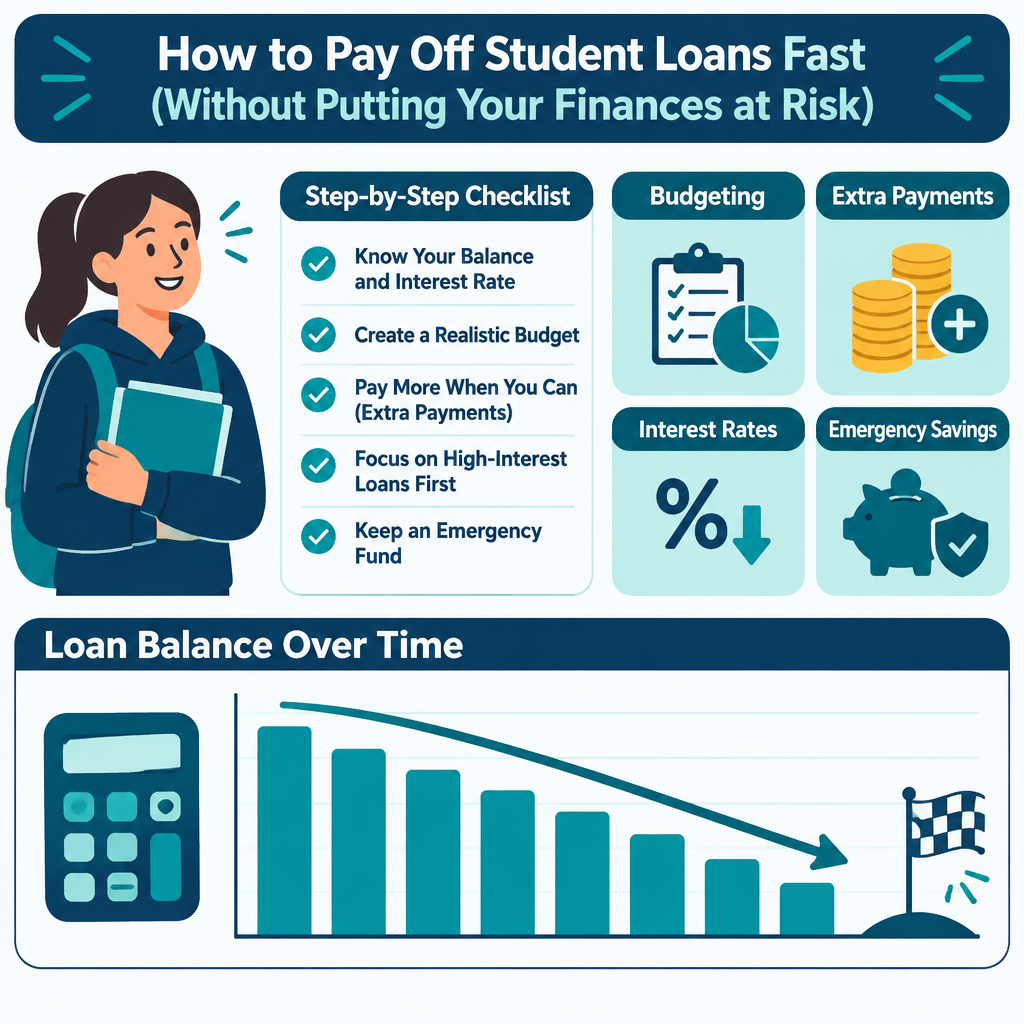
Step-by-Step Guide: Eight Ways to Pay Off Student Loans Quickly
- Increase your monthly payment.
Begin with a number your regular budget can carry. Even $25 or $50 more each month can shorten a schedule and reduce interest, though the result depends on your balance and rate. For the example above, raising the payment from about $222 to $300 cuts around 39 months and roughly $2,258 in interest, based on the stated assumptions. Set the amount through your servicer’s website or payment system, then check the next statement to see how it was applied. Do not assume an extra amount automatically lowers principal; some systems may treat it as a payment ahead of schedule or apply it in a way you did not intend. Keep the required due date covered, and ask the servicer how to target principal or a particular loan.
- Consider biweekly payments, but verify processing.
Splitting a monthly payment into two halves and paying every two weeks produces 26 half-payments in a year—equivalent to 13 full monthly payments rather than 12. For the $20,000 example at 6%, that approach could pay the loan off in about nine years instead of 10 and save roughly $762 in interest, depending on processing and timing. It can fit well when paychecks arrive every other week. But do not simply send partial payments without asking how the servicer handles them: a payment might be held until the full amount arrives, or a split schedule could create confusion about the due date. One safe alternative is to make the normal monthly payment and add a separate extra payment when the cash is available.
- Ask whether your employer offers repayment assistance.
Check the benefits handbook or ask human resources whether the company contributes directly to student loans. The International Foundation of Employee Benefit Plans reported that 14% of employers offered student loan repayment assistance in 2024, compared with 4% in 2019. Availability, eligibility, waiting periods, and payment limits differ by employer; some plans require six to 12 months of service. Tax treatment can also depend on current law and the employer’s plan, so check with payroll or a qualified tax professional. A hypothetical $100 monthly contribution toward the $20,000 loan at 6% could shorten repayment by about 46 months and save around $2,638 in interest. Read the plan details, and make sure the contribution is actually sent to the loan.
- Use part of a windfall.
A tax refund, work bonus, cash gift, or inheritance can make a noticeable one-time reduction. Decide in advance what share goes to debt and what share stays available for taxes, repairs, health costs, or other obligations. A 2025 IRS filing-season snapshot put the average refund at $3,052; the average changes as returns are processed, but that amount would still make a substantial dent in many balances. Putting a similar lump sum toward a $20,000 loan each year could bring payoff to just under four years under the example’s assumptions, with no other extra payments. Do not count a refund before it arrives, and do not spend next month’s rent in anticipation of it.
- Put small savings to work with the snowflake method.
A debt snowflake is a small, irregular amount sent toward a balance as soon as practical. It might be $3 from a cash-back reward, $12 saved on groceries, or money left over after a low-cost week. The individual payments will not transform the loan overnight. Their value is that they turn available savings into steady principal reduction and give you visible momentum. Keep a small tracking category in your budget or a separate account, then send the total on a schedule that does not trigger payment-processing fees. Confirm that the lender applies the money as intended. If tracking every few dollars creates more stress than progress, use one monthly transfer instead; a method that you abandon is no method at all.
- Raise income without building a second problem.
A raise, overtime shift, higher-paying job, freelance project, tutoring, or delivery work can create room for larger payments. The right option depends on health, schedule, transport costs, taxes, and the value of your time. Estimate net income—not the headline amount—after expenses and any tax obligations, then choose a fixed share for debt. In the supplied example, an extra $300 a month from occasional delivery work, added to the regular payment of about $222, was estimated to clear the loan in roughly 43 months. Actual results vary with costs and timing. Avoid taking on a side job that harms your primary work, family responsibilities, or health; extra income that disappears into burnout is expensive income.
- Refinance only after pricing the lost protections.
Refinancing replaces one or more existing loans with a new private loan. A lower interest rate or shorter term may cut the total cost, but approval and rates depend on credit, income, debt, and lender rules. For example, refinancing $20,000 from 7% to 5% and choosing a seven-year term instead of 10 years could raise the monthly payment by about $50 while saving approximately $4,120 in interest and finishing three years earlier, based on the example’s assumptions. The trade-off is serious for federal debt: refinancing federal loans privately permanently removes access to federal repayment plans and protections tied to those loans. The Consumer Financial Protection Bureau’s explanation of refinancing federal student loans is worth reading before applying. Compare the APR, fixed versus variable rate, fees, term, cosigner terms, and hardship options—not just the advertised monthly payment.
- Target the highest-rate loan with extra payments.
Pay at least the minimum on every loan, then direct extra money to the loan with the highest interest rate. This “avalanche” method generally minimizes interest when rates, fees, and other terms are comparable. If a small balance can be cleared quickly and doing so helps you stay consistent, a snowball approach—targeting the smallest balance—may suit your behavior better, but it can cost more interest. For federal borrowers, first check whether repayment or forgiveness eligibility makes aggressive payment a poor fit. I favor the highest-rate target when the numbers are clear, but a plan you can follow is more useful than a mathematically perfect plan you quit.
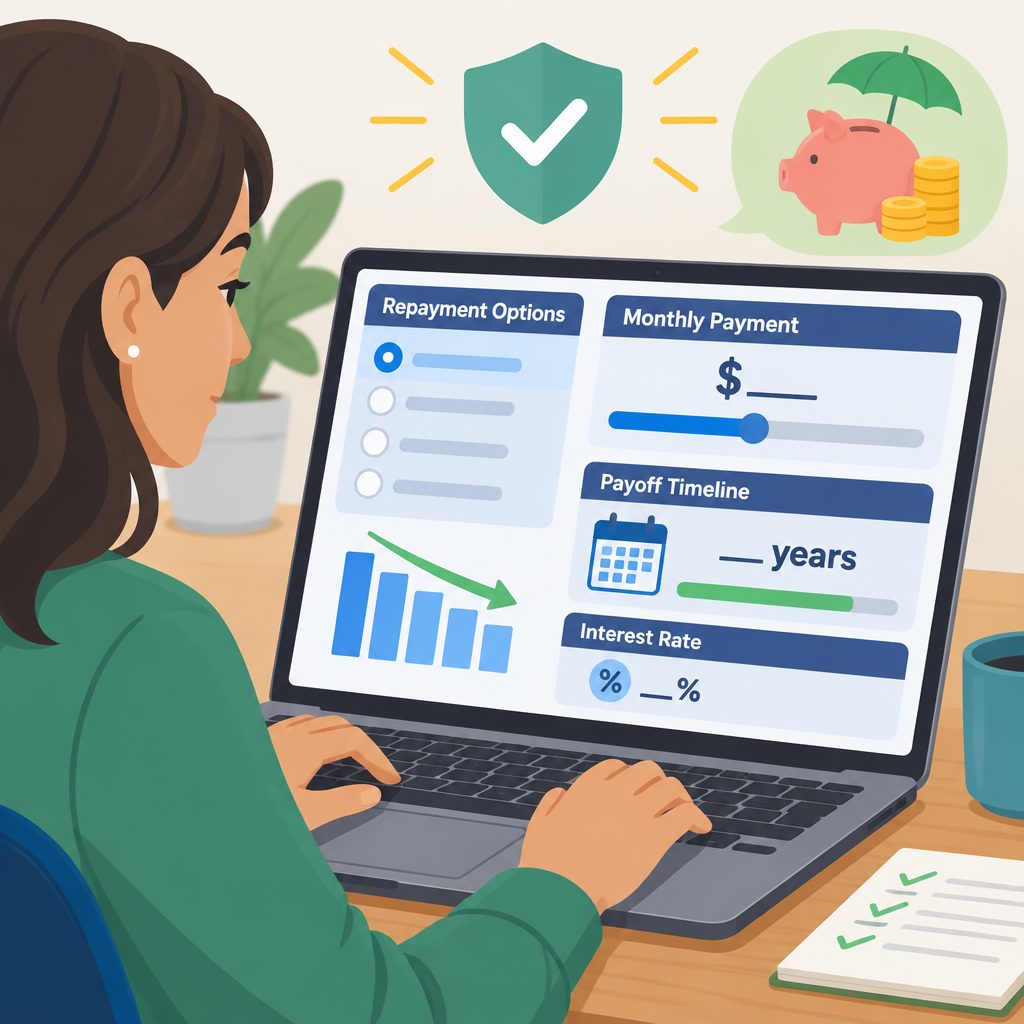
Comparison: Accelerated Payments vs. Standard Repayment
The standard schedule offers a predictable required payment and preserves cash for other goals. Accelerated repayment adds voluntary payments to reduce the balance sooner. Neither option is automatically right: compare the interest savings with the value of flexibility, benefits, and liquidity.
| Approach | Example payment or action | Approximate result on the stated example | Main trade-off |
|---|
| Standard 10-year schedule | About $222 monthly on $20,000 at 6% | Debt paid in 10 years | Lowest required cash commitment among these examples, but more time accruing interest |
| Raise the monthly payment | $300 monthly | About 39 months earlier; roughly $2,258 less interest | Requires a larger, steady monthly budget |
| Pay biweekly | Half the monthly amount every two weeks | About nine years; roughly $762 less interest | Servicer handling and payment timing must be checked |
| Add employer assistance | Hypothetical $100 monthly contribution | About 46 months earlier; roughly $2,638 less interest | Depends on employer eligibility and plan rules |
| Refinance and shorten term | $20,000 from 7% to 5%, seven-year term | About three years sooner; roughly $4,120 saved | Higher required payment and possible loss of federal protections |
These figures are illustrations, not quotes. They assume the stated balances, rates, terms, and payment patterns; actual interest depends on accrual and payment dates, and refinancing offers are borrower-specific. The standard repayment amount in the first row is a baseline, not an endorsement for every federal borrower. Use the Federal Student Aid Loan Simulator to compare applicable federal options, and use lender calculators for private-loan estimates. A calculator cannot decide whether you should preserve a federal benefit or keep more money in savings. That judgment belongs in the plan too.
Common Mistakes to Avoid
Draining your emergency savings. A student loan may carry a moderate rate, but an unexpected repair paid with a high-rate card can undo months of progress. Keep a practical cash reserve based on job stability, dependents, health needs, and predictable expenses. You do not need a perfect reserve before making any extra payment; you do need a plan for foreseeable shocks.
Refinancing federal loans without understanding the cost. A lower rate can look persuasive on a spreadsheet. But private refinancing generally ends access to federal repayment options and related protections for the refinanced amount, and the change cannot simply be reversed later. The CFPB warns borrowers to compare these benefits against the rate savings. If you are pursuing forgiveness or rely on income-sensitive payments, verify eligibility and payment counts before making a move.
Sending extra money without checking allocation. A larger payment does not necessarily behave the way you expect. Your servicer may advance a due date, split the money among multiple loans, or follow a default allocation. Review payment instructions, specify the loan you want to target, and confirm the principal balance afterward. Keep screenshots or confirmations for your records. A five-minute check beats months of assuming.
Paying debt while ignoring more urgent obligations. Late rent, unpaid taxes, overdue utility bills, and high-rate credit-card debt can carry worse consequences than a student loan. Also review whether you are missing an employer retirement match or avoiding necessary insurance. Compare the interest cost, risk, and flexibility of each choice instead of following a slogan such as “all debt first” or “invest everything.” Let's be real: the right order depends on the numbers and the household.
Believing the advertised payment is the full cost. A lower monthly payment may come from stretching the term, not reducing the rate. A variable-rate refinance can also become more expensive if the rate rises. Compare total payments, fees, term, and hardship provisions. Read what happens if you lose income or want to pay the loan early. The cheapest-looking monthly figure is not necessarily the cheapest loan.
Forgetting that tax and benefit rules change. Employer assistance, interest deductions, repayment options, and forgiveness rules can depend on current law, loan type, income, and dates. Check official guidance such as IRS Publication 15-B for employer benefit tax treatment, and confirm plan terms with payroll. Do not build a multi-year payoff decision on a tax rule you have not verified.
Frequently Asked Questions
Is it better to pay off student loans early or invest?
It depends on the loan rate, investment risk, employer match, tax position, and available cash. Paying a high-rate loan offers a more predictable interest saving than investing in assets whose value can fall, but it may not be wise to skip an employer match or empty your emergency fund. Compare options using after-tax figures and a realistic risk tolerance. There is no universal rate cutoff that makes the decision for everyone.
Should I pay the highest-interest student loan first?
Usually, yes—after making every required minimum payment and checking whether federal benefits or forgiveness eligibility affect your plan. Directing extra payments to the highest-rate loan generally reduces total interest faster than spreading extra money evenly. The smallest-balance-first method can be motivating, but it may cost more. Choose deliberately, and confirm that the servicer applies the extra payment to the loan you selected.
Does refinancing federal student loans save money?
It can lower the rate or shorten repayment for some borrowers, but refinancing federal loans with a private lender removes federal protections and program access for the refinanced balance. Compare the full cost with the value of income-driven repayment, eligible forgiveness, and available hardship options. The change is generally permanent, so do not decide from the monthly payment alone. If you need federal flexibility, keep those loans federal and compare private refinancing only for private debt.
How much extra should I pay each month?
Choose an amount that still leaves room for required bills, a reasonable cash reserve, and other high-priority goals. Try a modest increase for two or three months before committing to a larger automatic payment. If income varies, use a stable base payment and add windfalls or side-income when they actually arrive. The “right” amount is the one your budget can support through ordinary months, not just a good month.
A practical payoff plan is less dramatic than the slogans make it sound. It starts with accurate loan details, protects the cash you need to keep your household functioning, and sends extra dollars where they do the most good. Some borrowers will get there through one larger payment; others will combine a small monthly increase, employer assistance, and occasional windfalls. The common thread is control: know what each loan costs, what protections it carries, and how your servicer treats extra payments. Debt should be repaid responsibly, but your dignity and stability are not side issues. Set a pace you can sustain, review it when your income or family needs change, and let steady arithmetic—not panic—do the work.