Paying off student loans fast means sending more money toward your balance than the required payment, while protecting essentials such as emergency savings and...
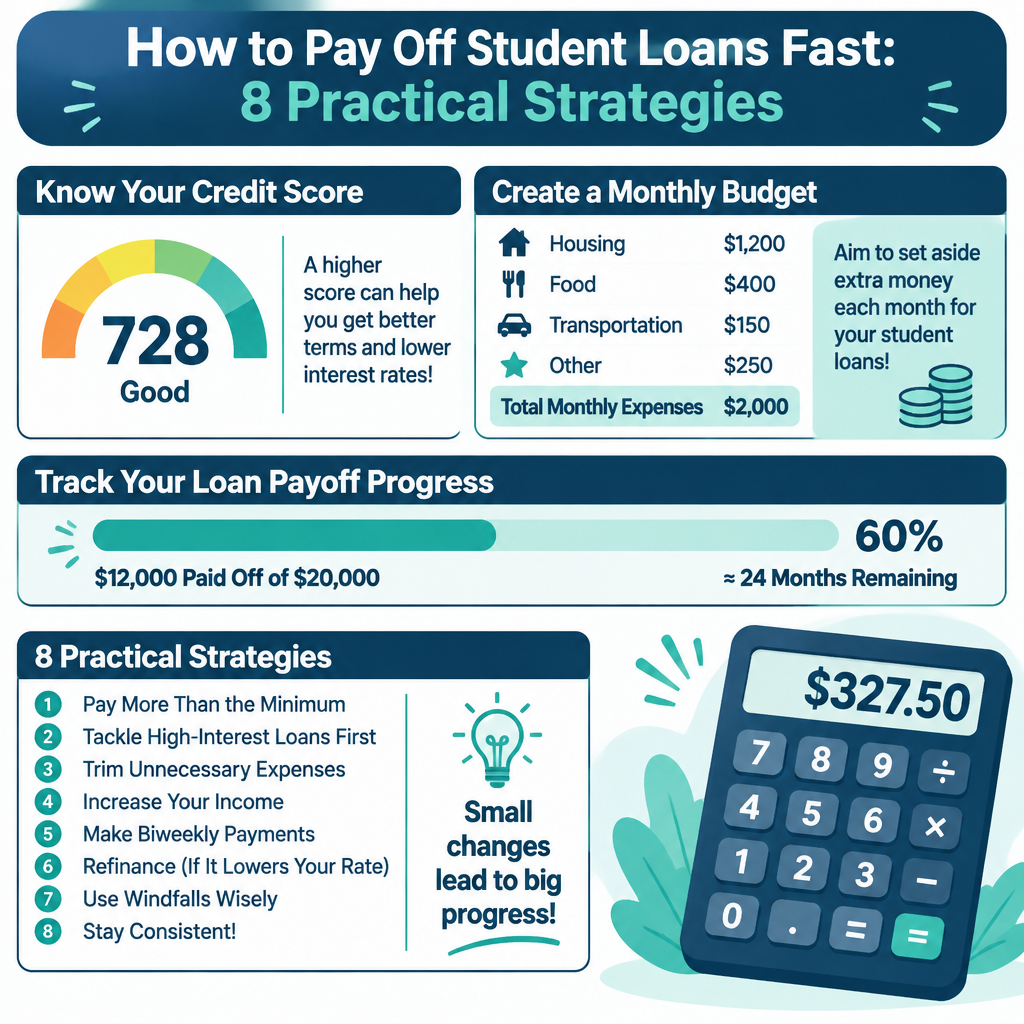
How to Pay Off Student Loans Fast: 8 Practical Strategies
Paying off student loans fast means sending more money toward your balance than the required payment, while protecting essentials such as emergency savings and retirement contributions. The best plan depends on your interest rates, loan protections, budget, and eligibility for forgiveness. A faster payoff can cut interest, but reckless repayment can leave you short when real life sends a bill.
Key Takeaways
- Add extra payments when your budget can support them, and tell your servicer how to apply the money.
- Combine steady tactics—such as higher payments, employer help, and windfalls—rather than relying on one dramatic move.
- Keep an emergency cushion, and compare the value of federal loan protections before refinancing.
- Use payoff estimates as examples, not promises: your balance, rate, payment timing, and servicer rules matter.
There is no prize for paying a loan early if the strategy leaves you unable to cover rent, groceries, insurance, or an unexpected car repair. I favor plans that work in an ordinary month, not just in a perfect one. A small, repeatable overpayment often beats a heroic payment followed by credit-card debt.
The figures below use the examples provided: a $20,000 balance, fixed rates, and regular payments. Actual results vary with loan terms, interest accrual, payment processing, and any fees. Before changing a federal repayment plan, check current options through the Federal Student Aid repayment-plan guide and your servicer.
What Is Paying Off Student Loans Fast?
Paying off student loans fast is a repayment approach that shortens the time you carry education debt by directing extra cash toward principal, reducing the interest rate, or making payments more frequently. It can involve federal loans, private loans, or a mix of both. The phrase sounds simple. The decisions behind it are not.
A normal monthly payment covers interest that has accrued and reduces principal according to the loan’s terms. When you pay above the amount due, the extra can reduce principal sooner, which may lower the interest charged later. But payment systems can apply extra money in ways you did not intend—for example, treating it as an advance toward a future bill. Check your account settings and give clear instructions.
The main variables are your balance, annual interest rate, repayment term, required monthly payment, and payment timing. A high-rate private loan is usually a stronger candidate for extra payments than a low-rate loan with valuable federal protections. That does not mean the smallest balance always comes first. It means your plan should reflect both the math and the risks you would give up by changing it.
Federal and private loans are not interchangeable. Federal loans may include income-driven options, qualifying forgiveness programs, deferment, or forbearance rules. Refinancing federal debt with a private lender permanently gives up federal benefits attached to those loans. The Consumer Financial Protection Bureau’s refinancing guidance explains why a lower rate alone does not settle that decision.
I have analyzed repayment examples where borrowers focus on the interest rate and ignore the exit doors attached to the loan. That is a mistake. A loan is a financial obligation, but a borrower’s health, job stability, dependents, and future eligibility also matter. Pay debt with discipline, not tunnel vision.
Core Benefits and Importance
The obvious benefit is less interest. The less obvious one is flexibility. Once a loan is gone, the payment can be redirected toward retirement savings, a home deposit, childcare, or other needs. A debt-free month can feel like a raise, though the cash only becomes useful if you give it a job.
Paying faster can also reduce the years you spend exposed to rate changes on variable-rate private loans. It may simplify a household budget, especially when you have several separate bills. And it can create psychological momentum: watching the balance fall is more satisfying than watching a minimum payment barely move it. Frankly, motivation matters—but it should support the numbers, not replace them.
Here are the practical benefits:
- Lower interest costs: Extra principal payments can reduce the balance on which future interest is calculated. The effect grows when you make extra payments early and consistently.
- Earlier cash-flow relief: Eliminating a monthly bill frees money for other priorities. Do not count that money twice in your budget before the loan is actually paid off.
- Fewer years in debt: A shorter repayment period can reduce the chance that a job change, family expense, or other setback disrupts your long-term plan.
- More control over your portfolio: With debt handled, you can allocate more toward retirement accounts or other investments. Compare the loan’s interest cost with your goals; do not assume an investment return is guaranteed.
- A clearer financial plan: A payoff target can make budgeting concrete, especially when you track balances and review progress every few months.
But fastest is not always best. If you have no emergency fund, are missing an employer retirement match, or may qualify for federal forgiveness, sending every spare dollar to loans can cost you elsewhere. The Federal Student Aid guide to loan forgiveness is worth reviewing before you pay extra on potentially eligible federal debt.
The point is stewardship: use income responsibly while meeting obligations to yourself and the people who depend on you. The dignity of work includes earning and providing; a repayment plan should not require you to neglect health or family responsibilities to look impressive on a spreadsheet.
Step-by-Step Guide: 8 Ways to Pay Off Student Loans Quickly
Start with the basic figures. List each loan’s balance, rate, minimum payment, type, and repayment terms. Then pick one or more methods below. Combining a few modest changes often works better than betting everything on a single tactic.
Increase your monthly payment
This is the most direct method. If your budget can handle an extra $25, $50, or $100 a month, set that amount to go toward the loan rather than leaving it to chance. Even a manageable increase can shorten repayment and cut interest because the balance declines sooner.
For example, a $20,000 loan at 6% with a standard 10-year payment has a payment of about $222 a month. Paying $300 instead would clear it about 39 months early and save roughly $2,258 in interest, assuming the rate and payment schedule stay as described. Contact your servicer or check your online account to set the amount. Confirm that extra payments reduce principal and are not simply counted as future installments.
Switch to biweekly payments
If your pay arrives every two weeks, splitting the monthly payment into two halves can make budgeting easier. There are 26 biweekly pay periods in a year, so paying half the monthly amount every two weeks adds up to 13 full monthly payments rather than 12. That extra annual payment can shorten the schedule without requiring a large one-time contribution.
On the $20,000 example at 6%, the stated estimate is a payoff in about nine years, with roughly $762 less interest than a 10-year schedule. Check how the servicer processes partial payments and make sure each one is credited when intended. Here’s the kicker: a calendar trick only works if you actually make all 26 half-payments and do not miss a due date.
Ask about employer repayment assistance
Some employers contribute directly to employees’ student loan payments. The International Foundation of Employee Benefit Plans reported that 14% of employers offered this benefit in 2024, up from 4% in 2019. Ask Human Resources whether the benefit exists, how much it covers, when you qualify, and whether you need to remain employed for a minimum period.
A $100 monthly employer contribution toward the $20,000 example at 6% could shorten repayment by about 46 months and save roughly $2,638 in interest, based on the stated assumptions. Read the eligibility rules before counting on the money. If your employer does not offer assistance, you can ask whether it would consider adding the benefit, but do not treat a request as a promise.
Put part of windfalls toward the balance
Tax refunds, work bonuses, gifts, and inheritances can make a useful lump-sum payment. You do not have to put the entire amount toward debt. Set aside money for taxes, essential repairs, or near-term bills first; then send a deliberate portion to the loan.
A $3,052 refund—the average cited for the 2025 tax season in IRS filing-season statistics—would make a meaningful dent in a $20,000 balance. If you made a similar lump-sum payment each year in the example, alongside the regular scheduled payments, the loan could be paid off in just under four years. Your refund will differ, and the estimate depends on assumptions. Do not borrow or overspend in anticipation of a refund that has not arrived.
Use the debt snowflake method
A debt snowflake is a small, one-off amount sent to a loan whenever you save or earn a little extra. That could be cash-back rewards, money saved with a coupon, or a small amount left over after a planned purchase. Move the amount into a dedicated loan-payment fund, then make an extra payment when it is practical.
No single snowflake will transform a large balance. The method can still build a habit and make your progress visible. Be sensible about rewards: do not spend more to earn cash back, and do not carry credit-card interest for a small student-loan payment. When the money reaches your servicer, specify how it should be applied to principal.
Boost your income without burning out
A raise, overtime, a better-paying role, or a side job can create room for faster repayment. Tutoring, freelancing, delivery work, and other paid skills are options, but the right choice depends on your schedule, health, and local demand. Decide in advance what share of extra take-home pay will go to debt.
For example, adding $300 a month to the roughly $222 regular payment on a $20,000 loan at 6% could clear the balance in about 43 months, under the stated assumptions. Track expenses and taxes associated with side income, and do not assume gross earnings are spendable cash. Let’s be real: a side hustle that wrecks your health or main job can be a bad financial trade.
Consider refinancing—with caution
Refinancing replaces one or more existing loans with a new private loan. A lower rate can reduce interest, while a shorter term can make the loan disappear earlier. A $20,000 loan refinanced from 7% to 5% with a seven-year term would raise the monthly payment by about $50 compared with a 10-year loan, but save approximately $4,120 in interest and finish three years sooner, based on the stated example.
That calculation is not a recommendation to refinance every loan. If you refinance federal loans privately, you lose federal repayment options and protections for those loans. Compare fixed and variable rates, fees, hardship provisions, cosigner terms, and the actual total cost. Refinancing private loans may be attractive when the replacement terms are genuinely better, but check the new contract rather than relying on a rate quote alone.
Enroll in autopay
Automatic payments can reduce the risk of forgetting a due date, and some lenders offer an interest-rate discount for enrolling. The discount varies. Federal Direct Loans generally offer a 0.25 percentage-point reduction for eligible automatic debit, while some private lenders advertise larger discounts, in certain cases up to 1.00%. Confirm the terms with your servicer; do not assume every lender offers the same break.
Autopay by itself may not dramatically shorten repayment, but a lower rate can compound with extra payments over time. Keep enough money in the linked account before the withdrawal date and review statements regularly. Automation helps with routine tasks; it does not excuse you from checking the account.

Comparison: Accelerated Repayment vs. Minimum Payments
The main alternative to an accelerated strategy is paying only the required amount on the standard schedule. Neither choice is automatically correct. Minimum payments preserve cash for other goals, while extra payments can reduce total interest and shorten the debt period. The better option depends on loan terms, risk tolerance, cash reserves, and forgiveness eligibility.
The table uses the $20,000 example and figures described above. Results are estimates, not lender quotes. Each accelerated tactic is shown on its own; do not add the savings together as if the math were independent. Combining methods changes the balance and timing, so the actual result requires a fresh calculation.
| Approach | Example payment or action | Approximate payoff | Approximate interest effect |
|---|
| Standard 10-year schedule | About $222 monthly on $20,000 at 6% | 10 years | Baseline |
| Pay more each month | $300 monthly | About 39 months earlier | About $2,258 saved |
| Biweekly payments | Half the monthly bill every two weeks | About 9 years | About $762 saved |
| Employer assistance | Employer adds $100 monthly | About 46 months earlier | About $2,638 saved |
| Annual windfall | About $3,052 paid once a year, plus regular payments | Just under 4 years in the example | Depends on payment timing |
| Refinance example | 7% to 5%, with a 7-year term | 3 years earlier than 10-year term | About $4,120 saved; payment rises about $50 |
Minimum payments can make sense if you need liquidity, qualify for a forgiveness route, or have higher-priority debt. Accelerated repayment can make sense when the emergency fund is adequate, the rate is costly, and you have no valuable benefit to preserve. I would compare more than the monthly payment. Look at total interest, total paid, payoff date, and what protections disappear.
For an apples-to-apples comparison, use the same starting balance and include any fees or rate changes. A lower payment created by stretching the term is not necessarily a better deal. Likewise, a large monthly payment that leaves no room for a financial shock is not a sound plan merely because it wins on interest.
Common Mistakes to Avoid
The most common error is sending every spare dollar to student debt before building any cash cushion. A broken appliance or medical bill can then land on a high-interest credit card, undoing part of the interest savings. Start with a reserve you can actually reach. A $500 to $1,000 buffer can cover many routine surprises; work toward three to six months of expenses over time, adjusting for job stability and household needs.
Another mistake is ignoring federal benefits. Borrowers who may qualify for income-driven repayment or forgiveness should check the current rules before paying extra or refinancing. Paying more than required could reduce the amount that might otherwise be forgiven, though eligibility and program terms vary. Get current information from official sources, and keep records of qualifying payments and employment where relevant.
A third mistake is failing to tell the servicer what to do with extra money. Some systems may treat an overpayment as an advance toward a future bill, rather than reducing the principal as you intended. Confirm payment allocation, check the next statement, and keep a record of instructions. The details are dull. They still affect the result.
Do not assume a lower rate always wins. A variable rate can rise, a short term can strain your budget, and refinancing federal loans can remove protections that are difficult or impossible to restore. Compare the loan contract, not just the headline rate. Ask what happens during unemployment, disability, or financial hardship.
Be wary of paying off a low-rate student loan while leaving higher-rate credit-card debt untouched. Usually, the costlier balance deserves attention first, after minimum payments and a basic emergency reserve. Also avoid treating a projected investment return as a guaranteed substitute for paying debt. The comparison is not simply “market return versus loan rate”; taxes, volatility, time horizon, and the value of liquidity all matter.
Finally, do not build a repayment plan that depends on constant overtime or a side hustle you can barely sustain. A good plan survives ordinary setbacks. Review it every three to six months, especially after a raise, a change in household expenses, or a change in loan terms.
Frequently Asked Questions
Should I pay off student loans early or invest?
It depends on the interest rate, your emergency savings, workplace retirement match, tax situation, and comfort with investment risk. Paying down a loan produces a more predictable saving in interest than an uncertain market return, but investing may be sensible for long-term goals when the loan rate is low and your finances are stable. Consider both rather than treating the decision as all or nothing.
Does paying extra reduce my student-loan principal?
It can, but confirm your servicer’s payment-allocation rules. Tell the servicer to apply extra money to the principal or the loan you selected, and check your statement afterward. Keep making the required payment unless the servicer confirms a different due amount; an extra payment does not necessarily satisfy your next bill.
Is refinancing federal student loans a good idea?
It can lower the interest rate for some borrowers, but refinancing federal loans with a private lender permanently gives up federal benefits attached to those loans. Review repayment options, potential forgiveness eligibility, and hardship protections first. A lower rate is not worth much if you lose a benefit you may need.
How much should I keep in savings before making extra payments?
There is no single amount for every household. A starter reserve of $500 to $1,000 can help cover common bills, while a longer-term goal is often three to six months of essential expenses. Consider job stability, dependents, health costs, and access to other resources. Keep adding to savings while paying loans rather than waiting for a perfect fund before doing anything.
Final Thought
Paying student loans quickly is not a contest. It is a choice about where your next dollar does the most useful work. Start by protecting the basics, understand which loans carry the highest cost, and check whether federal options could be worth more than an early payoff. Then choose a monthly amount you can sustain and make sure your servicer applies extra money as intended.
When I run the numbers, consistency usually matters more than a clever trick. A reliable $50 extra payment, employer assistance, or a carefully chosen refund payment can add up without making the household fragile. Revisit the plan when your income or obligations change; there is no shame in slowing down during a difficult stretch.
Debt deserves attention, not panic. Responsible stewardship means paying what you owe while preserving the capacity to care for yourself and others. A sound plan leaves room for the unexpected, respects the protections attached to federal loans, and treats work and savings as parts of one financial life. That is faster repayment with your eyes open.