How to Pay Off Student Loans Fast: 8 Practical Strategies
Paying off student loans fast means making extra progress toward your balance without putting rent, emergency savings, retirement contributions, or other essential obligations at risk. The best plan depends on your interest rates, loan type, income, and eligibility for federal repayment or forgiveness programs. A few deliberate changes can shorten repayment and reduce interest.
Paying a loan off early can free cash for a home deposit, retirement investing, family needs, or other priorities. But speed alone is not a sensible measure of financial success. If you drain your savings to send a large payment, a car repair or medical bill may push you toward expensive credit-card debt—the sort of swap that leaves you worse off.
When I run the numbers, the biggest gains usually come from a clear order of operations: meet every minimum payment, secure a basic cash buffer, collect valuable workplace benefits, and then target high-rate debt. The details matter. Federal loans can carry repayment options and borrower protections that private loans do not, so a lower interest rate is not automatically a better deal.
What Does It Mean to Pay Off Student Loans Fast?
Paying off student loans fast means shortening the repayment period by paying more than the required amount, reducing the interest rate, or combining both approaches. Your regular payment generally covers accrued interest first, with the rest reducing principal; lowering principal sooner means less interest can build in later months. Exact results depend on the loan’s rate, balance, payment schedule, and servicer rules.
A federal loan and a private student loan are not interchangeable. Federal loans may offer income-driven repayment, deferment or forbearance options, and forgiveness pathways for borrowers who qualify. Private lenders set their own rates, eligibility rules, and hardship policies. The official Federal Student Aid loan-servicer information is a sensible place to confirm whom to contact and how to manage a federal account.
Here’s the catch. If you are pursuing a forgiveness program or a payment based on income, sending extra money may not help your overall plan. It can reduce the amount eventually forgiven, or divert cash from a more urgent goal. Before paying ahead, review the requirements and your expected total cost; Federal Student Aid explains income-driven repayment plans, though program terms can change and should be checked directly.
For ordinary repayment, extra payments can be a straightforward way to reduce principal, but the way you submit them matters. Some servicers may place an account in paid-ahead status after receiving more than the amount due. That can make the next bill smaller or push its due date out, while a borrower may have intended to keep paying the normal amount and shorten the loan instead. Contact the servicer, give clear instructions, and check the next statement to confirm how the payment was applied.
Why Faster Repayment Can Matter
The clearest benefit is interest savings. Interest is charged on the outstanding balance, so reducing principal earlier can lower the amount charged in future periods. The effect is strongest when rates are high and extra payments arrive early in the repayment schedule. It is smaller on a low-rate loan near payoff, where few months of interest remain.
Faster repayment can also free up monthly cash flow. Once a loan is gone, you can redirect that payment toward retirement, a home purchase, education costs, or another goal. Debt reduction can ease financial stress, too, although peace of mind is personal and should not be confused with a mathematical return.
There is a useful psychological benefit. A visible balance that falls each month can reinforce steady habits, and a small one-time payment can help make progress feel tangible. Frankly, motivation helps only when the plan is sustainable; a punishing budget that collapses after three months is not a winning strategy.
Consider the trade-off before you make extra payments. Money sent to a student loan is no longer available for an emergency, a retirement contribution, or another investment. Paying down a loan with a 7% rate offers a fairly clear interest saving, but it is not identical to earning a guaranteed 7% investment return after tax and risk. Nor should a borrower compare that rate with an optimistic market forecast as if the forecast were certain.
A balanced approach treats money as a resource to steward responsibly, not a scoreboard. That means honoring essential obligations, caring for dependents, and protecting the ability to respond to setbacks while making honest progress on debt. The right payoff target is the fastest pace your household can maintain without creating a more expensive problem elsewhere.
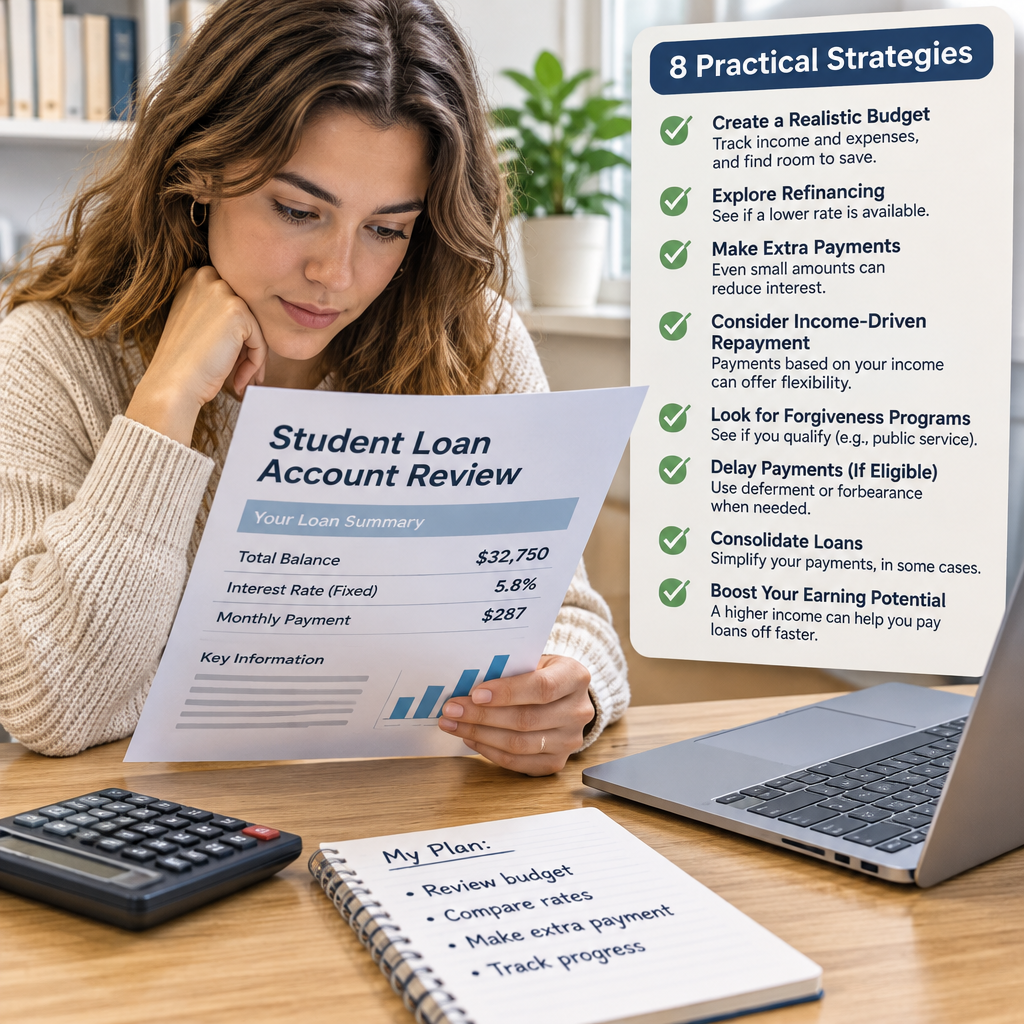
8 Ways to Pay Off Student Loans Quickly
- Increase your monthly payment. This is the simplest lever to control. Suppose you owe $20,000 at 6% with a standard 10-year payment of about $222 a month. Raising the payment to $300 could repay the loan roughly 39 months early and save about $2,258 in interest, assuming a fixed rate, monthly payments, and no fees. The estimate is illustrative, not a promise from a servicer. Set an amount that leaves room for essentials, and ask how additional money will be applied to principal.
- Try biweekly payments. Split the monthly payment in half and pay that amount every two weeks. Because a year has 26 two-week periods, you make the equivalent of 13 full monthly payments rather than 12. On the same $20,000 loan at 6%, that schedule may bring a 10-year payoff to about nine years and save roughly $762 in interest. Make sure the servicer accepts the timing you intend; simply sending half-payments early may not produce the same result if payments are held or processed differently.
- Ask about employer student-loan assistance. Some workplaces contribute directly to employees’ student debt, so check your benefits documents or ask human resources. An employer contribution of $100 a month toward the $20,000 example could shorten repayment by around 46 months and save approximately $2,638 in interest, depending on payment timing and terms. The IRS explains that employer educational-assistance programs may cover student-loan principal and interest when the program meets applicable requirements. Confirm eligibility, vesting rules, and tax treatment before counting the benefit in your budget.
- Put part of a windfall toward the balance. A tax refund, bonus, gift, or inheritance can make a useful one-time payment without permanently raising your monthly budget. The example in this article uses a $3,052 tax refund, a reported 2025 average; refund amounts vary by person and by filing season. Applying a payment of that size each year to a $20,000 loan, alongside regular monthly payments, could reduce a 10-year schedule to just under four years, depending on when each lump sum arrives. Keep enough of the windfall for near-term expenses first.
- Use the debt snowflake method. A snowflake is a small amount redirected to debt as it appears: cash-back rewards, a coupon saving, or money left over after a planned purchase. One $3 transfer will not transform a repayment plan, but recurring small contributions can add up and help build momentum. Collect the amounts in a separate account or make occasional extra payments, and verify their allocation. Don’t manufacture spending to earn rewards; interest or fees can wipe out the benefit.
- Increase income, if the extra work is worth it. A raise, overtime, a better-paying position, tutoring, freelancing, or occasional delivery work can create money for additional payments. For example, adding $300 a month to the regular $222 payment on a $20,000 loan at 6% could pay it off in about 43 months. That calculation assumes the full extra amount goes to the loan and that the rate stays fixed. Consider taxes, transportation costs, caregiving, and fatigue before committing; income that damages your health or main job may not be a bargain.
- Refinance private loans carefully. Refinancing replaces one or more loans with a new private loan, potentially at a lower rate or shorter term. In an illustration, refinancing $20,000 from 7% over 10 years to 5% over seven years raises the monthly payment by about $50, but can save roughly $4,120 in interest and finish three years earlier. Actual offers depend on credit, income, loan balance, and lender terms. The Consumer Financial Protection Bureau outlines important considerations when you refinance federal student loans: moving federal debt to a private lender generally ends access to federal benefits tied to those loans. Private-loan refinancing may be less complicated, but compare fees, variable-rate terms, and hardship provisions.
- Enroll in autopay and confirm the discount. Automatic debit can prevent missed payments and may reduce the interest rate. Federal Direct Loans commonly offer a 0.25 percentage-point interest-rate reduction for eligible automatic payments; private lenders set their own discounts and conditions. Don’t assume a discount of 1% or any other amount without checking your lender’s current terms. Keep enough money in the linked account, review statements, and remember that autopay alone usually will not dramatically shorten repayment. It works best alongside extra principal payments.
Accelerated Repayment vs. the Standard Schedule
A standard schedule offers predictable payments and a defined end date. An accelerated schedule adds money, changes payment timing, obtains a lower rate, or uses a combination of these moves. The accelerated option can reduce total interest, but it also commits more of your monthly cash to debt. That difference matters when income is irregular or savings are thin.
The figures below use the $20,000 example from above and are approximate. They assume fixed rates, timely monthly payments, no fees, and extra amounts applied as intended. Real servicer calculations may differ, especially when payment dates, compounding rules, loan groups, or rate changes differ.
| Approach | Approximate payment pattern | Approximate payoff | Approximate interest effect |
|---|
| Standard schedule: $20,000 at 6% for 10 years | $222 monthly | 10 years | About $6,645 interest |
| Pay $300 monthly | $300 monthly | About 81 months | About $2,258 less interest |
| Biweekly half-payments | $111 every two weeks | About 9 years | About $762 less interest |
| Add $100 employer contribution monthly | About $322 total monthly | About 74 months | About $2,638 less interest |
The standard schedule is the comparison point, not a failure. It can be reasonable when a borrower needs room for an emergency fund, retirement contributions, or federal repayment protections. Faster repayment is more attractive when the interest rate is high, the borrower has stable cash flow, and there is no forgiveness strategy worth preserving.
Here’s the kicker: the best-looking total in a table may not be the best choice for a real household. A seven-year refinance can save interest but demand a larger payment every month, even during a layoff or medical leave. Compare the required payment, not just the projected interest, and check whether a refinance has a fixed rate, a variable rate, fees, or limited relief options. Use lender disclosures and your actual loan statements rather than a generic calculator alone.
Common Mistakes to Avoid
Don’t drain every dollar of savings to make a dramatic payment. A modest emergency reserve—perhaps an initial $500 to $1,000, adjusted for your circumstances—can cover many small surprises, though it is not a full emergency fund. Build toward a larger reserve over time; three to six months of essential expenses is a common target, not a rule that fits every household. Without cash on hand, a repair can land on a credit card at a much higher rate than your student loan.
Don’t put low-rate student debt ahead of high-rate credit-card debt by reflex. If a card charges substantially more interest, paying it down first often saves more money, provided you keep making every student-loan minimum. Compare rates and fees, then direct extra payments to the costliest debt. Some borrowers prefer clearing a small balance for motivation, but the interest-rate-first method generally minimizes interest when all else is equal.
Don’t skip a full employer retirement match just to accelerate student-loan payments. A match is part of your compensation, and missing it can be an expensive choice. At the same time, do not assume every dollar belongs in a retirement account if you have unstable cash flow or very high-rate debt. Look at the match rules, vesting terms, loan rates, and household needs together.
Don’t refinance federal loans solely because an advertised rate looks low. Federal protections may matter if your income falls, you qualify for a specific repayment option, or you pursue a forgiveness program. The CFPB warns borrowers to weigh those lost benefits before replacing federal debt with private debt. Once refinanced, the new private loan generally cannot be converted back into a federal loan.
Don’t confuse an extra payment with a smaller principal balance unless you verify it. Ask the servicer whether you can direct extra amounts to a particular loan, request that the payment not simply advance your due date, and inspect the transaction history afterward. Federal Student Aid’s servicer guidance can help you identify the right contact for a federal account. Keep records of requests and confirmations; a quick check can prevent months of misunderstanding.
Finally, don’t make the budget so severe that it fails. Cutting every modest pleasure, ignoring health costs, or taking exhausting side work may work briefly and then rebound. A plan should respect the dignity of work, family responsibilities, and basic well-being. Choose an extra amount you can repeat, review it when your income or expenses change, and increase it only when the numbers still make sense.
Frequently Asked Questions
Is it smart to pay off student loans early?
It can be smart when you have a cash reserve, no more expensive debt, and no federal forgiveness or repayment strategy that would be harmed by extra payments. The benefit is strongest when the loan rate is relatively high and you have stable income. Compare the interest you expect to avoid with other uses for the same money, including an employer retirement match and essential savings. There is no universal rule that every borrower should pay early.
Should I pay the highest-interest student loan first?
Usually, yes. After making the minimum payment on every loan, directing extra money to the highest-rate balance generally reduces total interest fastest; this is often called the debt avalanche method. If one small balance is causing real stress, paying it off first can offer a motivational win, but it may cost more. Keep federal and private loan features in view, not only the rate shown on a statement.
Does refinancing student loans hurt federal benefits?
Refinancing federal student loans with a private lender generally removes access to federal repayment plans, forgiveness programs, and other protections attached to the federal loans. A private lender may offer different hardship options, but those are governed by its own contract. Compare the full terms and consider whether you might use federal benefits before accepting a refinance. Do not rely on a headline interest rate alone.
How much should I keep in savings before making extra payments?
There is no single amount for every borrower. Many people start with a small buffer, such as $500 to $1,000, then build toward several months of essential expenses while continuing regular loan payments. The right reserve depends on job stability, health, dependents, insurance, and access to other reliable support. Avoid sending cash to a loan if doing so would leave you unable to handle a likely emergency.
Paying off student loans quickly is not a contest. It is a series of choices about interest, security, time, and the other people who depend on your financial decisions. Start with the loan terms in front of you, not a stranger’s payoff timeline. Automate the required payment, keep a reserve, and make extra payments only after deciding where each dollar does the most good.
When I compare repayment plans, I look for a strategy that can survive an ordinary bad month, not just one that looks impressive in a spreadsheet. A small extra payment repeated for years can be more useful than a heroic payment followed by new high-rate borrowing. If your income rises, direct a portion of the increase to principal; if your circumstances tighten, protect essentials and revisit the plan. Consistent progress is still progress—and sound stewardship means leaving enough room to meet today’s responsibilities while preparing for tomorrow.