Student loans shrink fastest when extra money consistently reaches the balance. A larger payment, employer assistance, and occasional lump sums can shorten...
How to Pay Off Student Loans Fast: 8 Strategies That Protect Your Finances
Student loans shrink fastest when extra money consistently reaches the balance. A larger payment, employer assistance, and occasional lump sums can shorten repayment and reduce interest, but the right plan depends on your loan terms, cash reserves, and eligibility for federal benefits. The aim is speed without creating a new financial problem.
Fast repayment is a choice, not a virtue contest. A household with thin savings, high-interest credit-card debt, or an employer retirement match it is not using may be better off fixing those gaps before sending every spare dollar to a student loan. Frankly, a loan balance is only one part of a financial picture.
The figures below use a $20,000 loan at 6% interest as an illustration, not a promise about what every borrower will save. Payment timing, fees, loan type, and how a servicer processes money can change the result. Check your current statements and terms before changing a payment schedule.
What Does It Mean to Pay Off Student Loans Fast?
Paying off student loans fast means paying more than the required amount, when doing so fits your broader plan, so the balance is cleared before the scheduled end date. Interest generally accrues over time on the outstanding balance; paying principal down sooner can reduce the amount on which future interest accrues. The exact calculation depends on the loan’s rate, repayment method, and payment dates.
That distinction matters. A payment larger than the minimum does not always reduce principal by the entire extra amount right away. Under standard payment allocation, outstanding fees or interest may be handled first, and only the remainder reduces principal. Servicer procedures differ, so ask how the payment will be applied and check the next statement. The Consumer Financial Protection Bureau explains the role of a student loan servicer.
Federal and private loans also come with different trade-offs. Federal borrowers may have access to repayment plans and forgiveness programs based on current rules and eligibility. Paying extra can be a poor fit if it reduces the balance that might otherwise qualify for forgiveness. Before accelerating federal debt, use the Department of Education’s Loan Simulator and review applicable program requirements, including Public Service Loan Forgiveness.
Private loans have no federal forgiveness programs, but their terms vary by lender. Refinancing may lower a private loan’s rate for a borrower who qualifies, though a variable rate or longer term can change the risk and total cost. I compare the payoff schedule, not just the advertised monthly payment: a smaller payment can conceal a longer, more expensive repayment period. The useful question is whether extra payments improve your actual position after savings, benefits, and other debts are considered.
Why Faster Repayment Can Matter
The clearest benefit is reduced interest. On a fixed-rate loan, the interest cost is tied to the balance and time outstanding, so principal payments made earlier can prevent some later interest from accruing. In the example used here, a $20,000 balance at 6% with a 10-year schedule has a payment of about $222 a month. Paying $300 monthly can clear it in roughly 82 months rather than 120, saving around $2,250 in interest. Your loan may behave differently.
Faster payoff can also free up monthly cash flow. Once the debt is gone, the old payment can be redirected to retirement contributions, a home deposit, childcare, or a reserve for unexpected expenses. That flexibility can matter more than the emotional satisfaction of seeing a zero balance. Here’s the kicker: a faster payoff only improves your finances if the money is not more urgently needed elsewhere.
There are reasonable non-financial benefits, too. Fewer outstanding obligations can make a household budget easier to manage, and a clear payoff target can help some borrowers stay engaged. But debt freedom is not worth draining every dollar of liquid savings. A surprise car repair, medical bill, or gap in employment can push someone toward high-rate borrowing, which may undo the interest saved on a student loan.
A sensible priority order is personal. Keep required payments current, build a cash buffer suited to your income and responsibilities, capture any valuable employer retirement match, and compare the loan rate with other debt. Credit-card balances at much higher rates often deserve attention first. Good financial stewardship is not simply paying one creditor as quickly as possible; it is using limited resources responsibly while meeting obligations to the people who depend on you.
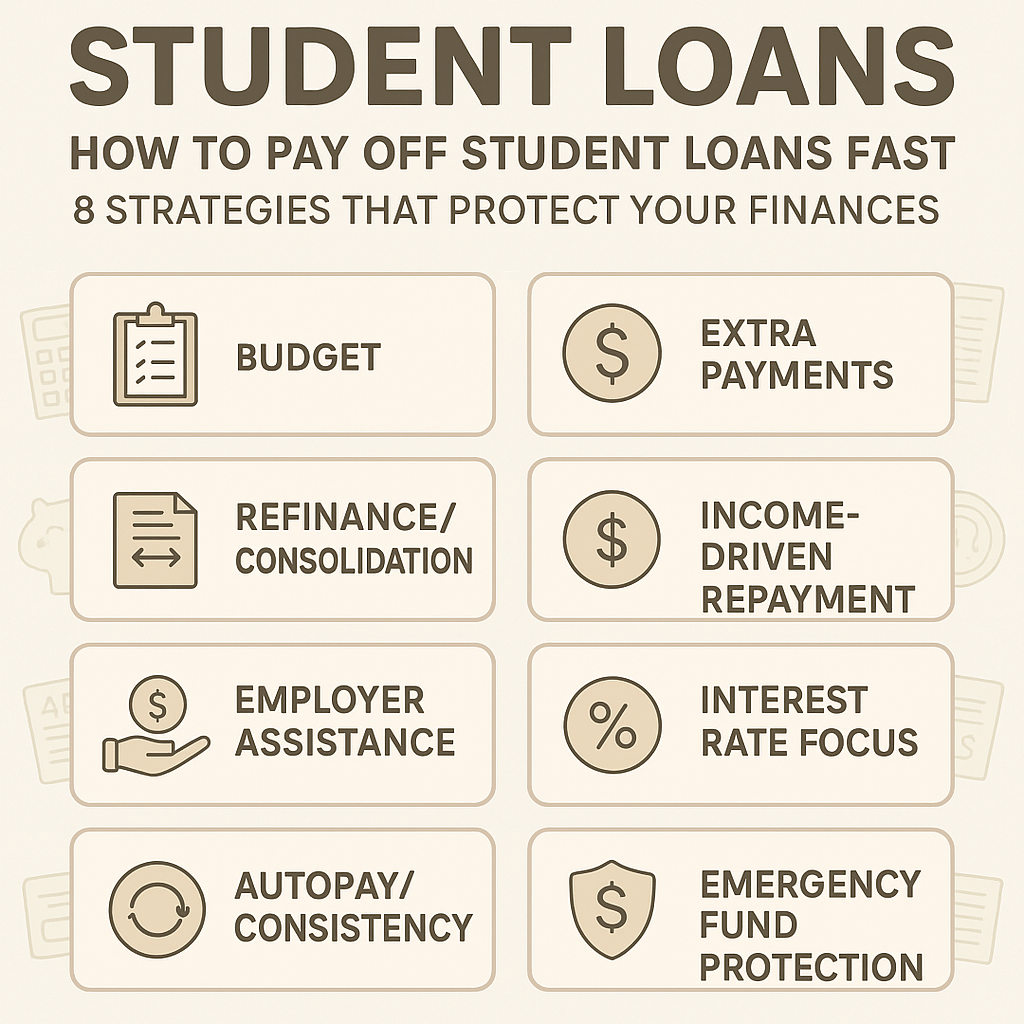
8 Ways to Pay Off Student Loans Quickly
Use the options that fit your budget. Combining two or three sustainable methods often works better than relying on one drastic change.
- Increase your monthly payment. Pick an amount you can sustain, then make it automatic. On the $20,000, 6% example, the scheduled payment is about $222; paying $300 monthly shortens repayment by roughly 38 months and saves about $2,250 in interest, assuming payments are processed as expected. That is meaningful, but not worth missing rent or a minimum payment elsewhere. Ask the servicer how to direct the extra amount to the loan you intend to pay down, and confirm that it does not merely advance your next due date. Check the statement afterward. Small errors can persist for months if nobody looks.
- Use a biweekly schedule—or make one extra payment a year. If you are paid every two weeks, setting aside half a monthly payment from each paycheck can make budgeting easier. Twenty-six half-payments add up to 13 full monthly payments rather than 12. In the example, that extra annual payment can cut repayment by about a year and save roughly $760 in interest, though the precise result depends on when the servicer posts each payment. Some servicers may hold partial payments until a full installment is due. Ask first, and watch for fees or processing rules. The simpler alternative is to make one extra payment each year when cash flow allows.
- Ask about employer student-loan assistance. Check your benefits portal or ask human resources whether your employer contributes toward eligible student debt. The International Foundation of Employee Benefit Plans reported that 14% of employers offered student-loan repayment assistance in 2024, compared with 4% in 2019. Plans differ: eligibility dates, contribution limits, eligible loans, and tax treatment need checking before you count on the money. As an illustration, an employer contribution of $100 monthly toward the example loan could shorten repayment by roughly 46 months and save around $2,638 in interest, depending on timing and payment application. If no program exists, raising the subject is fair—but do not treat an unapproved benefit as part of your budget. International Foundation of Employee Benefit Plans
- Put part of windfalls toward the balance. A tax refund, work bonus, cash gift, or inheritance can reduce principal in one stroke. For scale, a $3,052 lump-sum payment is a substantial addition to a $20,000 balance. If you receive a similar amount regularly and apply it alongside scheduled payments, the loan could be paid in about four years rather than ten, depending on when the money arrives and how much you devote to debt. You do not have to send the whole windfall. Set aside what you need for taxes, near-term expenses, and savings, then choose a deliberate share for repayment. A plan beats an impulsive transfer.
- Try the debt snowflake method. A snowflake is a small, unplanned extra payment: cashback, a refunded purchase, or a modest amount left after a grocery run. Move these small sums into a dedicated payoff fund and send them to the loan on a regular schedule. A few dollars will not transform the balance overnight, and it is not worth spending hours chasing tiny discounts. The method can work because it turns scattered savings into a visible contribution and helps build a habit. Keep the minimum payment on autopay, then make sure snowflake payments go to the intended loan and are not treated only as payments due in future months.
- Use the debt avalanche for multiple loans. Pay the minimum on every loan, then aim extra money at the loan with the highest interest rate. When it is cleared, roll that payment into the next-highest rate. This approach generally minimizes interest when rates and terms are compared on a like-for-like basis. A different method, paying the smallest balance first, can provide a quick psychological win; that may help some people stay consistent, although it can cost more if a much higher-rate loan is left untouched. I would compare the balances and rates before choosing. If the rate difference is large, the arithmetic deserves a vote.
- Check for an autopay interest-rate reduction. Some federal and private loan servicers offer a modest interest-rate discount when you enroll in automatic payments; the amount and eligibility depend on the loan and servicer. Read the terms and confirm the discount appears on your account. Autopay can reduce missed-payment risk, but it does not replace a payoff plan, and you still need enough cash in the linked account on the withdrawal date. A declined payment can trigger fees or other trouble under the loan agreement. Set a calendar reminder to review the balance and payment history. Convenience is useful; blind trust is not.
- Consider refinancing private loans carefully. A lower fixed rate can reduce interest cost or help you pay down a private loan faster if you keep paying the old amount after refinancing. Compare the annual percentage rate, fees, repayment term, rate type, and any co-signer release provisions. Do not choose a longer term merely because it lowers the monthly bill; that can increase total interest. Refinancing federal loans into a private loan also gives up federal protections and potential eligibility for federal repayment or forgiveness programs. That change is generally difficult or impossible to reverse. If federal benefits matter to you, do not trade them away for a rate discount without careful analysis.
Accelerated Repayment vs. Standard Repayment
The largest competitor to accelerated payoff is simply following the scheduled payment plan. That approach can preserve more cash each month, while extra payments can reduce the interest bill and end the debt earlier. The table uses an illustrative $20,000 balance at 6% with a 10-year repayment schedule; figures are rounded and assume the rate and payment processing remain as described.
| Measure | Standard scheduled payment | Accelerated payment |
|---|
| Example monthly payment | About $222 | $300 total |
| Approximate payoff period | 120 months | About 82 months |
| Approximate interest paid | About $6,645 | About $4,350 |
| Approximate interest saved | — | About $2,250 |
| Monthly cash available now | More | Less |
The accelerated case pays around $78 more each month than the scheduled amount. That difference is the price of speed; it is not free money. If it causes you to carry a credit-card balance, skip an employer match, or leave yourself without a cash reserve, the trade may be poor even if the loan’s interest math looks attractive.
A repayment plan is not a contest. Federal borrowers can compare official options with the Department of Education’s Loan Simulator, while borrowers should check their own promissory note and statements for rates, fees, and servicing terms. A lower required payment might be useful during a tight period, even if it does not minimize interest over the full life of the debt. Choose based on the full household picture, not a single column in a table.
Common Mistakes to Avoid
Draining savings to make one dramatic payment. A large principal reduction feels decisive, but an empty bank account leaves little room for a job interruption or urgent bill. Keep a reserve that reflects how stable your income is, who relies on it, and what expenses could arise. There is no single emergency-fund number that fits every borrower. If you need to rebuild cash after an extra payment, the apparent progress may not be progress at all.
Paying federal loans early without checking forgiveness eligibility. Borrowers pursuing Public Service Loan Forgiveness or another federal program should review current rules and their own qualifying-payment record before paying beyond the required amount. Extra payments may reduce a balance that might otherwise receive qualifying treatment, and repayment rules can change. Use official federal resources, keep records, and seek qualified tax or financial advice where the consequences are unclear. A bold payoff target is no substitute for reading the program terms.
Assuming all extra money goes straight to principal. Servicers may apply amounts to fees and accrued interest first, and payment instructions can affect which loan receives the money. Ask for the allocation you want, keep confirmation, and review the next statement. The CFPB’s guidance on working with a student loan servicer is a useful starting point if you are unsure who handles your account. Frankly, never assume a payment was handled exactly as you intended just because the bank transfer cleared.
Refinancing federal debt for a lower rate without pricing the lost protections. A private lender’s rate quote does not include access to federal repayment plans or federal forgiveness programs. Variable rates can rise, and a longer term can increase total interest even if the monthly payment drops. Compare the full cost and protections before signing. If you are unsure whether a federal option applies, verify it through official sources rather than relying on a refinance advertisement.
Confusing payment frequency with payment amount. Biweekly payments help only if the schedule creates an additional annual payment or changes when money is credited in a useful way. If a servicer holds half-payments, you may not receive the timing benefit you expected. Confirm the policy and avoid services that charge a fee merely to arrange payments you can make yourself. A straightforward extra payment may accomplish the same goal with less fuss.
Ignoring higher-rate debt and the tax details. A student-loan interest deduction may be available to eligible taxpayers, subject to current law and income rules; consult the IRS’s Topic 456 guidance or a tax professional rather than assuming you qualify. Also compare student-loan rates with credit-card or other debt rates. Paying the lowest-rate loan first can be emotionally satisfying, but it may not be the best use of an extra dollar.
Frequently Asked Questions
What is the fastest way to pay off student loans?
The most direct method is to pay more than the required minimum and direct the extra amount to the loan with the highest interest rate, while keeping every other loan current. The best route changes if you are likely to qualify for federal forgiveness, have expensive debt elsewhere, or lack emergency savings. First check the terms, then choose an extra amount you can sustain month after month.
Do biweekly student loan payments save money?
They can, particularly if paying every two weeks results in 13 full monthly payments each year. The exact savings depend on payment timing and the servicer’s processing rules; some may hold partial payments. Ask how the payments are credited and compare the result with simply making one extra monthly payment annually. Do not pay a fee for a schedule you can manage directly.
Should I pay off student loans or build savings first?
Usually, do not leave yourself with no accessible cash just to pay a loan faster. Keep a reasonable reserve for likely emergencies, make all required debt payments, and consider any valuable employer retirement match and higher-rate debt. The right balance depends on job stability, family responsibilities, and loan terms. A little less speed can be a sound trade for resilience.
Should I refinance federal student loans to get a lower rate?
Think carefully before doing so. Refinancing federal loans with a private lender can remove federal repayment and forgiveness options, and the change is generally irreversible. A lower rate may look appealing, but compare it with the value of the protections you would lose and the total cost across the new term. Verify current eligibility and rules through official federal resources before making a decision.
Final Thought
The best payoff plan is one you can follow without turning a manageable loan into a fragile household budget. Automate the minimum, protect enough cash for real emergencies, and choose a modest extra amount that does not compete with more urgent needs. Then review the balance every few months. If income rises, a bonus arrives, or another debt disappears, increase the payment deliberately rather than promising yourself an unsustainable sprint.
I would judge progress by more than the loan’s remaining balance. Are payments current? Is the interest cost falling? Do you still have room for savings and the people who depend on your income? Those questions matter because money is a tool entrusted to us, not a scoreboard. Responsible stewardship can mean paying debt quickly; it can also mean keeping a buffer, honoring family obligations, and avoiding a risky trade of federal protections for a marginally lower rate.
There is no prize for reaching zero debt a few months sooner if the method leaves you exposed. Use the numbers, check the fine print, and make extra payments when they genuinely improve your position. Consistency does the heavy lifting. A sensible plan, repeated over time, is usually stronger than one dramatic gesture followed by a financial scramble.