How to Pay Off Student Loans Fast: 8 Strategies That Protect Your Finances
Paying off student loans fast means directing more money than required toward principal, choosing the right repayment order, and avoiding moves that weaken your financial safety net. The soundest plan weighs interest savings against emergency savings, employer benefits, federal forgiveness eligibility, and the need to keep cash available for essential expenses.
A quick payoff is not automatically a good payoff. If you drain savings, miss a retirement match, or surrender a valuable forgiveness path, the interest saved may not make up for the cost. The practical target is the earliest date you can reach without creating a new financial problem.
The figures in this guide use a simple example: a $20,000 balance at 6% interest. Actual results vary with loan type, payment timing, fees, servicer rules, and whether interest continues to accrue. Use your own balances and terms for decisions, and confirm details with your lender or servicer. Frankly, a repayment plan only works if you can keep following it when an ordinary expense lands in your lap.
What Does It Mean to Pay Off Student Loans Fast?
Paying off student loans fast means making payments above the required amount, then ensuring the extra money reduces the balance that accrues interest. That sounds straightforward. The details matter.
A student loan payment may cover interest that has accrued since the last payment, then reduce principal. Principal is the amount borrowed that remains unpaid. Interest is the cost of borrowing, usually calculated from the outstanding balance and the loan’s rate. As principal falls, future interest generally has less balance to accrue against. That is why even moderate extra payments can have a larger effect when made early in repayment.
But “fast” is relative. One borrower may aim to clear private loans before starting a family, while another may reasonably keep federal loans on an income-based path because they expect to qualify for a forgiveness program. A borrower who has no cash reserve may be better served by building a small emergency fund before sending every spare dollar to a lender. The best repayment speed depends on the rate, loan protections, income stability, and other financial obligations—not on a slogan.
I start by separating loans by type and terms. List each balance, interest rate, minimum payment, and whether it is federal or private. Then check for any forgiveness eligibility, special repayment conditions, and benefits tied to the loan. The Federal Student Aid repayment plan information explains federal options, while the Loan Simulator can help compare estimates. Federal rules and programs can change, so verify current eligibility before making a large extra payment.
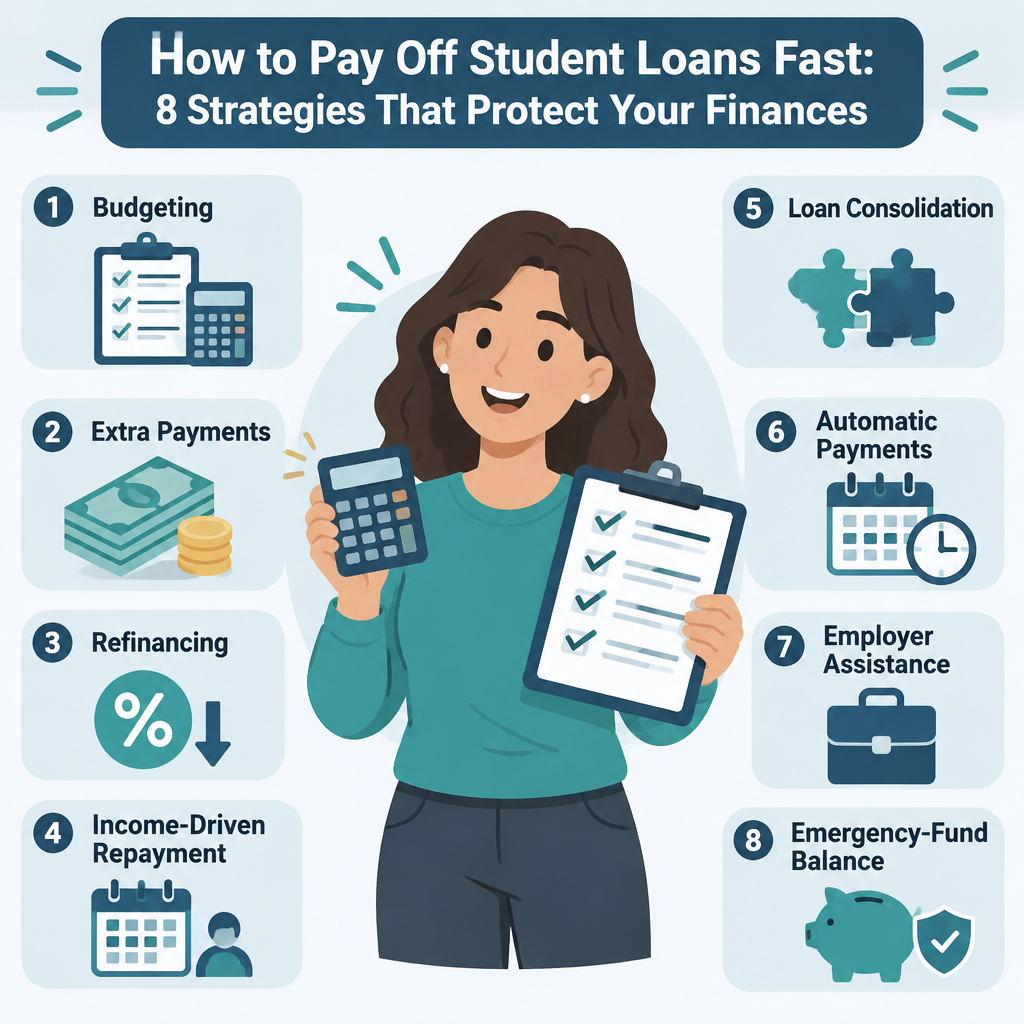
The distinction between federal and private loans is important. Federal loans may carry options such as qualifying income-driven repayment or Public Service Loan Forgiveness, subject to current rules and eligibility. Private loans generally have different protections and lender-specific terms. Refinancing a federal loan into a private loan can remove access to federal programs and protections. A lower rate is not a bargain if it costs you a benefit worth more.
Why Paying Student Loans Faster Can Matter
The clearest benefit is lower interest expense. With less principal outstanding, less interest can accrue over time, assuming the rate and other terms stay the same. Extra payments can also shorten the period when a job loss, rate change on a variable-rate loan, or other disruption might make the debt harder to manage.
There is a cash-flow benefit later. Once a loan is paid off, the amount that used to go to the lender can be redirected to saving, investing, a home deposit, or other obligations. That flexibility is valuable, especially when a borrower has several competing goals. But be patient: paying debt down is not the same as immediately having more money. Until the loan is gone, extra payments reduce cash available today.
A faster payoff can also simplify household finances. Fewer balances mean fewer due dates and fewer opportunities to miss a payment. That is useful, though not magical. If a borrower has high-interest credit-card debt, no emergency savings, or unpaid taxes, student loans may not be the most urgent use of extra cash. Rank obligations by their costs, risks, and consequences, not by which balance feels most irritating.
Here’s the kicker: the best strategy may be not to accelerate every loan. If you are pursuing a qualifying forgiveness program, making payments beyond what the program requires might simply send money to a balance that could otherwise be forgiven. Confirm the program’s rules and track qualifying payments carefully before changing your approach. The Consumer Financial Protection Bureau’s student-loan guidance is a useful starting point for understanding borrower questions and repayment issues.
A sound plan also preserves basic stability. Keep required payments current, maintain a reasonable cash reserve, and account for insurance, housing, food, and other necessary expenses. A budget is a tool of stewardship, not a scorecard; a plan that protects your household’s needs and treats obligations responsibly is better than a dramatic payoff date built on fragile finances.
How to Pay Off Student Loans Fast: An Eight-Step Plan
Use these approaches together when they fit. You do not need to use all eight, and some are more powerful than others. Start with the steps that save the most or cost the least to implement.
- Increase your monthly payment. This is the simplest direct method. In a $20,000 loan example at 6% with a standard 10-year payoff, the payment is about $222 a month. Raising it to $300 can pay the balance off roughly 39 months early and save about $2,250 in interest, assuming a fixed rate, regular monthly payments, and no fees. The exact result varies. Before changing an automatic payment, check with the servicer and state how the extra amount should be applied. The CFPB explains how to make extra payments on student loans. If the servicer lets you choose, direct extra funds to principal or to a specific loan rather than simply advancing your next due date. Then check a statement to make sure the payment was handled as requested.
- Try biweekly payments—or make one extra payment a year. If you are paid every two weeks, paying half of your monthly amount with each paycheck can make budgeting easier. There are 26 biweekly pay periods in a year, so the pattern adds up to 13 full monthly payments instead of 12. On the $20,000 example, that can shorten repayment by about a year and save around $760 in interest, depending on timing and servicer processing. Do not assume that every lender handles partial payments the same way. Ask whether funds are applied as they arrive or held until a full payment is due. If the servicer will not apply them promptly, save the amounts in your account and send one additional payment each year instead. That gets the extra-payment benefit without creating confusion about due dates.
- Ask whether your employer helps repay student loans. Some employers offer contributions as a workplace benefit. The International Foundation of Employee Benefit Plans reported that 14% of employers offered student-loan repayment assistance in 2024, up from 4% in 2019. Check your benefits portal or ask human resources whether the program exists, when you qualify, how payments are made, and whether there are service requirements. Ask whether the contribution is applied to your loan balance or handled another way, and how current tax rules affect the benefit. The IRS provides information on employer educational assistance programs and student-loan payments; confirm the current rules rather than relying on an old benefits summary. If your workplace does not offer the benefit, asking about it is reasonable, but do not count on a new program until it is approved and documented.
- Put windfalls to work deliberately. A tax refund, cash gift, work bonus, or sale of an unused item can make a useful one-time payment. Decide the amount before the money arrives. You might split a bonus between the loan and savings rather than sending the whole amount to the servicer. That can be the more prudent choice if your cash reserve is thin or a large expense is coming. Check for prepayment fees, although many student loans do not have them, and confirm how the payment will be allocated. A windfall can speed the schedule; it should not be treated as recurring income if it is not recurring.
- Use the debt avalanche for multiple loans. Make the minimum payment on each loan, then direct your extra payment to the one with the highest interest rate. When that loan is paid off, roll the amount you were paying into the next-highest-rate loan. This approach usually minimizes interest when rates, balances, and other terms are comparable. A small-balance-first strategy, often called the debt snowball, can provide a quick psychological win, but it can cost more if it leaves a high-rate loan untouched for longer. There is no need to turn this into a moral contest. Choose the method you can stick with, and compare the interest difference before deciding.
- Consider refinancing only after comparing the trade-offs. Refinancing can replace one or more private loans with a new loan, potentially at a lower interest rate or a different term. It may help borrowers with stable income and strong credit, but approval and rates depend on the lender and applicant. Compare the annual percentage rate, fixed versus variable rate, repayment term, fees, cosigner conditions, and hardship options—not just the advertised monthly payment. A longer term can reduce the payment while increasing total interest. Be especially cautious about refinancing federal loans into private debt: doing so generally gives up access to federal repayment and forgiveness programs and other federal protections. The lower rate has to compensate for the rights you surrender, and that is not always possible to measure confidently.
- Use autopay to avoid missed payments and check for a rate discount. Automatic payments can reduce the chance of forgetting a due date. Some lenders also offer a small interest-rate discount for enrolling, but offers and eligibility vary. Confirm the current discount with the servicer and check the account regularly to ensure payments clear. Do not set an automatic amount that leaves your checking account short before rent or other essential bills. Autopay is a convenience, not a reason to stop reviewing statements. If your income changes, update the payment plan promptly rather than letting overdrafts or returned payments pile up.
- Find a sustainable monthly amount and automate the extra. Review several months of spending, identify costs you can reduce without damaging your health or basic needs, then pick a fixed extra amount. Directing $40 or $75 every month is often more useful than promising to send every spare dollar and abandoning the plan after one difficult month. I prefer a modest amount that survives ordinary surprises to an aggressive payment that requires a credit card when the car needs repairs. Set the extra payment for after payday, leave money for essentials and savings, and revisit the amount every few months. When a loan is paid off, redirect that freed payment to the next loan or another planned goal instead of letting it disappear into untracked spending.
Before making a permanent change, run the numbers. The Federal Student Aid Loan Simulator can help estimate federal payment options, but read the assumptions and confirm current program terms. A calculator is useful for comparing scenarios, not a substitute for checking account-specific rules with your servicer.
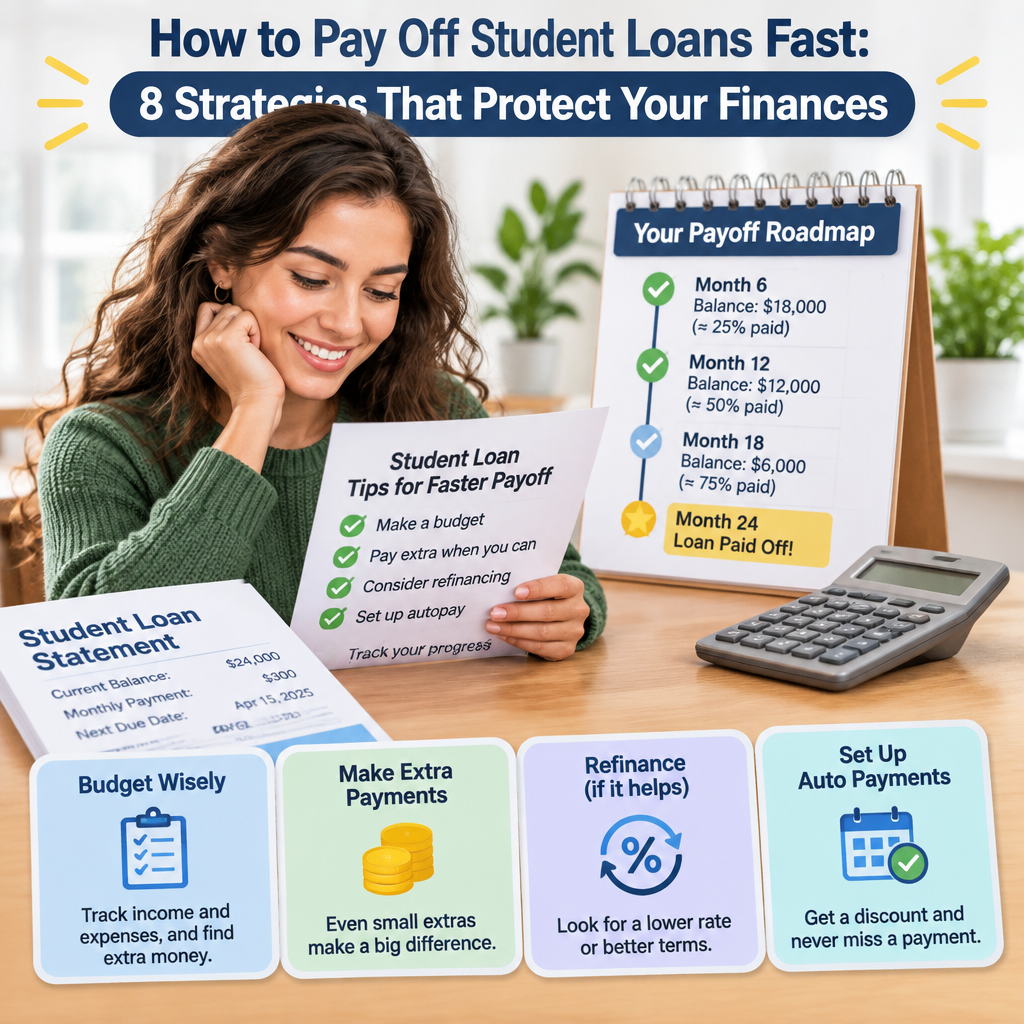
Comparison: Accelerated Payments vs. Minimum Payments
The fairest comparison is not “debt is bad” versus “debt is fine.” It is the cost and time of two payment plans against the borrower’s other needs. The table uses a $20,000 loan at a fixed 6% rate and assumes a standard 10-year schedule. Figures are estimates, rounded for readability.
| Approach | Approximate monthly amount | Estimated payoff time | Estimated interest | Main trade-off |
|---|
| Minimum scheduled payment | $222 | 10 years | $6,645 | More cash remains available each month, but interest costs more over time. |
| Accelerated payment | $300 | About 6 years, 9 months | About $4,390 | Saves roughly $2,250 in interest, but uses about $78 more each month. |
| Biweekly equivalent | Half the monthly payment every two weeks | About 9 years | Around $760 less interest than the standard schedule | Adds one monthly payment per year; timing and servicer processing matter. |
The accelerated option saves interest because it reduces the balance sooner. It also commits an extra $78 every month. That money cannot simultaneously build an emergency fund, earn an employer retirement match, pay down more expensive debt, or cover a necessary bill. Compare the total financial picture, not just the loan calculator’s final number.
A lower minimum payment can be sensible when income is uncertain, when a borrower is pursuing a qualifying federal forgiveness route, or when high-interest debt needs attention first. Conversely, a stable borrower with a healthy reserve and no forgiveness plan may prefer to pay more. The best competitor to a fast payoff is not laziness; it is a considered use of money elsewhere. In my analysis, that comparison—not the desire to be debt-free at any price—is where the decision gets useful.
Common Mistakes to Avoid
Sending every spare dollar to the loan. This advice sounds decisive. It can be reckless. Without accessible savings, a medical bill or job interruption can push a borrower toward credit-card debt, which often carries a higher rate. Keep an emergency reserve suited to your circumstances before treating every extra dollar as loan money. The right reserve depends on income stability, dependents, health needs, and other resources; a rigid universal target is not helpful to everyone.
Ignoring forgiveness or federal protections. Federal loans can have repayment and forgiveness options that private loans do not provide in the same way. If you may qualify for Public Service Loan Forgiveness or an income-driven program, verify current requirements and your own payment history before accelerating. A loan balance that may be forgiven should not be approached as if it were an ordinary private balance. Rules are specific, and assumptions based on a friend’s situation or an old article can be expensive.
Letting the servicer choose where extra money goes. A payment larger than the amount due may affect the next due date, or it may be directed according to account settings. Tell the servicer what you want, target the intended loan, and review the following statement. CFPB guidance on extra payments is useful here. Keep a record of requests and confirmations, especially if your loans have several separate balances or interest rates.
Refinancing federal loans just to advertise a lower rate. A lower interest rate can look attractive, but it is only one piece of the decision. Private refinancing can remove federal benefits, including certain repayment and forgiveness options. Compare the full set of terms and consider whether a fixed rate is preferable to a variable one. If you cannot put a reasonable value on the protections you would lose, pause and get qualified advice before signing.
Choosing the most aggressive payment without testing your budget. A payment plan that only works in a perfect month is not a plan. Leave room for predictable irregular costs such as car maintenance, annual insurance bills, school expenses, or medical care. If the payment depends on borrowing again whenever something breaks, it is too large. Set a sustainable amount first; increase it after several months of proving that the budget can handle it.
Assuming extra payments always beat investing or retirement contributions. The loan’s rate matters, but so do taxes, employer matches, risk, liquidity, and time horizon. An employer retirement match may be valuable compensation, while investment returns are uncertain and debt interest may be predictable. There is no universal answer. Compare the after-tax value and the risk rather than repeating a blanket rule. And do not invest money needed for a near-term loan payment in volatile assets simply because the expected return looks higher on paper.

Frequently Asked Questions
Is it worth paying off student loans early?
It can be, particularly when the interest rate is meaningful, you have adequate emergency savings, you are current on higher-priority obligations, and you are not giving up a valuable forgiveness option. Compare the interest saved with alternative uses for the money. If you expect a qualifying federal forgiveness benefit, check the program rules before making extra payments.
Should I pay off the highest-interest student loan first?
Usually, yes, if your goal is to minimize interest and the loans have comparable terms. Pay every minimum, then direct extra money to the highest-rate balance. If one loan has a special benefit, variable rate, cosigner issue, or forgiveness eligibility, consider that before applying a simple interest-rate ranking.
Does paying extra on student loans reduce principal?
Extra payments generally go toward accrued interest and then principal, but account rules and payment instructions matter. Tell your servicer how to apply the extra amount and whether it should target a particular loan. Review your account afterward. The CFPB’s extra-payment guidance outlines steps borrowers can take to communicate their preferences.
Is biweekly student-loan payment better than monthly payment?
It can be, because 26 half-payments equal 13 full monthly payments each year. That creates one extra payment compared with a standard 12-payment schedule. But the benefit depends on when the servicer applies partial payments and whether there are fees or processing rules. Ask first. If partial payments are held, making one additional monthly payment each year may be simpler.
Final Thought
A shorter repayment schedule is useful only if it leaves your finances sturdier, not more brittle. Start with the terms in front of you: loan type, rate, balance, required payment, forgiveness eligibility, and servicer rules. Then choose an extra amount that fits the budget after essential bills and a reasonable cash reserve. You can raise it later. There is no prize for making a payment so large that you need to borrow again next month.
Most importantly, treat each loan according to its actual cost and protections. A private loan at a high rate may deserve the avalanche treatment. A federal loan tied to a potential forgiveness program deserves a careful eligibility check first. An employer contribution is worth investigating, but only once you know its conditions. Those distinctions are less flashy than a universal payoff hack, and far more useful.
I have found the most reliable approach is plain: keep every required payment current, direct extra money deliberately, check how it appears on the account, and review the plan when income or life changes. Pay down debt with discipline, but do not confuse speed with wisdom. A stable household, room to meet obligations, and a clear path toward future goals are part of the payoff too.