How to Pay Off Student Loans Fast: 8 Strategies That Protect Your Finances
Paying off student loans fast means sending more than the required minimum toward principal, without sacrificing emergency savings, employer retirement matches, or federal protections you may need. The best approach depends on interest rates, cash flow, loan type, and forgiveness eligibility; for many borrowers, a modest extra payment plus autopay beats an aggressive plan that leaves no room for shocks.
Paying a little extra can make a meaningful difference because it reduces the balance that accrues interest. But paying off debt is not a contest to see who can leave themselves with the smallest bank balance. Keep enough cash for likely emergencies, cover essential bills, and take account of high-interest debt before committing every spare dollar to student loans.
The useful question is not simply how quickly you can clear the balance. It is how quickly you can do so without creating a new, more expensive problem. The steps below explain how to shorten repayment, what the numbers can look like, and when keeping a loan may be wiser than rushing to erase it.
What Does Paying Off Student Loans Fast Mean?
Paying off student loans fast means reducing the time you carry the debt by paying more than the amount required by your repayment schedule. Extra money can reduce the balance, lower the interest that accrues over time, and bring the final payment closer. The result depends on your interest rate, payment timing, loan terms, and the way your servicer processes additional payments.
Most student loan payments first cover applicable fees and interest due. The remaining amount reduces principal. That is why an extra payment does not always lower the principal by the full amount you send: interest may have accumulated since your last payment. Ask your servicer how to make an additional payment and whether you can direct it to a particular loan. If you have several loans, targeting the highest-rate balance often reduces total interest most efficiently. The Consumer Financial Protection Bureau’s guidance on paying student loans faster explains why payment instructions matter.
There are two broad kinds of student loans to consider. Federal student loans are made under government programs and may come with repayment options or forgiveness eligibility subject to current rules. Private student loans are issued by banks, credit unions, or other lenders, and their benefits and repayment terms depend on the contract. A strategy that makes sense for a private loan may be a poor fit for a federal loan if you expect to use a federal repayment or forgiveness program.
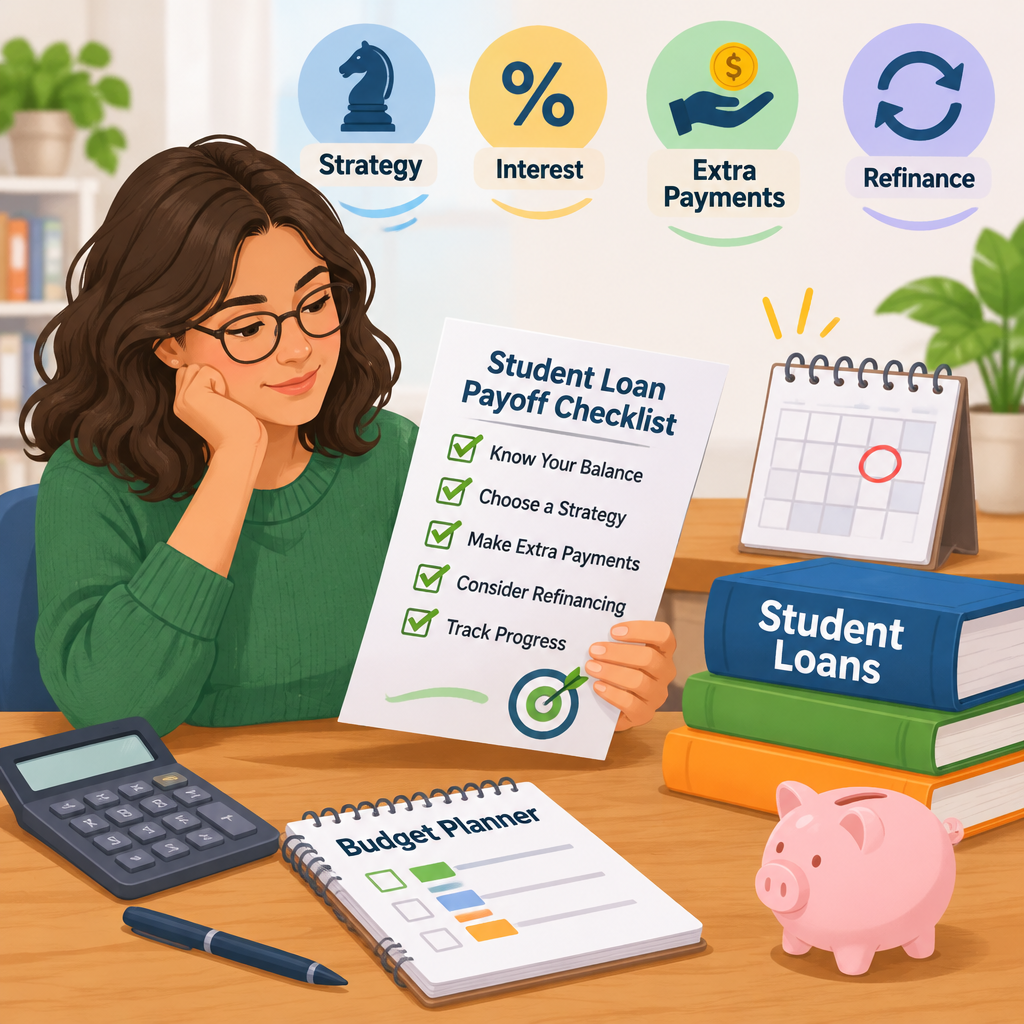
Frankly, “pay it off as fast as possible” is not a complete financial plan. Before making extra payments, check whether you have a starter emergency fund, expensive credit-card debt, an employer retirement match, or a realistic path to loan forgiveness. Paying extra on a loan at 4% while carrying credit-card debt at a much higher rate is usually an expensive way to feel productive. Review your federal options on Federal Student Aid’s repayment plans page, and verify current eligibility rather than relying on old advice.
For a simple illustration, assume a fixed-rate loan balance of $20,000 at 6%, paid monthly over ten years, with no fees or forgiveness. The scheduled payment is about $222 a month. Paying $300 instead could clear the balance in roughly 82 months and save around $2,260 in interest. Actual results vary with payment dates, servicing, and loan terms, so treat the figures in this article as estimates, not a payoff quote.
Why Paying Student Loans Faster Can Matter
The first benefit is lower interest cost. Interest is the price of borrowing, and it continues to accrue according to your loan’s rules while a balance remains. An additional payment can reduce future interest by lowering principal sooner. The savings are usually clearest on higher-rate loans and when extra payments arrive early in the repayment period.
A faster payoff can also free up monthly cash flow. When a loan payment disappears, that money can go toward savings, retirement contributions, a home purchase, or other goals. The benefit is not only the interest avoided; it is having more choices in your budget later. Still, that future flexibility is worth pursuing only if the current plan leaves room for necessities and unexpected expenses.
There can be a psychological benefit, too. Some borrowers sleep better with less debt. Others prefer to keep lower-rate debt while building savings and investing for long-term goals. Neither reaction is automatically right. I would compare the guaranteed interest avoided with the value of keeping cash accessible, rather than assuming that a zero balance is always the best outcome.
A clear repayment target can make budgeting easier. For example, choosing a monthly amount and tracking the balance gives you a visible measure of progress. That can help replace vague intentions with a repeatable habit. But do not confuse a neat spreadsheet with financial security; a plan that depends on overtime every week or every dollar of a bonus is brittle.
There is also a stewardship question, though it need not be a grand one. Meeting obligations matters, and so does preserving the ability to care for your household, honor the dignity of work, and contribute to the common good. A responsible plan weighs all of those duties instead of treating debt repayment as the only worthy use of money.
Here’s the kicker: the best payoff strategy is not necessarily the one with the shortest possible timeline. It is the one that reduces costly interest without forcing you to borrow again when your car breaks down, your hours are cut, or a medical bill arrives. Build the plan around both the math and the life you actually have.
How to Pay Off Student Loans Fast: 8 Practical Steps
Start with the required payment, then add tactics you can maintain. You do not need to use all eight. Combining two or three can work better than building an elaborate plan you abandon after a month.
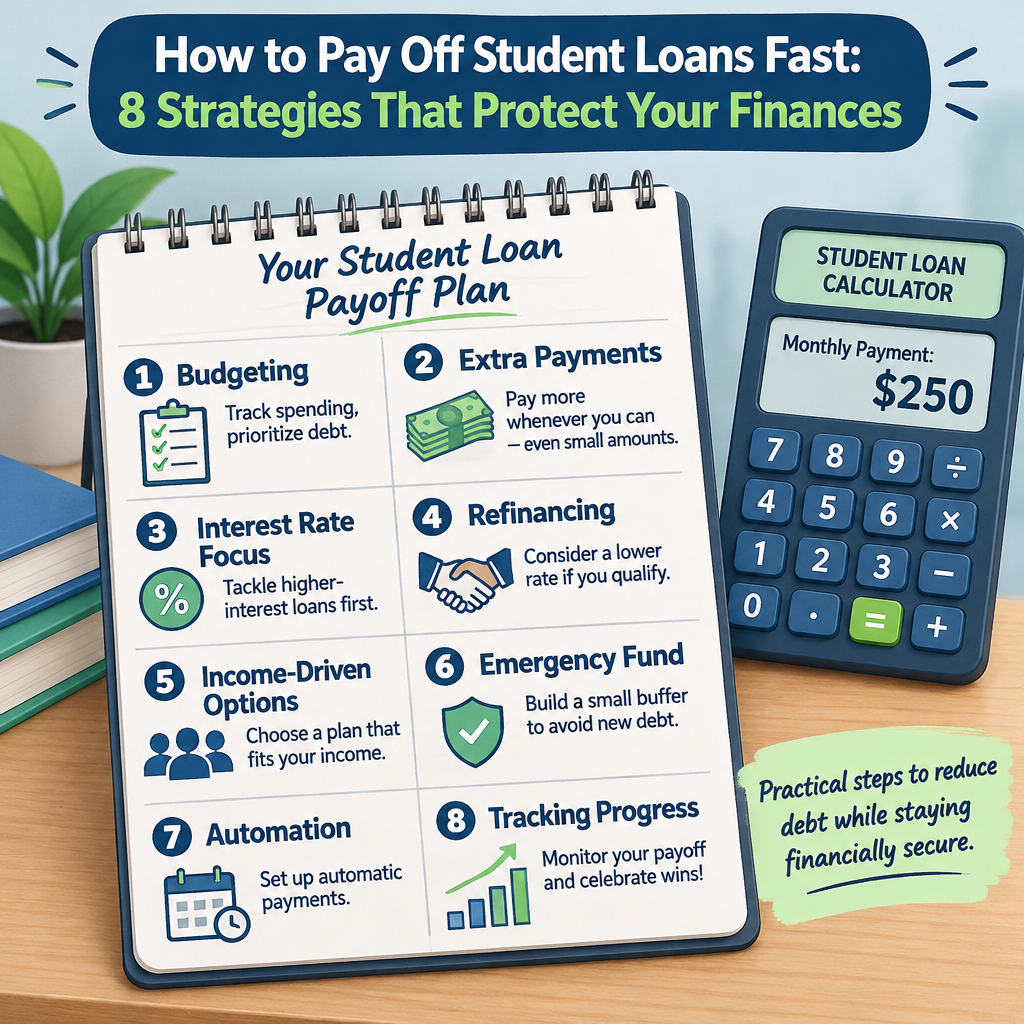
- Increase your monthly payment. Add a manageable amount to your regular payment, even if it is only $25 or $50 to begin with. In the $20,000, 6% illustration above, increasing the payment from about $222 to $300 shortens repayment from ten years to roughly 82 months and saves about $2,260 in interest. Check your servicer’s payment settings and specify how extra money should be applied. If you have multiple loans, direct the extra amount to the highest-rate loan while keeping minimum payments current on the others. Revisit the amount when your income or essential expenses change; a payment you can sustain is worth more than a bigger one you miss.
- Consider biweekly payments. Divide the monthly amount in half and make a payment every two weeks, if your servicer accepts and promptly credits payments. There are 26 two-week periods in a year, so this schedule amounts to 13 full monthly payments rather than 12. On the example loan, an extra payment each year could cut repayment by about a year and save several hundred dollars in interest. The precise result depends on when the servicer credits each payment. Ask before changing the schedule; some billing systems may hold partial payments, which can reduce the benefit. Matching payment dates to a biweekly paycheck can make budgeting simpler, but do not overdraft your account to keep the calendar tidy.
- Ask about employer student-loan assistance. Check your benefits documents or ask human resources whether your employer contributes to student-loan payments. Programs differ: some pay the servicer directly, while others have eligibility rules, waiting periods, or annual limits. Read the terms and understand how the benefit is treated for tax purposes before building it into your budget. As an illustration, if an employer contributes $100 each month on top of the scheduled payment on a $20,000 loan at 6%, payoff could take about 75 months rather than 120, with roughly $2,650 less interest. That estimate assumes the contribution is applied as intended and the other loan details remain unchanged. Do not count a benefit as guaranteed until you know the rules.
- Put part of a windfall toward the balance. A bonus, cash gift, inheritance, or tax refund can make a useful lump-sum payment if it is genuinely surplus. First account for upcoming bills, needed repairs, taxes, and your emergency savings. Then decide what share to send to the loan. For instance, a $3,000 annual lump sum can shorten repayment substantially when added to the scheduled payment on the example loan; the exact payoff date depends on when each payment arrives. Do not spend a refund in advance or take on new debt just to make a large payment look impressive. Windfalls are irregular, so use them to supplement a plan rather than replace a monthly budget.
- Use small savings as debt snowflakes. Move small amounts left over from a grocery discount, a cash-back reward, or an unplanned expense into a separate loan-payment fund. Send the accumulated amount to the loan on a schedule that works for your servicer. The math from a few dollars at a time will not usually transform a large balance by itself. The value is the habit: small savings become intentional payments instead of disappearing into casual spending. Check reward terms, too; do not buy things you do not need just to earn cash back. If your servicer has awkward payment processing, save the snowflakes and make one additional payment each month.
- Increase income, but protect your health. A raise, overtime, a better-paid role, tutoring, freelance work, or a side job can create room for extra payments. Decide in advance what portion of the additional take-home income goes to debt, and account for taxes, transport, equipment, childcare, and other costs. If an occasional side job produces $300 a month that you can actually keep, adding it to the example loan’s $222 scheduled payment could reduce payoff to about 43 months. That is an illustration, not a promise: income and expenses vary. Let’s be real, a side hustle that damages your health or jeopardizes your main job can cost more than it earns. Set a limit and review it after a few months.
- Refinance only after comparing the trade-offs. Refinancing means replacing one or more existing loans with a new private loan. If you qualify for a lower rate or choose a shorter term, you may reduce interest or finish earlier. For example, replacing a $20,000 loan at 7% with a 5% loan over seven years could raise the payment by about $50 compared with a ten-year payment at 7%, while saving roughly $4,100 in interest, assuming no fees and unchanged terms. A lower monthly bill is not the same as a lower total cost; compare the rate, term, fees, and total payments. Be especially cautious about refinancing federal loans into private loans. You can lose access to federal repayment options, deferment or forbearance provisions, and forgiveness eligibility. The CFPB’s discussion of refinancing federal student loans lays out this central trade-off. If you have private loans, compare offers carefully and confirm that the new contract is genuinely better for your needs.
- Enroll in autopay, then check the account. Automatic payments can reduce the chance of missing a due date, and some servicers or lenders offer an interest-rate reduction. For eligible federal Direct Loans, automatic debit generally comes with a 0.25 percentage-point rate reduction while the loan is in repayment; private lenders set their own terms. Confirm the discount, start date, account requirements, and what happens if a payment fails. Keep enough money in the linked account and check statements after enrollment. Autopay is a useful supporting tool, not a substitute for monitoring the loan or choosing a sensible extra-payment amount.
Accelerated Repayment vs. Standard Repayment
The comparison below uses a hypothetical $20,000 fixed-rate loan, no fees, no forgiveness, and the assumptions listed for each option. Amounts are rounded. It is a planning illustration, not a lender quote; actual accrual and payment handling can change the result.
| Approach | Example payment | Approximate payoff time | What changes |
|---|
| Standard schedule: 6% over 10 years | $222 monthly | 120 months | About $6,645 in total interest under the stated assumptions. |
| Accelerated monthly payment: 6%, paying $300 | $300 monthly | 82 months | Roughly 38 months sooner and about $2,260 less interest than the standard schedule. |
| Biweekly half-payments: 6% | About $111 every two weeks | Around 9 years | One extra full monthly payment each year; timing and servicer processing affect savings. |
| Refinance example: 7% to 5%, seven years | About $283 monthly | 84 months | Compared with a 10-year payment at 7%, the payment is about $50 higher and interest savings are roughly $4,100, before any fees. |
The strongest comparison is not simply “fast” against “slow.” It is the total cost and risk of each option. A shorter term usually means a larger required payment, which can leave less room for a job loss or medical expense. An extra payment on your current loan may give you more flexibility than refinancing, since you can often stop making voluntary extras if money gets tight while keeping the required payment unchanged.
When I compare repayment schedules, I look at total interest, the required monthly obligation, access to federal protections, and cash reserves—not just the date the balance reaches zero. If a federal borrower may qualify for a forgiveness program, extra payments could reduce the amount ultimately forgiven without providing a worthwhile benefit. Verify program rules and your own eligibility with Federal Student Aid before paying ahead.
Common Mistakes to Avoid
Draining savings to make a dramatic payment. A big principal reduction can look satisfying, but an empty emergency fund leaves you vulnerable to a car repair, a gap in work, or an unexpected bill. If you then put those expenses on a high-rate credit card, the loan payoff may have made your finances worse. Keep a reasonable cash cushion before making large voluntary payments.
Paying extra without checking forgiveness or repayment eligibility. Federal programs have rules that can depend on loan type, employer, payment history, and other conditions. Those rules can change. If you are pursuing a qualifying forgiveness path, understand how additional payments affect your expected balance and timeline. Get current information from official sources; do not assume a social media post or an old employer handout still describes the rules.
Letting the servicer advance your due date unintentionally. Some servicers may apply an extra payment in a way that moves your next due date forward. That can be convenient, but it may not match your intention to reduce principal while still making the regular monthly payment. Check the account after each extra payment, use available allocation instructions, and contact the servicer if the record does not match your request. Keep confirmation numbers or screenshots when appropriate.
Refinancing for a lower monthly payment without checking total cost. Stretching a loan over more years may lower the monthly bill while increasing the total interest paid. A teaser rate or variable rate can also change later. Compare the annual percentage rate, whether the rate is fixed or variable, repayment term, fees, required payment, and total amount due. With federal debt, include lost benefits in the comparison; the lowest advertised rate does not compensate everyone for that loss.
Assuming every extra dollar belongs on student loans. The highest-rate debt may be a credit card, or your employer may offer a retirement match you would forfeit by skipping contributions. Your household may also need savings for near-term expenses. Compare the likely return or avoided cost, the certainty of the benefit, and the consequences of delaying each goal. Do not turn one sound tactic into a rigid rule.
Relying on a side hustle or a windfall that may not arrive. A budget based on uncertain overtime, gig work, or next year’s bonus can break quickly. Set the required payment using dependable income. Treat irregular money as an optional accelerator, and reduce extra payments when circumstances change. The truth is, staying current for years beats an ambitious plan that collapses after two months.
Missing the small print on taxes and benefits. Employer contributions, interest deductions, and refinancing terms can have tax or eligibility details. Rules depend on the benefit and your circumstances. Review official guidance or speak with a qualified tax professional when the amount is material. Do not assume that a benefit is tax-free or that a deduction makes a loan financially worthwhile.
Frequently Asked Questions
What is the fastest way to pay off student loans?
There is no single fastest method for every borrower. If you have stable income, no near-term forgiveness path, and adequate savings, paying extra toward the highest-rate loan is often an efficient starting point. Make minimum payments on all other loans, confirm that extra money is applied as intended, and add lump sums when you can afford them. Refinancing may help some borrowers, but federal borrowers should weigh the protections they would give up before signing a private loan.
Should I pay off student loans or save first?
Usually, do both in sensible proportions. Keep enough emergency savings to avoid turning a surprise expense into credit-card debt, and consider any employer retirement match before making large extra payments. The right balance depends on your expenses, job stability, loan interest rates, and any forgiveness eligibility. If you have high-rate consumer debt, compare that cost with your student-loan rate before deciding where the next dollar goes.
Does paying student loans biweekly save money?
It can, if the servicer credits the payments promptly. Paying half the monthly amount every two weeks results in 26 half-payments, equal to 13 monthly payments over a year. That extra payment can shorten the schedule and reduce interest. Ask how partial payments are handled first; a servicer that holds a partial payment until the rest is due may change the benefit. Keep funds available so the new schedule does not cause a missed payment elsewhere.
Is refinancing federal student loans a good idea?
It can make sense for some borrowers, but it is a consequential choice. Refinancing federal debt with a private lender generally removes access to federal repayment plans, federal forgiveness programs, and certain federal protections. A lower rate may not be worth that trade if you need those options or are eligible for forgiveness. Compare the full contract and your likely future needs, not just the advertised rate or the first monthly payment.
Final Thought
A student-loan payoff plan should lower the cost of borrowing without making the rest of your finances fragile. Start by listing each loan’s balance, rate, type, minimum payment, and any relevant repayment or forgiveness rules. Keep required payments current. Then choose one repeatable extra-payment method: a fixed monthly amount, an employer contribution, a windfall when it arrives, or a combination that fits your budget.
Check progress every few months, not every few hours. If your income rises, consider increasing the extra payment; if essential costs rise, pause it before you miss a required bill or drain your savings. Keep records of payment instructions and verify that your servicer applied money as expected. Those small checks prevent avoidable confusion.
Frankly, there is no prize for paying a loan off early if the process leaves you unable to handle ordinary setbacks. Nor is there a virtue in carrying costly debt merely because someone says all debt is harmless. Look at the rate, the protections, your cash reserves, and your obligations to the people who depend on you. A steady, informed plan honors both repayment and responsible stewardship. Make the next payment one you can repeat—and let the balance fall from there.
