How to Pay Off Student Loans Fast: 8 Practical Strategies
Paying off student loans fast means sending more money to your loan principal, lowering the interest cost where possible, or doing both without neglecting essential savings and obligations. A reliable plan starts with your loan terms, protects your financial cushion, and accounts for federal benefits you could lose by refinancing. Speed matters, but so does stability.
A faster payoff can reduce interest and free up future cash flow, but the best plan is not always the one that produces the earliest zero balance. For some federal borrowers, an income-driven plan or Public Service Loan Forgiveness may be worth more than aggressive repayment; the details depend on eligibility and current program rules. Check your options with the official Federal Student Aid repayment plan information before making a big change.
The figures in this article are illustrations, not lender quotes. Rates, payment timing, and servicer rules change the math, so use your account statements and a repayment calculator before committing. Frankly, a plan you can sustain for years beats a dramatic budget cut you abandon by spring.
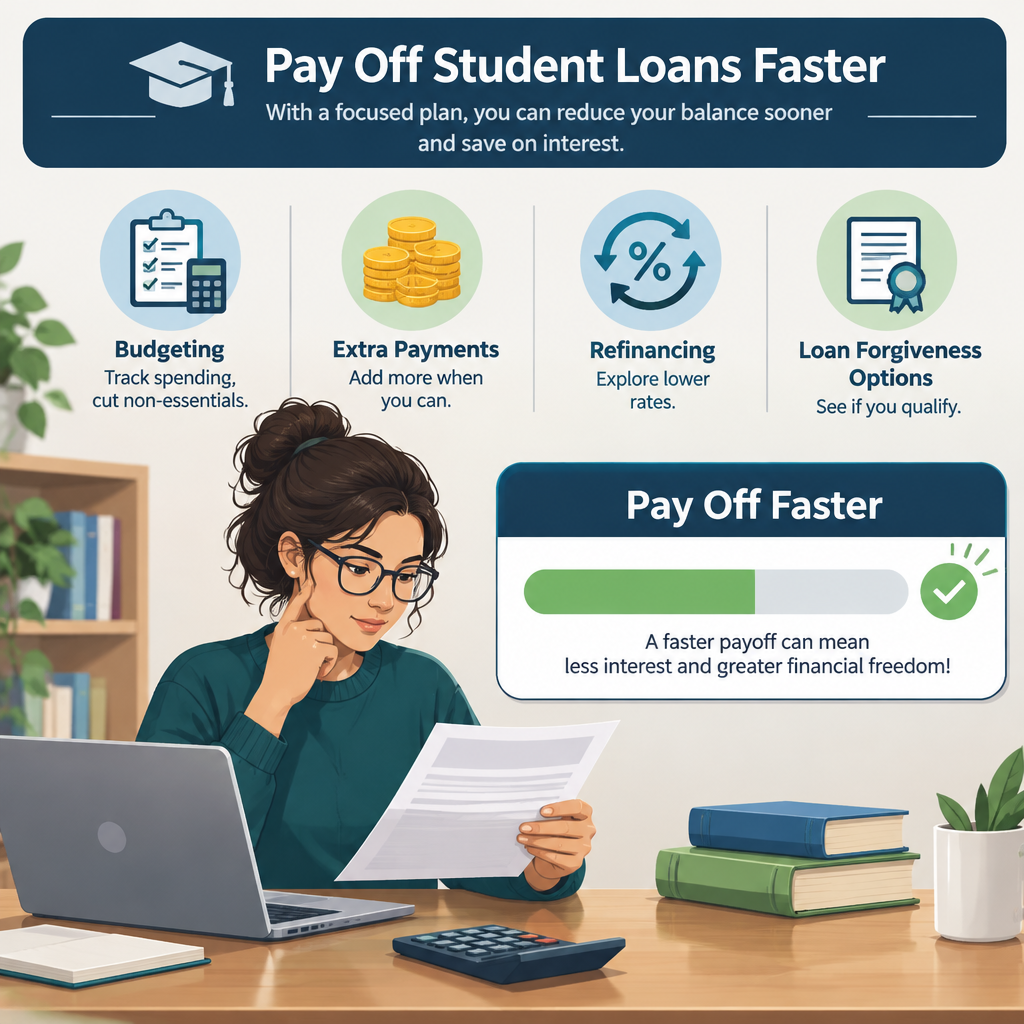
What Does It Mean to Pay Off Student Loans Fast?
Paying off student loans fast means repaying your outstanding balance ahead of its scheduled end date, usually by paying more than the required amount, reducing the interest rate, or making occasional lump-sum payments. Your regular payment covers interest and principal, but the split changes over time; extra payments can reduce the balance that future interest is calculated on. That is the basic math.
For a simple illustration, a $20,000 loan at 6% interest on a 10-year schedule requires about $222 a month, before fees or changes in loan terms. Paying $300 each month could clear that balance roughly 39 months early and save around $2,300 in interest, assuming the rate stays fixed and extra money reduces principal. Small increases can matter.
The phrase “extra payment” can be misleading. A servicer might apply additional money to a future bill or advance your due date unless you give payment instructions, while interest that has accrued still needs to be paid before the principal falls. Review your servicer’s payment settings, keep making required payments, and check the balance after each extra payment. Do not assume.
Federal and private student loans also come with different trade-offs. Federal loans may offer income-driven repayment, deferment or forbearance rules, and forgiveness pathways; private loans follow the lender’s contract and generally do not provide the same federal protections. Federal repayment programs and rules can change, so check official information and your own eligibility rather than relying on an old estimate. Details matter.
If you are pursuing Public Service Loan Forgiveness or another forgiveness route, paying extra may be a poor use of cash because it can reduce the balance that might otherwise qualify for forgiveness. I would first confirm qualifying employment, payment counts, and current program rules, then compare the likely total cost of staying on the relevant plan with paying aggressively. Run the numbers before sending more.
Why Paying Student Loans Faster Can Help
The clearest benefit is lower interest. Interest generally accrues based on the outstanding balance and rate, so bringing principal down sooner can shrink the amount charged later; the exact result depends on the loan’s interest method and payment timing. Lower balances help.
- You free future cash flow. Once the loans are gone, the payment can support retirement savings, a home purchase, family needs, or other goals. That flexibility has real value.
- You reduce payment obligations. Eliminating a loan removes one monthly bill and can make your budget less exposed to an income interruption. Fewer obligations can ease pressure.
- You create a clear milestone. A payoff target can help you stay engaged, especially when you can see progress in the balance rather than only in a budget spreadsheet. Motivation counts.
- You may reduce financial risk. Lower debt can leave more room to handle a job change, medical bill, or other unexpected expense, provided you have not emptied your savings to get there. Balance is essential.
- You can make room for other priorities later. Faster repayment is useful when it fits alongside emergency savings, retirement contributions, and high-interest debt repayment. Priorities compete.
Here’s the kicker: paying a low-rate student loan early is not automatically the best financial move. If you have credit-card debt at a much higher rate, no emergency cushion, or an employer match you are not using, those gaps may deserve attention first. Interest rates and risks count.
I look at payoff plans as a cash-flow decision, not a contest. Money is a tool entrusted to households, and responsible stewardship means meeting obligations while keeping enough capacity to care for dependents and withstand setbacks. A faster payoff is worthwhile when it strengthens the whole plan, not when it leaves the rest of your finances brittle. Keep perspective.
Eight Ways to Pay Off Student Loans Faster
1. Increase Your Monthly Payment
Start with an amount you can repeat. Raising a $222 payment to $250 or $300 can shorten repayment and reduce interest, but only if the increase does not force you to borrow again for routine expenses. Sustainable beats heroic.
Set the new amount through your servicer or bank, then check how extra payments are allocated. Where the system allows it, instruct the servicer to apply additional money to the loan principal rather than simply moving your next due date forward. Verify the balance afterward.
2. Use a Biweekly Schedule Carefully
Paying half your monthly bill every two weeks produces 26 half-payments a year, or the equivalent of 13 full monthly payments. That extra annual payment can shorten the schedule; on a $20,000 loan at 6%, it could save roughly $750 and about a year compared with paying only the scheduled amount. Timing varies.
This method suits borrowers paid every two weeks, but do not split payments blindly. Some servicers may hold a partial payment until the full amount arrives, and payment processing rules differ. Ask first.
3. Check for Employer Student-Loan Assistance
Ask Human Resources whether your employer makes payments toward student debt, offers a matching benefit, or has another education-related program. Benefits vary in amount and eligibility, and some require a waiting period or continued employment. Read the terms.
If your employer contributes $100 a month to a $20,000 loan at 6%, that added payment can significantly shorten repayment without taking $100 from your own monthly budget. Confirm how the contribution reaches the servicer and whether you must make a minimum payment yourself. Don’t count a benefit until it is confirmed.
4. Put Part of Windfalls to Work
Tax refunds, bonuses, cash gifts, and other one-time income can make useful lump-sum payments. Before sending the whole amount, check near-term expenses and the balance of your emergency fund; using every dollar may send you back to a credit card after the next car repair. Keep some breathing room.
You can set a rule in advance, such as putting half of a bonus toward debt and keeping the rest for savings or planned costs. A repeatable rule prevents a windfall from disappearing into untracked spending. Decide before the money arrives.
5. Try the Debt Snowflake Method
A snowflake is a small, unplanned amount directed to debt: cashback, a modest grocery saving, or money left over at the end of a pay period. One small transfer will not transform the loan, but repeated contributions can add up and make repayment feel tangible. Small is still real.
Collect the amounts in a dedicated account or send them to the servicer when practical. Check for processing fees and payment rules, and do not spend hours chasing tiny savings while ignoring the major budget items. Use the method as a supplement.
6. Increase Income Without Burning Out
A raise, overtime, a better-paying role, tutoring, freelance work, or occasional delivery work can create room for higher payments. Decide how much of the added take-home pay will go to loans before it becomes part of your normal spending. Keep the rule simple.
For example, adding $300 a month to a $222 payment on a $20,000 loan at 6% could bring payoff to about 43 months, assuming the full extra amount reduces principal. Account for taxes, work costs, and time away from family or rest. Exhaustion has a price.
7. Consider Refinancing—With Your Eyes Open
Refinancing replaces one or more loans with a new private loan, potentially at a lower rate or a shorter term. A $20,000 balance refinanced from 7% over 10 years to 5% over seven years could increase the payment by about $50 a month while saving roughly $4,100 in interest, depending on fees and exact terms. Offers are not guaranteed.
Refinancing federal loans into a private loan permanently removes federal protections attached to those loans, including access to federal repayment and forgiveness programs. The Consumer Financial Protection Bureau’s refinancing guidance explains the trade-off; compare the new contract, fixed or variable rate, fees, and borrower protections before signing. A lower rate is not the whole story.
8. Enroll in Autopay if It Fits Your Budget
Automatic payments reduce the chance of forgetting a due date, and some lenders offer an interest-rate reduction for enrolling. For eligible federal loans, the discount is commonly 0.25 percentage point; private lender offers differ, so confirm the amount and conditions with your servicer. Check the actual offer.
Autopay is not a substitute for monitoring your account. Keep enough money in the linked account, review statements, and confirm payments are posted correctly; a returned payment or overdraft fee can eat into a small rate discount. Convenience should not create a new problem.
The Department of Education explains federal automatic debit and its rate discount in its autopay guidance. You can also test different payment amounts and schedules with the official Federal Student Aid Loan Simulator. Use a calculator, then verify with your servicer.
Extra Payments or Refinancing: Which Approach Fits?
Both approaches can speed repayment, but they work differently. Extra payments reduce principal under your current contract, while refinancing replaces the contract and may change the rate, term, protections, and required payment. Keep those distinctions clear.
| Feature | Extra payments on current loans | Refinancing |
|---|
| How it works | Pay above the required amount; confirm how the servicer applies it. | Replace eligible loans with a new private loan and new terms. |
| Potential payoff effect | Directly shortens repayment when extra funds reduce principal. | Can shorten repayment through a shorter term or lower rate. |
| Illustrative example | $20,000 at 6%: paying about $300 monthly may finish around 39 months early and save about $2,300. | $20,000 moved from 7% over 10 years to 5% over seven years may save about $4,100, with a payment about $50 higher. |
| Main risk | Too much extra payment can drain cash reserves or crowd out higher priorities. | Refinancing federal loans privately removes federal benefits and protections. |
| Often suits | Borrowers who want flexibility and wish to preserve existing loan terms. | Borrowers with stable finances who qualify for clearly better private terms. |
These examples use different starting rates and terms, so they are not a head-to-head price comparison. Fees, variable rates, credit approval, and exact payment dates can change results. Compare total cost and risk, not just the monthly bill.
Mistakes to Avoid When Paying Loans Down
The first mistake is treating every spare dollar as loan money. A car breakdown, medical expense, or short period without work can force a borrower with no savings to use expensive credit, undoing some of the interest savings. Build a starter emergency reserve first.
A full target of three to six months of expenses may take time, so start with an amount that could cover a common surprise and keep adding when possible. The right buffer depends on job stability, dependents, health costs, and access to other resources. There is no magic number for everyone.
Next, do not ignore debt that costs more. If a credit card charges a much higher rate than your student loans, paying the card down may save more interest than making extra student-loan payments. Compare rates and minimum payments.
Do not skip an employer retirement match to speed up student-loan repayment. If your workplace offers a 401(k) match, contributing enough to receive the full match can be a valuable part of the plan, though you still need to consider debt costs and cash needs. Free matching dollars are hard to replace.
Another common error is refinancing federal loans based only on a lower advertised rate. Private refinancing can remove federal repayment choices and forgiveness eligibility, and a variable rate may rise. Read the contract and compare protections before you sign.
Finally, avoid extreme austerity and unverified payment instructions. Cutting every enjoyable expense or taking on exhausting side work can make the plan collapse; meanwhile, extra payments sent without clear allocation instructions may not reduce principal as expected. Check statements and protect your health.
Before paying aggressively, use the official Loan Simulator to examine current federal options and compare payment scenarios. If forgiveness may apply, confirm eligibility and payment counts through the relevant official program channels. A little checking can prevent an expensive mistake.
Frequently Asked Questions
Is it worth paying off student loans early?
It can be, especially when the loan rate is high, you have stable savings, and you are not giving up a valuable forgiveness path or employer match. Compare the guaranteed interest savings with other uses for the money, such as paying higher-rate debt or building emergency savings. Context decides.
Should I pay extra on federal student loans?
Maybe. First check whether you are pursuing Public Service Loan Forgiveness or another program where qualifying payments may lead to forgiveness; extra payments could reduce the amount left to forgive. Review your current repayment plan and eligibility using official Federal Student Aid information before changing payment behavior. Do not guess.
Does paying every two weeks save interest?
It can, if the schedule results in one additional full payment each year and your servicer credits payments promptly. Some servicers do not apply half-payments until the rest arrives, so ask how partial payments are handled and compare the result with making one extra payment annually. Processing matters.
Is refinancing student loans a good idea?
Refinancing may help if you qualify for a lower fixed rate or a term that fits your budget, especially with private loans. Refinancing federal loans privately sacrifices federal protections and program access, so the rate alone is not enough to decide. Compare the whole contract.
Final Thought
A fast payoff is a useful goal, but it is not a virtue if the plan makes your household fragile. Keep the required payments current, create a realistic cash reserve, and choose a monthly extra amount you can maintain through ordinary setbacks. Then use occasional bonuses or income gains to shorten the schedule when they truly are available. Steady progress works.
When I compare repayment plans, I look for the one that reduces interest without creating a fresh financial emergency. A few hundred dollars sent to principal can be powerful; a few hundred dollars withheld from essential savings can be costly. The arithmetic matters, and so does the life around it.
Treat your income and obligations with care. Paying debts responsibly, supporting the people who depend on you, and preserving the ability to meet future needs are all part of sound stewardship. Your balance will not disappear overnight, but a clear plan, checked regularly, can move it in the right direction. Start with the next payment.