Paying off student loans fast means reducing the balance sooner without neglecting essentials, high-interest debt, or valuable federal loan protections. The most reliable approach is to make targeted extra payments, direct them properly, and keep enough cash for emergencies. There is no prize for paying loans quickly if the plan leaves you financially exposed.
Key Takeaways- Add extra money to principal when your budget can handle it.
- Keep an emergency reserve and capture any available employer retirement match before sending every spare dollar to loans.
- Check federal repayment and forgiveness options before prepaying federal loans.
- Ask how your servicer applies extra payments; do not assume it will reduce principal as intended.
- Combine steady extra payments with employer contributions or occasional windfalls when practical.
The examples below use a $20,000 loan at 6% interest with a 10-year repayment term. They show how the math can work, not what every borrower will experience; loan terms, payment timing, interest accrual, and servicer practices can change the result. Frankly, a sustainable extra $50 each month beats a dramatic payment plan that collapses after two paychecks.
Paying quickly is a financial choice, not a moral test. Keep your rent, food, insurance, taxes, and other obligations current first, then weigh the interest you can avoid against cash reserves and any forgiveness you might qualify for. The sensible target is faster repayment without creating a fresh crisis.
What Does It Mean to Pay Off Student Loans Fast?
Paying off student loans fast means shortening the scheduled repayment period by making payments above the required amount, using legitimate assistance, or changing the loan’s terms when that change is worthwhile. The extra dollars generally reduce what you owe sooner, which can reduce the interest charged over the life of the debt. Check the loan’s rules before assuming every extra payment behaves the same way.
Student loans may be federal, private, or a mix. Federal loans may offer income-based repayment choices, deferment or forbearance options, and qualifying forgiveness programs; private loans are governed by lender contracts and usually do not come with the same federal programs. The Federal Student Aid site explains federal repayment plans, while its forgiveness and cancellation guidance is worth reviewing before you decide to pay ahead.
Here’s the kicker: a loan’s interest rate is only one part of its cost to you. If you are eligible for a forgiveness program, paying extra could mean sending money toward a balance that might otherwise be forgiven after you meet the program’s rules. That outcome depends on your loan type, employment, repayment history, and current program requirements, so verify your situation rather than relying on a rough online rule.
When I analyze a payoff plan, I start with four things: the balances and rates, the required payments, the household’s cash reserve, and any benefit or forgiveness eligibility. Then I compare the interest saved with the flexibility given up. A fixed-rate private loan at 9% may deserve extra attention; a federal loan at a lower rate with valuable protections may not.
Loan servicers also matter. A payment above the required amount can be applied to accrued interest and then principal, but instructions differ on how a surplus affects future due dates or multiple loans. Ask for the payment-allocation rules in writing, check your account after the first extra payment, and keep the confirmation. Do not let a website’s cheerful label such as principal payment replace checking the actual balance.
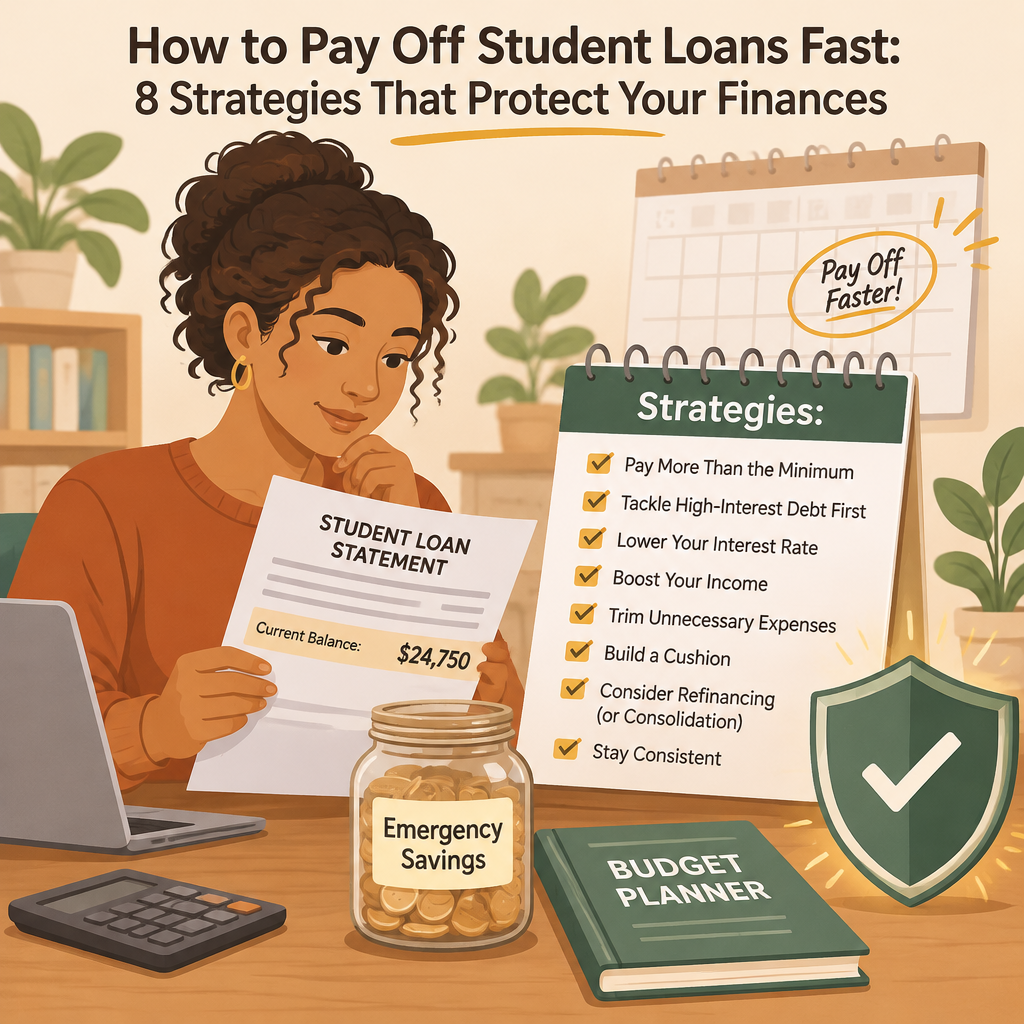
Core Benefits and Why Speed Is Not Everything
Extra payments can reduce interest. They can also shorten the period in which a monthly loan bill competes with other goals, which may free future income for retirement savings, a home down payment, family needs, or a career change. That flexibility has real value, though it is not captured in an interest calculator.
In the example of a $20,000 loan at 6% with a standard 10-year term, the monthly payment is about $222. Raising it to $300 could pay the loan off roughly 39 months early and save about $2,258 in interest, assuming the payment is applied as expected and there are no unusual fees or changes. That is a useful illustration, not a promise from your servicer.
The strongest plans are boring. A recurring payment that fits the budget is easier to maintain than a heroic one that depends on perfect months, and it compounds its effect by lowering the balance earlier. A small increase can still matter when kept up over time.
But faster is not automatically better. If you have no emergency fund, a car repair or medical bill could push you toward credit-card borrowing, often at a much higher rate than your student loan. If your employer offers a retirement match, skipping it to overpay a moderate-rate loan may also leave money on the table. Compare the trade-offs instead of treating debt payoff as the only respectable goal.
Risk management belongs in the same conversation as interest savings. Maintain a cash buffer suitable for your household, keep required payments current, and pay down more expensive debt before choosing extra student-loan payments in many cases. The Consumer Financial Protection Bureau’s student loan resources cover borrower issues and repayment concerns; use them alongside your servicer’s account details.
There is also a less numerical benefit: less debt can reduce stress and simplify a household budget. Still, stewardship means caring for the whole set of obligations, not just the balance that feels most irritating. Paying lenders on time, protecting family stability, and meeting obligations to employees or dependents are all part of responsible money management.
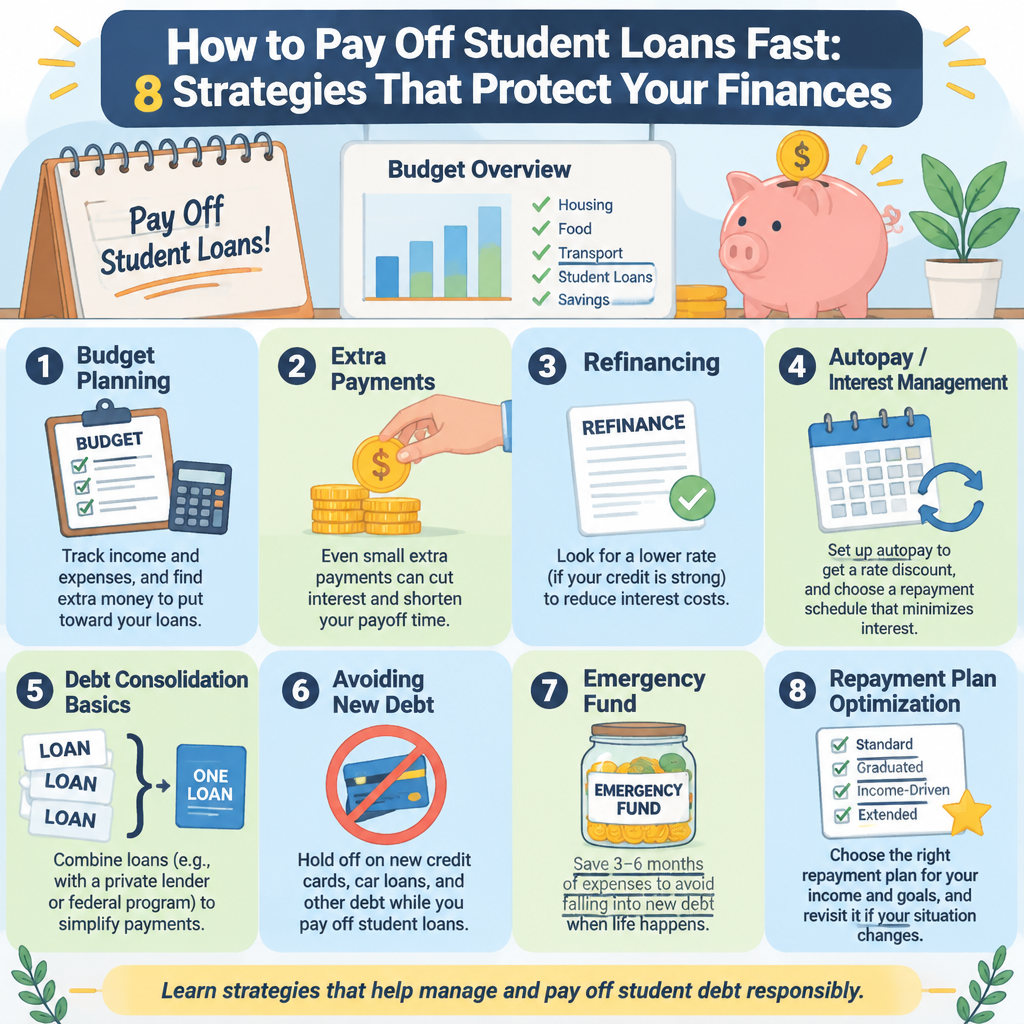
Eight Steps to Pay Off Student Loans Faster
- Increase your monthly payment. Start with a repeatable amount, even if it is only $25 or $50 above the minimum. In the $20,000, 6% example, increasing the monthly payment from about $222 to $300 cuts roughly 39 months and about $2,258 in interest. Set the amount through your servicer, then verify that the extra is not merely advancing the next due date. If your budget tightens, scale back rather than reaching for a credit card.
- Consider biweekly payments. Split the monthly amount in half and pay every two weeks, if your lender accepts that schedule without fees. Twenty-six half-payments equal 13 full monthly payments each year, rather than 12. For the example loan, this approach could bring payoff to about nine years and save around $762 in interest. Those results depend on when the lender credits each payment; ask before setting up automatic transfers. It is not magic. It is one extra payment a year, spread across paychecks.
- Check for employer repayment assistance. Ask human resources whether your workplace contributes toward student loans, and read the eligibility and payment rules. The International Foundation of Employee Benefit Plans reported that 14% of employers offered the benefit in 2024, compared with 4% in 2019. A $100 monthly contribution in the example has been estimated to shorten repayment by 46 months and save $2,638 in interest, but the actual result depends on timing and plan terms. The IRS explains employer-provided educational assistance; check current tax treatment with a qualified tax professional if needed.
- Put part of windfalls to work. Bonuses, cash gifts, inheritances, and tax refunds can make a meaningful one-time payment. The average tax refund reported for 2025 was $3,052; that figure is an average, not a forecast of your refund. In the example, applying a similar lump sum each year alongside scheduled payments could clear the debt in just under four years, depending on payment timing. First set aside money for taxes, urgent bills, and a reasonable reserve. A windfall is an opportunity, not an order to empty your bank account.
- Target the highest-rate loan first. If you have several loans, pay each required minimum and direct extra money to the loan with the highest interest rate. This is commonly called the debt avalanche method; it usually minimizes interest when rates and terms are known. Once that loan is gone, redirect its payment to the next one. Confirm how your servicer lets you target individual loans, because a single account can contain several separate balances.
- Automate a modest increase. A payment that happens without a monthly debate can help maintain a steady plan. Set automatic payments only after confirming the amount, date, and application rules, and leave enough money in the account to avoid overdrafts. Some lenders offer an autopay rate reduction, but the size and conditions vary, so ask the lender rather than assuming a discount. Review the account after the first withdrawal. Automation is useful; unattended automation is not.
- Use refinancing selectively. Refinancing a private loan into a lower-rate private loan may reduce interest or allow a shorter term, depending on the offer and your credit profile. Compare the annual percentage rate, fees, fixed versus variable rate, monthly payment, and total repayment cost—not just the advertised rate. Refinancing federal loans into a private loan can remove access to federal repayment plans and protections. A smaller payment is not necessarily a better deal if it stretches the term and raises total interest.
- Review the plan every few months. Update your budget when income, rates, family responsibilities, or loan rules change. Redirect raises or paid-off bills only after checking that essentials, savings, and other priorities remain covered. If a payment becomes difficult, contact your servicer early and review available options rather than ignoring notices. The Federal Student Aid repayment information is a good starting point for federal borrowers, but verify current eligibility directly. A plan should bend before it breaks.
Comparison: Extra Payments Versus Refinancing
Extra payments and refinancing can both shorten repayment, but they solve different problems. Extra payments keep the existing contract and focus on reducing principal faster; refinancing replaces an existing loan with a new one, often to change the rate, payment, or term. The right choice depends on protections, rate offers, fees, and what your monthly budget can safely support.
| Factor | Extra payments on the current loan | Refinancing into a new loan |
|---|
| Main purpose | Pay down principal sooner and reduce interest over time | Replace the old loan with new rate or term terms |
| Upfront cost | Usually no refinancing application or closing fee, but check loan rules | May involve fees or costs; review the lender’s disclosure |
| Monthly budget | Raises the amount you pay now; you can often adjust later | May lower or raise the required payment, based on the new term |
| Federal protections | Keeps the existing federal loan’s eligible protections | Moving a federal loan to a private lender generally gives up federal benefits |
| Rate certainty | Keeps the current rate and contract | Rate may be fixed or variable; compare carefully |
| Best fit | Borrower with spare cash and an acceptable existing loan | Borrower who qualifies for a clearly better private-loan offer and understands the trade-off |
Most guides make refinancing sound like a shortcut. It is not. The lower rate matters only if the full terms are better for your circumstances, and a new longer term can cost more overall even when the monthly bill shrinks. For example, a borrower with $20,000 at 6% might save interest by paying $300 per month on the current loan; that example does not prove that any refinance quote would beat it.
I compare offers by calculating total scheduled payments, possible fees, and the cost of protections being surrendered. Federal borrowers should be especially cautious: federal programs may be valuable even if they are hard to price in a spreadsheet. Private borrowers still need to compare fixed and variable rates and check how a lender handles financial hardship. A small rate reduction is not worth much if the new agreement removes flexibility you may need.
A borrower who wants to pay sooner can also combine approaches, such as refinancing an eligible private loan and then paying above the new minimum. Do not combine them blindly. Re-run the numbers using the actual quote and a realistic monthly budget, then keep documentation of any application and approval terms.
Common Mistakes to Avoid
Draining cash reserves. Sending every spare dollar to a loan may look disciplined until an unexpected bill arrives. If you then borrow at a steep credit-card rate, the math can turn against you quickly. Keep an emergency reserve that reflects your income stability and household needs, even while making extra payments. A fast payoff that leaves no room for a flat tire is not robust planning.
Ignoring federal forgiveness eligibility. Some borrowers may qualify for forgiveness under programs with specific loan, payment, employment, and documentation requirements. Extra payments can reduce the balance that might otherwise be forgiven, so estimate the likely value before accelerating repayment. Do not assume you qualify based on a slogan or social-media post. Read the current Federal Student Aid forgiveness guidance and confirm your status with the appropriate program administrator.
Letting extra payments get misapplied. A borrower may intend to reduce principal while the servicer instead advances a due date or distributes the payment among loans in an unwanted way. Ask how extra money is allocated, specify your preference when possible, and inspect the next statement. Keep screenshots or confirmations. A payment can leave your bank and still fail to do the job you intended.
Refinancing federal loans without pricing the lost benefits. Refinancing can exchange federal protections for private contract terms. Once federal loans are refinanced into private debt, you generally cannot restore the federal loan status by changing your mind. Compare the actual rate and full agreement, but also weigh forgiveness eligibility and repayment flexibility. Rate alone is not the whole bill.
Chasing payoff speed at the expense of expensive debt. A student loan at a moderate rate may be less urgent than a credit card charging substantially more. Likewise, neglecting a workplace retirement match or required insurance to make extra loan payments may create a different financial cost. Rank obligations by interest, risk, and available benefits; do not use one universal rule for every household.
Treating windfalls as guaranteed income. Tax refunds and bonuses vary, and a refund may reflect tax withholding rather than a permanent source of extra cash. The 2025 average refund of $3,052 does not mean your refund will be that amount. Use only money actually received, account for upcoming bills, and choose an amount that leaves your finances stable. Hope is not a budget line.
Choosing a payment that cannot survive a bad month. An aggressive plan can feel satisfying until a work interruption or family expense arrives. Start with a level you can sustain, then raise it after several months if your budget remains healthy. Pay required amounts on time and contact the servicer promptly if you expect trouble. Consistency beats a short burst followed by missed payments.
Frequently Asked Questions
Is it worth paying off student loans early?
It can be, especially if the interest rate is high, you have stable cash reserves, and you are not giving up a valuable forgiveness option or employer benefit. Compare the guaranteed interest avoided with other uses for the money, including higher-rate debt and retirement contributions. Federal borrowers should review eligibility for repayment and forgiveness programs first. There is no universal answer; the loan terms and your household’s finances decide the trade-off.
Should I pay extra on federal or private student loans first?
Keep every required payment current, then compare interest rates, borrower protections, and forgiveness eligibility. Extra money often goes first to the highest-rate debt if no special benefit changes the calculation. A private loan with a high rate may be a sensible target, while a federal loan could have protections or a forgiveness path worth preserving. Check loan-level rates and current program rules before directing extra payments.
Does paying student loans every two weeks save money?
It can. Paying half the monthly amount every two weeks creates 26 half-payments in a year, equal to 13 monthly payments instead of 12. That extra annual payment can reduce the balance earlier and shorten the repayment period. But the lender’s crediting schedule and payment rules matter, and the estimated nine-year payoff and $762 savings in the example are not guaranteed. Ask your servicer whether it accepts biweekly payments without fees.
Should I use my tax refund to pay student loans?
A refund can be a useful lump sum if your essential bills and emergency reserve are covered and you do not have more urgent, higher-rate debt. The reported 2025 average was $3,052, but individual refunds vary and a future refund is not certain. You can also split a refund between savings and debt. Use the actual amount received, not an assumed estimate, and make sure your payment is applied as intended.
Final Thought
A student-loan payoff plan should make your finances sturdier, not merely make one balance disappear sooner. Choose a monthly amount that you can sustain, keep a cash reserve, and check whether federal protections or forgiveness rules could change the value of paying ahead. Those steps may feel less dramatic than sending every spare dollar to a servicer, but they lower the odds that one emergency sends you backward.
Then make the process routine. Confirm the current balance and rate, choose where extra payments go, set a manageable automatic amount, and review the account after each change. Apply some windfalls when they truly are surplus, and revisit the plan as income and obligations shift. The example of $20,000 at 6% shows that extra payments can save thousands; it does not replace checking your own agreement and budget.
Frankly, money advice often praises speed because it is easy to sell. Good stewardship is quieter: meet obligations, protect people who depend on you, and use resources with care for both present needs and future ones. Pay the loan down as quickly as your real circumstances allow. Not as quickly as a calculator—or a stranger online—demands.