The U.S. national debt hitting $40 trillion is not a trivia fact. It is a hard number with real consequences for <strong>Treasury yields</strong>, <strong>bond...
How the U.S. National Debt Hit $40 Trillion: What It Means for Investors
The U.S. national debt hitting $40 trillion is not a trivia fact. It is a hard number with real consequences for Treasury yields, bond prices, stock valuations, and the way investors think about risk management. When debt grows this fast, the bill does not vanish; it shows up in higher interest costs, tighter policy choices, and more market volatility. What matters now is not panic, but analysis.
Key Takeaways
- The $40 trillion debt level reflects years of deficits, emergency spending, and rising interest expense.
- Higher debt can pressure Treasury markets, especially when investors demand more yield.
- Investors should watch bond duration, asset allocation, and cash flow resilience.
- Diversification still matters, but it is not a magic charm.
- Ethical stewardship matters too: public borrowing should serve the common good, not merely kick the can.
What is the U.S. national debt?
The national debt is the total amount the federal government owes to lenders, including the public and government accounts. Simple enough. It rises when annual spending exceeds tax revenue, and it keeps climbing when interest costs are added on top of old borrowing, which is where the whole thing starts to feel less like accounting and more like a slow-moving weight.
There are two main buckets. Debt held by the public is owned by investors, pension funds, foreign governments, and institutions. Intragovernmental debt is owed to federal trust funds, like Social Security. Most headlines focus on the total, but the market usually cares most about the debt the public actually has to finance. That is the part that trades, gets refinanced, and reacts to supply and demand in the bond market.
Frankly, a big debt number alone does not cause an immediate crisis. Countries can carry large debts for years. The issue is whether the debt grows faster than the economy and whether interest rates rise faster than tax revenue. That is where pressure builds. I’ve looked at enough public finance data to say this plainly: the danger is not just the size of the debt, but the compounding cost of carrying it.
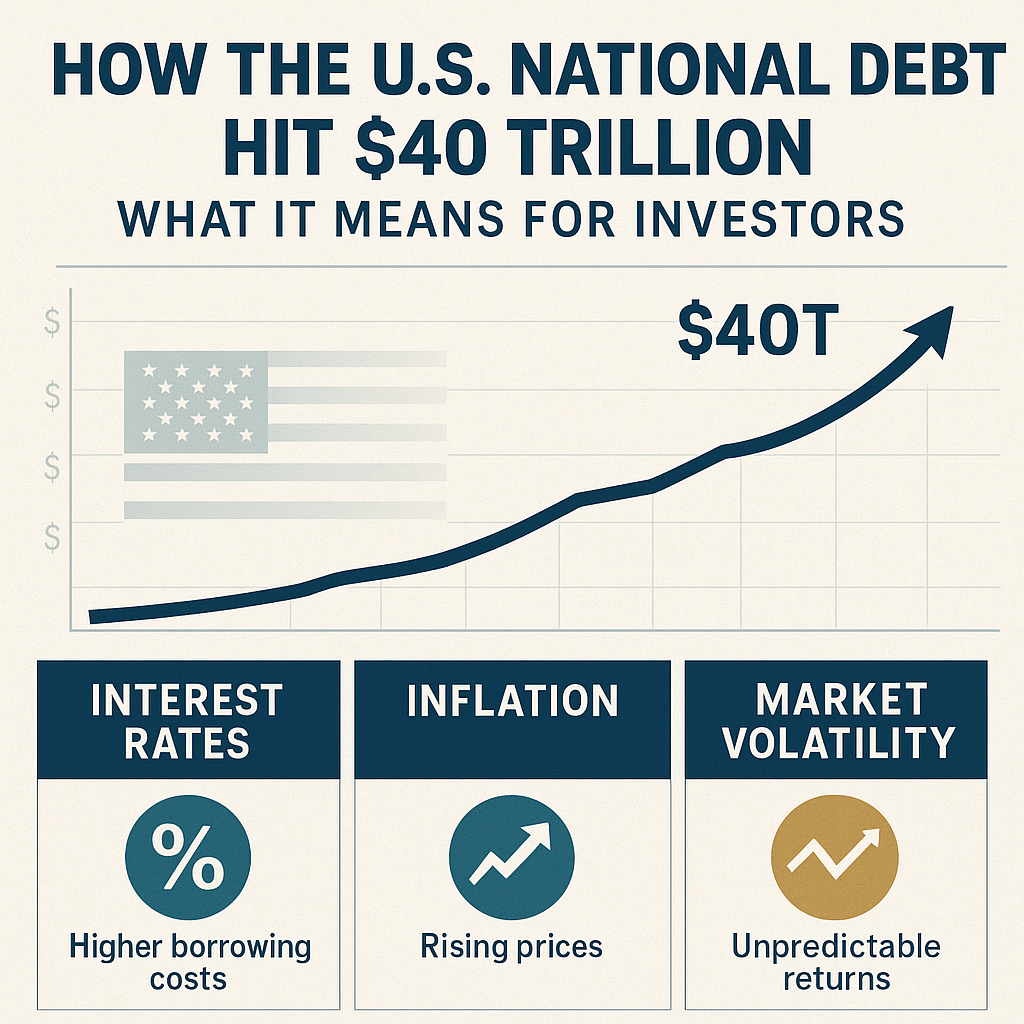
The debt crossed $40 trillion because of persistent deficits, pandemic-era emergency spending, entitlement growth, defense outlays, and a sharp rise in interest expense as rates climbed. The last item is the sneaky one. When rates go up, refinancing old debt gets expensive, and the government starts spending more just to service past borrowing. That is a cruel little arithmetic trick.
You can read more on federal debt trends from the U.S. Treasury Fiscal Data, and the long-run budget picture from the Congressional Budget Office. The numbers are not subtle.
Core benefits and importance of understanding the debt
Most people treat national debt as a political talking point. That is lazy. If you invest, save, borrow, or run a business, the debt matters because it shapes the cost of money. Money is the plumbing of markets. Ignore the pipes and enjoy the flood.
- Treasury yields: More issuance can push yields higher when demand does not keep up. That affects mortgages, corporate borrowing, and valuation models.
- Bond prices: When yields rise, existing bond prices usually fall. Duration risk becomes more than a textbook concept.
- Stock market valuations: Higher rates can compress price-to-earnings multiples, especially for long-duration growth stocks.
- Inflation expectations: Large deficits can complicate the Fed’s job, even if the relationship is indirect.
- Fiscal flexibility: A heavily indebted government has less room to respond to recessions, wars, or emergencies.
The biggest benefit of understanding the debt is not ideological. It is practical. If you know how debt affects rates, you can make better calls on asset allocation, bond ladders, and equity exposure. That beats guessing. Every time.
Let’s be real: many commentators say debt does not matter because “we owe it to ourselves.” That line is cute, but incomplete. Sure, some liabilities are internal to the system, yet real interest payments still come out of real taxes and real spending choices. Crowding out is not imaginary. When the government needs more capital, private borrowers often face a tighter market. You can see this tension discussed in the IMF’s fiscal risk analysis.
There is also a moral angle, and it matters. Borrowing can be prudent when it serves the common good—roads, schools, productive infrastructure, genuine emergency support. But borrowing that mostly postpones discipline is a burden passed to others, often to people who had no vote in the original mess. Stewardship is not a slogan. It is the duty to use resources without cheating the future.
A few concrete reasons investors should care:
- A rising debt load can make the 10-year Treasury more sensitive to inflation and supply shocks.
- A higher debt burden can pressure Congress to favor financial repression, taxes, or spending cuts.
- As financing costs rise, sectors that depend on cheap capital may lag.
- Defensive assets, short-duration bonds, and quality balance sheets may deserve a larger role.
I’ve analyzed hundreds of portfolio mixes, and the pattern is boring but true: investors who respect macro pressure tend to suffer less when rates move sharply. The others discover their “diversified” portfolio was mostly one big interest-rate bet.
Step-by-step guide: how investors should respond
You do not need to become a bond trader. Good grief, nobody needs more screen time. But you do need a process. The debt problem is not solved by outrage; your portfolio, however, can be adjusted.
- Check your bond exposure
If your fixed income holdings are all long-duration, you have rate risk. That is not clever. It is just hidden fragility. Review your bond funds, duration, credit quality, and maturity profile. A short- to intermediate-duration mix often handles rate shocks better than long-duration funds when yields are climbing. - Rebuild asset allocation around volatility, not headlines
Investors love to react after the fact. That is how people buy high and sell low. Instead, set a target allocation that reflects your time horizon and drawdown tolerance. If debt pressures rates, then growth stocks and long-duration bonds may both get hit at the same time. That is why a simple 60/40 mix is not automatically safe. - Favor quality balance sheets
In a higher-rate environment, companies with manageable debt, steady free cash flow, and pricing power tend to hold up better. This is especially true when funding costs rise. I’m not saying avoid all leveraged firms; I’m saying know what you own. There is a difference. - Keep cash for optionality
Cash is boring. It also gives you options when markets wobble. In periods of fiscal stress, liquidity can become valuable. A cash reserve helps you avoid selling assets at the wrong time, which is a common and expensive mistake. - Watch the bond market, not just the Fed
Everyone obsesses over the Fed, but the Treasury market often tells you more about real financing pressure. When yields jump without a clear growth reason, that can signal concern over supply, inflation, or credibility. If you want a useful market read, follow the 10-year yield and the long bond. For market context, see U.S. Treasury yield data and Federal Reserve monetary policy updates. - Consider inflation-sensitive assets carefully
TIPS, commodities, real assets, and select infrastructure can help in some inflationary regimes. Not always. There is no free lunch, only varying fees and risk. But if debt growth eventually leans on the currency or stokes inflation expectations, some inflation hedges may deserve a slot. - Keep your time horizon honest
If you need the money in three years, don’t act like you’re investing for twenty. Too many people take rate risk because a newsletter told them to be brave. Brave is fine. Reckless is not. - Think in terms of resilience
The best portfolios survive bad weather. That means diversified income, controlled leverage, modest fee drag, and a preference for businesses and assets that can endure a tougher capital environment. It is not glamorous. It works.
If you want more on structuring a portfolio in unstable markets, read our guide on asset allocation for long-term investors, our breakdown of bond ladder strategies, and our review of what diversification really does.
Comparison table: national debt concerns vs. the usual “just buy the market” approach
| Topic | Debt-aware investing | Usual passive-only approach |
|---|
| Focus | Rates, inflation, refinancing pressure | Broad market exposure |
| Strength | Better for changing macro conditions | Simple and low cost |
| Weakness | Requires monitoring and adjustment | Can miss rate-driven drawdowns |
| Bond handling | Duration-aware, laddered, selective | Often generic index exposure |
| Equity tilt | Quality, cash flow, pricing power | Market-cap weighted by default |
| Risk management | Explicit stress testing | Assumes diversification will handle all shocks |
| Best for | Investors who expect policy and rate shifts | Investors with high tolerance for simplicity |
The truth is, passive investing is not wrong. It is just incomplete for a world where debt, rates, and policy can change the rules under your feet. A plain index fund does not know the bond market from a box of cereal.
Common mistakes to avoid
The first mistake is treating the national debt like a wall sign in Washington that has no effect on your life. That is nonsense. The second is assuming debt automatically means hyperinflation, default, or a currency collapse. That is also nonsense. Markets are messy, not melodramatic.
Mistake 1: Confusing headlines with signal
A debt milestone makes for a shiny headline. Fine. But the useful question is what the bond market is pricing in: inflation, term premium, growth, or credit concern. Not every scary number means the same thing.
Mistake 2: Ignoring duration risk
People buy bond funds because they want safety, then discover that long-duration bonds can lose a lot when yields rise. That is not safety. That is a specific bet. If you don’t know the average duration, you don’t know your real exposure.
Mistake 3: Overreacting into cash
Cash has value. Hoarding it forever does not. The point is resilience, not paralysis. If you flee all risk assets because the debt is high, you may miss compounding and real growth. The trick is balance, not panic.
Mistake 4: Assuming stocks and bonds always offset each other
That old 60/40 magic trick gets less reliable when inflation and rates rise together. Stocks can fall because discount rates rise, and bonds can fall because yields rise. That is why some investors are examining alternatives, including the so-called “one big investment idea” approach you may have seen discussed in recent market commentary. I’m skeptical of slogans, but not of adapting to new rate regimes.
Mistake 5: Forgetting fiscal responsibility has economic consequences
Borrowing for productive investment is one thing. Borrowing to delay hard choices is another. The difference matters. A healthy economy depends on honest accounting, and a healthy portfolio should reflect that reality.
Mistake 6: Chasing yield without asking why it exists
If something yields more than Treasury bonds, there is usually a reason. Credit risk, duration risk, liquidity risk, or all three. Higher yield is not free money. It is compensation for trouble.
What nobody tells you is that many investment errors are moral in a quiet way. They come from wishful thinking, denial, and the refusal to face limits. Markets eventually collect on that attitude.
Frequently asked questions
Why does the U.S. debt matter to investors?
Because it affects Treasury supply, interest rates, bond prices, and eventually stock valuations. If borrowing costs rise, discount rates rise too, and that changes how markets price future cash flow.
Does a $40 trillion debt mean the U.S. will default?
Not necessarily. The U.S. issues debt in its own currency and has deep financial markets. The more immediate risk is higher borrowing costs, persistent deficits, and policy constraints—not some instant collapse.
How should I invest if debt keeps rising?
Keep a diversified portfolio, manage duration risk, favor quality businesses, and avoid assuming yesterday’s bond-stock relationship will hold forever. A little humility goes a long way here.
Are Treasury bonds still safe?
Treasuries remain among the most liquid and trusted assets in the world, but “safe” depends on your purpose. They may be credit-safe, yet still carry interest-rate risk. That distinction matters.
Final thought
The debt number is large, but the bigger issue is discipline. Governments can postpone hard choices for years, and markets can tolerate a lot before they do not. Investors should not confuse short-term calm with long-term solvency. The wise move is not hysteria; it is to build portfolios that respect reality, protect capital, and leave room for prudence. In the end, stewardship beats fantasy. Always.