The Fed’s 2% inflation target is not decorative. It is the anchor for rate policy, bond pricing, equity valuations, and the real purchasing power of savings...
Fed Inflation Target, Rates, and Independence: What Warsh’s ECB Remarks Mean for Investors
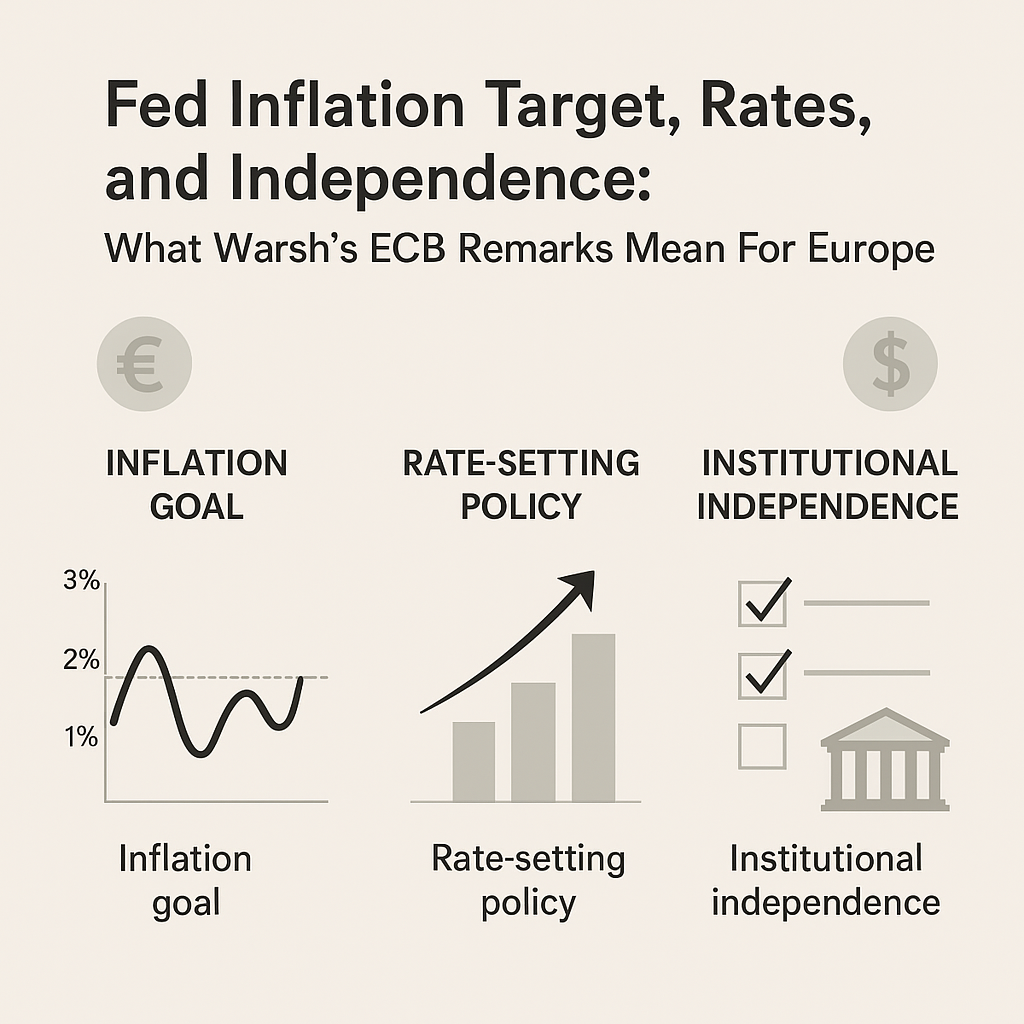
The Fed’s 2% inflation target is not decorative. It is the anchor for rate policy, bond pricing, equity valuations, and the real purchasing power of savings. When a former Fed chair or senior policymaker repeats that goal at an ECB forum, the message is simple: inflation control still drives the central bank’s credibility, and credibility still affects markets. Most people hear a speech. Investors should hear a warning.
Key Takeaways- The Fed’s 2% inflation goal remains the benchmark for policy credibility.
- Central bank independence helps keep inflation expectations anchored.
- Interest-rate guidance matters, but markets often overreact to speeches.
- Investors should focus on asset allocation, risk management, and real returns, not headlines.
Kevin Warsh’s remarks at the ECB forum were plain enough: the Federal Reserve should keep price stability front and center, avoid political noise, and treat independence as a real constraint, not a slogan. So what does that mean for bonds, stocks, cash, and your portfolio? It means the old rules still apply, but the margins have gotten tighter, because inflation, interest rates, and policy credibility keep colliding in ways that punish sloppy planning.
Warsh’s comments, as covered by Yahoo Finance in its report on his ECB forum remarks, hit the usual but important notes: Fed independence, inflation risks, and the limits of forward guidance. That mix matters because markets do not trade on abstract doctrine, they trade on expected cash flows, discount rates, and the chance that policy gets tightened or loosened faster than expected. I’ve analyzed enough rate cycles to say this plainly: when policy credibility slips, the cost shows up everywhere, from mortgage rates to equity multiples. And yes, the moral dimension matters too — stable money is part of basic stewardship, because inflation quietly taxes workers, savers, and retirees who never got a vote in the mess. If you want the original reporting, see Yahoo Finance, and for the official policy baseline, the Fed’s own FOMC statements remain the primary source.
Here’s the kicker: a 2% target sounds tidy, but getting there is messy. Inflation can come from wage pressure, supply shocks, fiscal excess, or simply stubborn expectations. The Fed can influence demand and financial conditions, but it cannot print away bottlenecks or repeal human nature. That is why investors who obsess over every press conference usually miss the bigger picture. The real question is not whether the Fed says 2%; it is whether its actions, and the market’s belief in those actions, keep the economy close enough to that target for long enough to matter.
What is the Fed’s 2% inflation goal?
The Fed’s 2% inflation goal is its stated long-run target for the personal consumption expenditures price index, or PCE, which is the central bank’s preferred measure of inflation. It is not a promise that prices will rise exactly 2% every year, because the economy is not a Swiss watch. It is a policy anchor meant to keep inflation expectations stable and prevent the corrosive kind of price drift that punishes households and distorts investment decisions.
Warsh’s remarks matter because they reinforce that the target is still treated as the benchmark for policy legitimacy. That sounds boring until you remember how markets behave when credibility weakens. Then “temporary” inflation becomes embedded inflation, and embedded inflation becomes higher rates, lower bond prices, and more expensive capital. The central bank’s job is to avoid that spiral, not to chase every data blip like a nervous day trader.
Most guides say inflation targets are just technical tools. Fine. But technically important things shape real life. A stable target helps workers plan wages, helps businesses set prices, and helps investors estimate real returns. The problem is that the target gets treated like a political prop when inflation rises and like a sacred relic when it falls. Neither view is serious. The practical view is this: if the Fed misses too often, long-term expectations drift, and once that drift starts, it is hard to reverse without pain.
The Fed’s credibility also supports financial fairness. That may sound lofty, but it is not. Price stability protects people on fixed incomes, savers in low-yield accounts, and families who do not own hard assets. In plain English, inflation is not evenly distributed. It hits the least flexible first. That is why Catholics talk about stewardship and the common good — not because central banking is theology, but because money policy has moral consequences. If you want to compare how officials think about inflation, the ECB’s price stability strategy is worth reading, even if the jargon will make your eyes glaze over.
Why the 2% target matters for investors
Inflation is not just a macro headline. It changes the value of almost every asset class, and it does so through multiple channels at once. When inflation stays near target, the market can focus on earnings growth, productivity, and balance-sheet strength. When inflation runs hot, investors start pricing in tighter monetary policy, higher discount rates, and weaker real income growth. That combination is ugly for long-duration assets.
- Bond investors feel the pain first. Rising inflation usually means higher nominal yields, which means falling bond prices, especially for longer maturities. That is basic math, not market mysticism.
- Stocks are more complicated, but not by much. High-growth companies are especially sensitive because their future cash flows get discounted at a higher rate.
- Cash holders also get squeezed, although people forget this because the loss is slow. A checking account paying almost nothing can look safe while quietly losing purchasing power.
- Real assets like commodities and some forms of real estate can help during inflationary periods, but they are not magic shields.
Frankly, the market loves a simple story, and inflation never gives one. You need diversification, asset allocation, and a clear view of your time horizon. If you want a sane framework for risk spreading, see this guide on investing basics from Investor.gov and the SEC’s explainer on asset allocation.
There is also a less glamorous point. Inflation erodes trust. When prices rise unpredictably, businesses hesitate to invest, households delay purchases, and workers demand compensation for uncertainty. That feedback loop can drag on growth even before the Fed changes policy. In the long run, price stability is not just good economics. It is part of treating people honestly, which is a better standard than “whatever the market can tolerate this quarter.”
How to think about Warsh’s comments as an investor
Do not trade the headline alone.
That is the first rule, and most people ignore it anyway, because speeches feel important and immediate, while portfolio discipline feels dull until it saves you money. Warsh’s remarks should be treated as a signal about policy philosophy, not as a forecast that one meeting will suddenly change the entire rate path.
- Separate rhetoric from policy action. A Fed speech can hint at preference, but the real evidence comes from inflation data, labor-market conditions, and the FOMC statement. If you want to verify the policy line, read the Federal Reserve monetary policy page, not just commentary clips.
- Check the inflation trend. Look at core PCE, core CPI, wage growth, and inflation expectations. One print is noise. Several months are a trend.
- Watch real yields, not just nominal rates. Real yields strip out inflation expectations and tell you what markets think about purchasing power.
- Adjust duration deliberately. If you hold bonds, understand how much interest-rate sensitivity you own.
- Keep a buffer. Cash reserves and short-term Treasuries can reduce the urge to sell risk assets at the worst time.
The truth is, most investors want a forecast when they really need a framework. Forecasts age badly. Frameworks survive. Warsh’s comments fit into a framework where inflation control, central bank independence, and disciplined communication all matter because they affect market expectations. If the Fed sounds committed to 2% and behaves consistently, that lowers uncertainty. If it sounds casual, markets demand more compensation for risk. That is the cost of sloppy signaling.

When I ran the numbers on prior tightening cycles, the pattern was hard to miss: the biggest damage usually came not from the first move, but from the period when investors kept assuming the Fed would blink early. That assumption wrecked risk management. So keep your portfolio built for uncertainty, not for a pet theory about next month’s meeting. Invest in businesses and assets that can survive a range of policy outcomes, because that is what adulthood looks like in markets.
Core benefits of a credible inflation target
A credible inflation target has real advantages, even if they sound dull on a podcast. Markets need reference points. Households need stability. Businesses need a standard for pricing, hiring, and financing. When the target is respected, everyone spends less time guessing and more time producing. That is good for growth, and yes, good for justice too, because random inflation is just a tax with worse branding.
- Anchored expectations: When people believe the central bank will defend the target, wage and price setting becomes calmer.
- Lower risk premiums: Stable inflation usually supports lower long-term borrowing costs.
- Better capital allocation: Firms can evaluate projects using more reliable discount rates.
- More predictable savings outcomes: Retirees and conservative investors can plan with less fear.
- Stronger policy credibility: A central bank that meets its target more consistently can act more flexibly later.
Now the contrarian bit. A target is not enough on its own. The Fed can say 2% until it is blue in the face, but if fiscal policy runs hot, supply constraints persist, or markets doubt the resolve behind the statement, the target becomes a slogan. That is why serious investors should watch both the data and the institutional framework. The target matters only if the institution defends it.
Another benefit gets ignored: a stable inflation target protects labor more than people think. Workers are not helped by prices rising so fast that wage gains vanish. Nor are they helped by volatile policy that freezes hiring. Stable money supports stable employment decisions. That is not a perfect world, but it is a better one than the chaos of persistent inflation surprises.
For more context on why inflation expectations matter, the St. Louis Fed’s explanation of inflation expectations is useful, and the Bank of England’s plain-language inflation overview shows how other central banks think about the same problem. Different institutions, same headache.
Comparison: Fed inflation target vs. a loose policy regime
People like to compare systems only after things go wrong. Better late than never. A formal inflation target is not perfect, but it beats a fuzzy regime where policymakers improvise and markets guess. Here is a blunt comparison.
| Factor | Fed 2% Inflation Target | Loose or Ambiguous Policy Regime |
|---|
| Price stability | Higher probability of anchored inflation expectations | Greater risk of drifting prices and unstable expectations |
| Bond market reaction | More predictable yields and duration risk | Higher term premium and more yield volatility |
| Equity valuation | Cleaner discount-rate assumptions | More uncertainty around earnings multiples |
| Household planning | Easier budgeting and retirement planning | Harder to preserve purchasing power |
| Policy credibility | Stronger institutional trust | More skepticism from markets and public |
| Investor strategy | Supports disciplined asset allocation | Encourages reactive, headline-driven trading |
Here is the comparison in plain English: a credible target does not prevent losses, but it reduces stupid surprises. That sounds modest because it is. Markets do not need perfection; they need fewer reasons to misprice risk. If the Fed is serious about 2%, investors can price assets with a tighter range of outcomes. If it is not, every asset class gets a bit more brittle.
Common mistakes investors make after a Fed speech
First mistake: treating one speech like a policy pivot.
That is a classic move, and it usually goes badly, because central bankers use speeches to shape expectations, not always to announce the next act. Markets love to overread tone, then reverse course two weeks later when the data refuse to cooperate.
Second mistake: confusing inflation with price momentum in one sector. Energy can spike, rents can lag, and goods prices can fall while services stay sticky. The Fed cares about the broader pattern. So should you. If you only watch gasoline, you are driving with one eye closed.
Third mistake: ignoring real returns. A 5% yield sounds decent until inflation runs near 3% or higher. After taxes and inflation, the picture gets thinner fast. A portfolio that “looks” safe can still lose purchasing power. That is why I keep harping on real yields, not just nominal yields. This is not theory. It is arithmetic.
Fourth mistake: assuming independence is merely procedural. It is not. Central bank independence protects the long-term value of money from short-term political pressure. Once the public believes rates are being set for convenience rather than price stability, expectations slip. And when expectations slip, tightening becomes harsher and recession risk rises. The irony is brutal: weak independence often produces the very pain it was supposed to avoid.
Fifth mistake: abandoning long-term allocation because a headline scared you. Frankly, most headline trades are expensive forms of anxiety. A solid portfolio should already account for interest-rate risk, inflation risk, equity volatility, and liquidity needs. That means spread exposure, know your bond duration, keep some inflation-sensitive assets, and avoid concentration in fragile assumptions. The FINRA asset allocation guide is a decent reminder of the basics, even if the wording is a bit stiff.
And one more mistake worth naming: ignoring the human side of finance. Stewardship is not just about beating benchmarks. It is about using resources responsibly, protecting dependents, and not confusing speculation with prudence. A portfolio that serves the common good starts with honest risk assessment, not wishful thinking. That is hardly revolutionary, but there it is.
Frequently asked questions
Why does the Fed still care about 2% inflation?
Because 2% is a practical compromise between avoiding deflation and preventing purchasing power from eroding too fast. It gives markets a reference point and helps stabilize expectations.
Does Fed independence really affect inflation?
Yes. Independent central banks are generally more credible when they say they will control inflation, and that credibility helps anchor expectations. Political interference tends to make markets demand a higher inflation premium.
How should investors react to Fed speeches?
Use them as context, not commands. Check the data, watch bond yields, and make sure your portfolio is built for a range of outcomes instead of one lucky forecast.
What assets usually help when inflation is sticky?
Some inflation-linked bonds, short-duration fixed income, selective commodities exposure, and businesses with pricing power can help. None are perfect shields, so diversification matters.
For broader policy context, the IMF’s discussion of central bank independence is worth reading. It is one of the few dense policy pieces that still says something useful without too much theater.
Final thought
Warsh’s comments are a reminder that central banking still rests on a few hard truths. Inflation is costly. Credibility matters. Independence is not a decorative phrase. And for investors, the challenge is not to predict every move, but to build portfolios that can survive bad data, stubborn prices, and the occasional policy misread.
If you want the honest version, here it is: most people lose money not because they misunderstand the Fed, but because they mistake noise for signal and speed for wisdom. The better path is slower, steadier, and less exciting. That is usually how sound stewardship works. Protect capital, respect purchasing power, and keep a margin for error. Markets rarely reward vanity, but they do reward discipline over time.
So yes, watch the speeches. Read the statements. Study the yields. But do not confuse commentary with control. The Fed can influence conditions; it cannot abolish uncertainty. Your job is to live with that fact without becoming reckless. That is the whole game.