Corporate America is more optimistic about profits, but the stock market is not rewarding that optimism the way it usually does. The gap matters because...
Corporate America Is More Bullish on Profits — So Why Isn’t the S&P 500 Rallying?
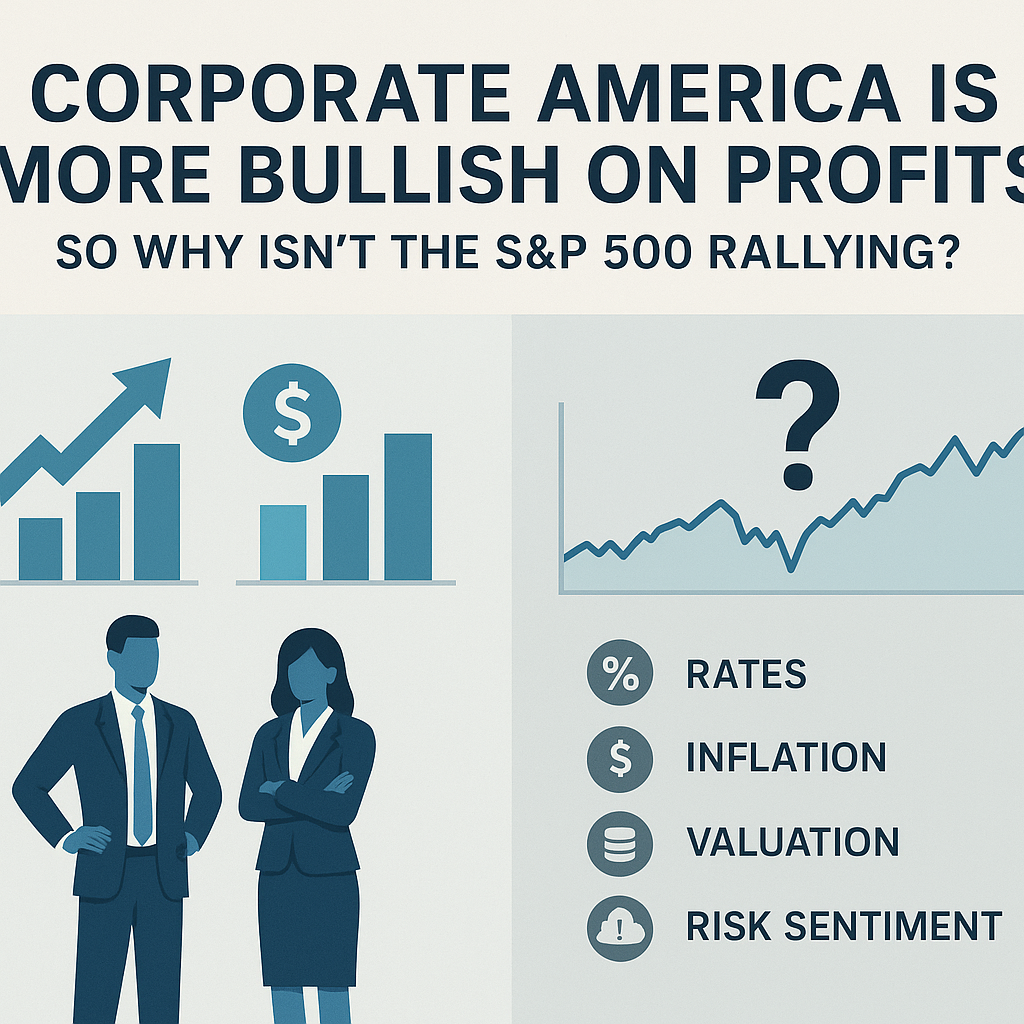
Corporate America is more optimistic about profits, but the stock market is not rewarding that optimism the way it usually does. The gap matters because earnings guidance, valuation, interest rates, and investor positioning are pulling in different directions, and that mismatch can keep the S&P 500 flat even when more companies raise outlooks than cut them.
Key Takeaways- More S&P 500 companies are raising guidance, which is usually bullish.
- Stock prices care about the rate of change, valuation, and the cost of money, not just upbeat press releases.
- A rally can stall when expectations are already high, rates stay elevated, or leadership is narrow.
- Investors should focus on earnings quality, free cash flow, margin trends, and portfolio diversification.
- Good stewardship means treating capital carefully, not chasing every shiny headline.
What is this? It is the strange case where earnings revisions turn positive, yet broad equity indices fail to respond with much enthusiasm. Normally, when more firms raise profit forecasts than trim them, investors see a cleaner earnings setup, stronger margins, and a better chance of future cash generation. That ought to support higher stock prices. But markets are not simple scoreboards. They are discounting machines, and they price future profits against inflation, Treasury yields, sector mix, and how much good news is already baked in.
I have analyzed enough earnings seasons to say this plainly: consensus optimism is useful, but it is not magic. The market asks a harder question. Is the news actually better than what investors already expected? If the answer is only 'a little,' the index can shrug. Why? Because the S&P 500 is often carried by a few giants, and if those leaders are already richly valued, small upgrades from the rest of the market do not move the needle much. That is the kicker.
This matters for anyone watching portfolio allocation, market volatility, or the health of the U.S. economy. It also matters for investors who confuse rising guidance with a guaranteed rally. That confusion is expensive. Capital should be managed with prudence, justice, and a real respect for the people whose work creates those profits in the first place.
A better approach is to examine the mix: who is raising guidance, whether margins are holding, how rates are affecting valuations, and whether profit growth is broad or concentrated. The data, not the cheerleading, should set the tone.
What is this? It is an earnings uptrend that has not yet earned a broad market celebration.
What is Corporate Profit Outlook Optimism?
Corporate profit outlook optimism means more public companies are revising earnings guidance upward than downward. That sounds straightforward, and usually it is a healthy sign. Analysts track these revisions because they help forecast future earnings per share, revenue growth, operating margins, and overall S&P 500 profit momentum. When upgrades outnumber downgrades, it often signals that business conditions are better than expected.
But here's the problem. Market prices do not respond to optimism in a vacuum. They respond to surprises. If analysts and investors already expected a recovery, then a wave of modestly better guidance may not trigger much buying. That is why a positive earnings revision ratio can coexist with a weak index. The market may have moved ahead of the news.
Most guides say earnings upgrades are an automatic bullish sign. They are not. I've seen periods where profits improved while stocks went nowhere, and the reason was usually the same: valuation was too high, rates were too high, or the gains were too narrow. If a handful of mega-cap names do the heavy lifting while the rest of the index treads water, broad-market enthusiasm stays limited.
A proper definition also includes earnings quality. Not all guidance is equal. A company can raise forecasts because demand improved, which is good. Or because it cut costs hard, postponed investment, or used accounting assumptions that flatter the near term. That is less impressive. Frankly, investors who treat every upward revision as proof of strength are not analyzing, they are daydreaming.
To make sense of the current setup, you need to track four things together:
- Guidance revisions: Are more firms raising than cutting?
- Earnings breadth: Is the improvement spread across sectors?
- Valuation: Are stocks already priced for perfection?
- Rates and liquidity: Is the cost of capital suppressing multiples?
The Bible has a simple line for this sort of thing: 'the borrower is servant to the lender.' In markets, that truth shows up as higher rates compressing valuations and forcing investors to count costs instead of stories. There is a moral angle here too: profits matter, but so does honest work, prudent stewardship, and care for the common good. A company that earns well by treating workers and customers fairly is better than one that juices EPS and leaves wreckage behind.
For a related perspective on how markets price risk, see the Federal Reserve’s monetary policy materials at Federal Reserve monetary policy and earnings season trend data in the FactSet earnings commentary.
Core Benefits and Why It Matters
Profit optimism matters.
When more companies raise guidance, several useful things can happen, even if the stock index does not immediately cooperate, because better expectations can still improve future cash flows, stabilize hiring, support capital spending, and reduce recession odds at the margins.
- Improved earnings visibility: Companies that raise guidance give investors a clearer view of future cash flow, which matters more than vague corporate cheer.
- Stronger margins: Upward revisions often hint that pricing power or cost control is working, and that can support valuations over time.
- Healthier balance sheets: Better profit expectations can improve debt service coverage and give firms room to invest or buy back shares.
- Sector clues: Revision breadth helps identify which industries are actually improving, rather than relying on a single mega-cap story.
- Economic signal: Broad upgrades can suggest demand is holding up better than feared, which is useful for asset allocation and risk management.
Here is the kicker: the benefit is not always immediate price appreciation. That frustrates people who think markets are a vending machine. Put in good news, get out gains. It does not work that way. Stocks are priced on expectations, and expectations can already be lofty.
I think this is where many investors go wrong. They confuse 'good' with 'undervalued.' A company can be excellent and still be a poor stock at the wrong price. That is especially true when price-to-earnings multiples are stretched. If investors already paid up for a rosy future, then better guidance may simply prevent a decline rather than spark a rally.
There is also a broader stewardship lesson. Capital is not just a number on a screen. It represents labor, savings, deferred consumption, and family security. From that angle, the goal is not to chase every short-term move; it is to allocate resources wisely, avoid waste, and prefer firms that create durable value rather than spectacle.
For deeper context on how earnings revisions affect stocks, the earnings revisions overview is useful, and the S&P 500 index facts show how concentrated the benchmark can be.
Step-by-Step Guide to Interpreting the Signal
Start with the numbers.
You do not need a PhD to read earnings season, but you do need discipline, because the market is full of shiny nonsense and lazy takes, and the difference between a real trend and a temporary pop often lies in a few boring details.
- Check the revision ratio
Look at how many companies raised guidance versus cut it. A favorable ratio is good, but ask whether it is broad or concentrated in a few sectors like technology, communication services, or energy. - Compare to expectations
Ask whether the upgrades are beating analyst estimates by enough to matter. If estimates were already low, the upside may be less impressive than the headline suggests. - Measure margin quality
Are firms growing because revenue is healthy, or because costs were squeezed? I always care more about operating leverage supported by demand than about one-time trimming. - Watch rates and the discount rate
Even when profits improve, higher Treasury yields can lower equity valuations. That is math, not opinion. When the risk-free rate rises, future earnings are worth less in present-value terms. - Check market breadth
If only a few mega-caps are lifting the index while the median stock lags, the rally is fragile. Breadth tells you whether investors believe the story or just love a handful of names. - Review free cash flow
Earnings can be massaged. Cash is harder to fake. If guidance improves but cash conversion weakens, that is a warning sign. - Assess capital allocation
Are companies investing wisely, repurchasing shares at sane prices, and paying dividends sustainably? Or are they using financial engineering to mask slower growth? Be blunt about it.

Here's what nobody tells you: the best investors do not just ask 'Is guidance up?' They ask 'What is the source of the improvement, who benefits, and what price is already reflected in the stock?' That is the difference between analysis and applause.
I usually run the numbers in three layers. First, I look at sector revisions to see where the earnings cycle is turning. Second, I check valuation against history and bond yields. Third, I compare cash flow and balance sheet strength, because companies with low leverage can absorb shocks better than those living on borrowed time.
That process works because it respects reality. Markets punish sloppy thinking. They also reward patience, which is a fine old virtue and not just a religious one. A disciplined investor sees profit optimism as a clue, not a command.
For more on the mechanics of valuation and rates, see the BlackRock market outlook and the CME interest rate market data.
Comparison Table: Earnings Optimism vs. Broad Market Rally
The two are not the same.
A positive earnings revision trend can support stocks over time, but a rally depends on valuation, breadth, rates, and investor appetite, and that is why the market can stay stubborn even when corporate America sounds upbeat.
| Factor | Corporate Profit Outlook Optimism | Broad S&P 500 Rally |
|---|
| Core driver | Upward earnings guidance and revisions | Higher stock prices across many sectors |
| What investors focus on | Future profits, margin trends, cash flow | Valuation, liquidity, sentiment, breadth |
| Typical response | Better medium-term fundamentals | Immediate price gains |
| Main risk | Optimism may already be priced in | Rally can be narrow or overstretched |
| Best use | Screening strong businesses | Measuring market-wide participation |
| Biggest weakness | Does not guarantee stock gains | Can fade if earnings disappoint |
| Competitor in practice | Rising Treasury yields and high multiples can mute impact | Strong breadth usually needs easing rates and cheap valuations |
Frankly, this table explains the whole mess. One signal speaks to business health; the other speaks to investor behavior. Those are related, but they are not twins.
The current market may be telling us that profits are improving, but valuations and rates are doing a better job of setting price than earnings revisions alone. That is not bearish by itself. It is just a reminder that stock prices are paid in the present, while profits are earned over time.
Common Mistakes to Avoid.
Do not worship the headline.
Investors make the same mistakes every cycle, and the most expensive one is assuming that a positive headline equals a positive portfolio outcome, when in truth the details matter far more than the press release language.
- Chasing guidance without checking valuation: A firm can raise forecasts and still be overpriced. The stock may already reflect the good news.
- Ignoring concentration: If the S&P 500 is led by a few giants, broad optimism may be weaker than it looks.
- Confusing earnings with cash flow: Reported profits can improve while real cash generation stays weak.
- Overlooking interest rates: Higher yields can suppress price-to-earnings multiples even when earnings rise.
- Assuming all sectors behave alike: Financials, utilities, technology, and industrials react differently to profit upgrades.
- Reacting to one quarter: One earnings season does not define a full cycle. Investors who overreact are usually paying tuition to the market.
Most commentary gets this backward. It celebrates better guidance as if the job is done. It is not. The useful question is whether the revised outlook changes the intrinsic value enough to justify buying now. If not, pass. There is nothing noble about owning expensive stocks just because the mood turned cheerful.
I also think investors should be skeptical of aggressive buyback narratives. Repurchases can boost EPS, but they do not create true economic strength if the company is borrowing to fund them or buying back shares at silly prices. That is financial paint, not substance.
There is a quiet moral point here: wise investing is a form of stewardship, not gambling with the family ledger. Prudence is not fear. It is discipline. And discipline usually beats excitement.
Frequently Asked Questions
Why don’t stocks rally when earnings outlooks improve?
Because markets price expectations ahead of time, and if the good news was anticipated, the stock may not move much. Higher interest rates, weak breadth, or stretched valuations can also offset positive guidance.
Is more guidance upside always bullish?
No. It is bullish only if the revisions are meaningful, broad, and supported by cash flow and margins. A modest upgrade after a big run can be a shrug, not a signal to buy.
What should investors watch besides earnings guidance?
Watch free cash flow, margin trends, debt levels, valuation multiples, and market breadth. Those factors usually tell you more about stock performance than one headline number.
Does positive corporate guidance mean recession risk is falling?
It can, but not automatically. It depends on whether the improvement is broad across sectors and whether consumers, labor markets, and credit conditions are still holding up.
The truth is, a market rally needs more than hopeful language from CEOs. It needs credible profits, reasonable prices, and enough participation from the rest of the index to make the move real.
Corporate America can sound confident and still fail to lift stocks.
That is not a contradiction; it is the market doing its usual blunt arithmetic, weighing earnings against valuation, rates, and the crowded hopes already sitting in prices, and reminding investors that good businesses do not always make good investments at every moment.
When I look at a setup like this, I do not ask whether optimism exists. It does. I ask what it costs, whether the improvement is broad, and whether the gains are built on durable cash generation or merely a bit of financial theater. That sounds severe, but markets reward severity. They punish laziness.
So the sensible response is not panic, and it is not cheerleading either. It is selective buying, careful sizing, and a preference for companies that create real value through honest products, sound balance sheets, and respect for human work. There is a reason old wisdom keeps resurfacing in modern finance: prudence ages well.
If the next few earnings reports show stronger breadth, better margins, and calmer rates, the rally may come. If not, the market will keep waiting, because the market is rude that way. And usually right.