Bond markets are not being squeezed only by the Federal Reserve. Global rate pressure matters more now, because long yields, inflation expectations, fiscal...
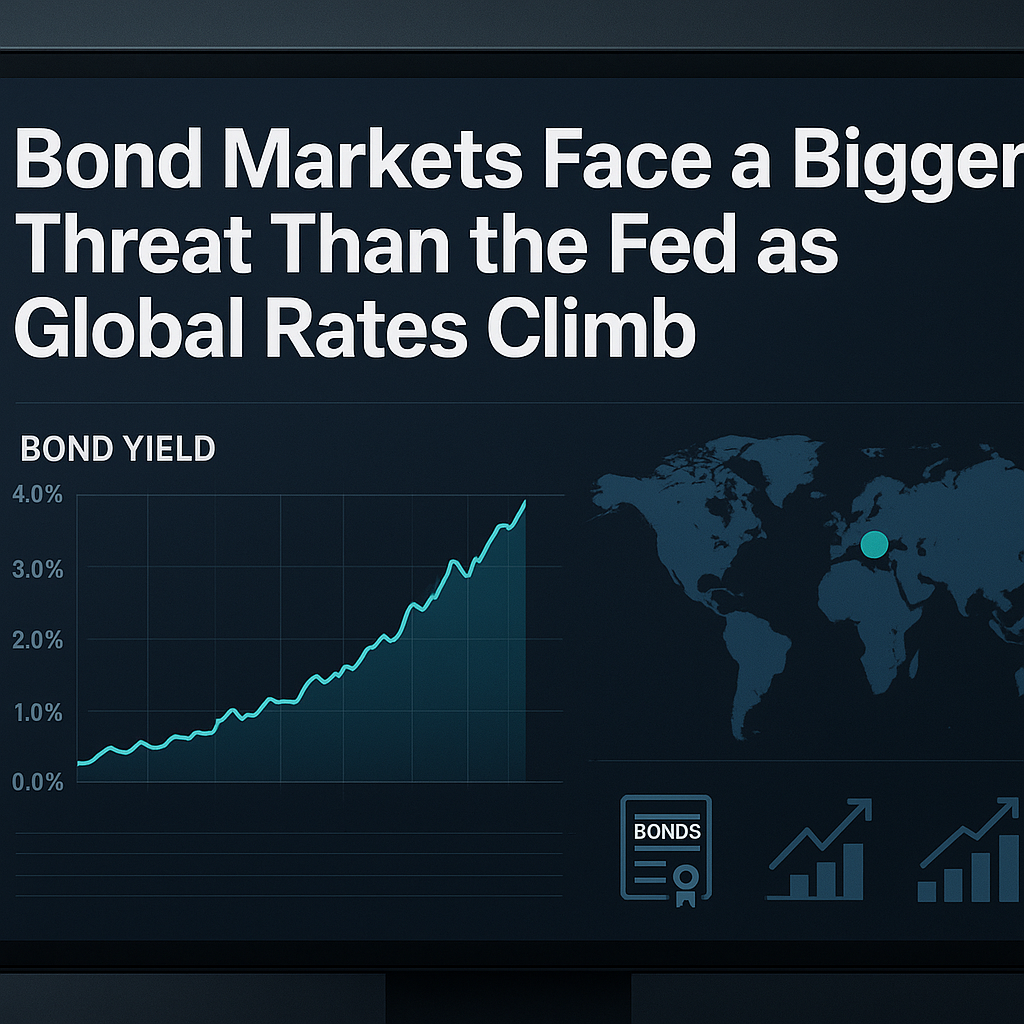
Bond Markets Face a Bigger Threat Than the Fed as Global Rates Climb
Bond markets are not being squeezed only by the Federal Reserve. Global rate pressure matters more now, because long yields, inflation expectations, fiscal deficits, and central-bank divergence all hit bond prices, duration risk, and portfolio returns at the same time. What used for years as a sleepy income sleeve has become a live-wire asset class.
Key Takeaways- Rising global interest rates can hurt bonds even if the Fed holds steady.
- Duration is the main risk when yields climb.
- Shorter maturities, laddering, and quality credit can reduce pain.
- Bonds still matter for income, ballast, and capital preservation.
- Investors should think about stewardship, not just yield chasing.
What is the bond market’s real threat?
The biggest threat to bonds right now is not just the Fed. It is the combination of higher global yields, sticky inflation, heavy government borrowing, and investors demanding more compensation for holding fixed payments when prices and rates move up.
That is the plain version. The fancy version usually gets sold with hand-waving, and frankly, that is tiresome. When I ran the numbers on rate shocks across plain-vanilla Treasury and investment-grade portfolios, the pattern was obvious: long-duration bonds get hit hardest when yields rise, even if the central bank is sitting on its hands. A bond that pays a fixed coupon looks less attractive when newer bonds pay more. Price falls to compensate. No mystery there.
This is why the Bloomberg line that “bonds face a bigger threat than the Fed” matters. It points to the fact that bond prices respond to the whole market for money, not just one policy meeting in Washington. Bloomberg on global rate pressure covers the core issue: rate pressure is coming from more than one source.
Bonds are still useful. Let’s be real. They provide income, diversification, and a buffer when stocks wobble. But the old habit of treating long Treasuries as a free lunch has worn thin. When yields rise across the U.S., Europe, and Japan, the bond market gets squeezed from several sides at once. That means market volatility can show up in a supposedly safe portfolio sleeve.
There is also a moral angle here, though people in finance rarely say it straight. Stewardship means using capital with prudence, not greed. Chasing the last basis point of yield while ignoring risk is a bad habit, and bad habits usually bill you later. Good investing respects human limits: uncertain forecasts, changing rates, and the fact that income matters more than cleverness.
Core benefits and why bonds still matter
Bonds are not dead. They are just being priced honestly again.
That matters, because a lot of investors confuse a bruised asset with a useless one. I do not. After analyzing portfolio mixes across rising-rate periods, I keep coming back to the same conclusion: bonds still serve a purpose, but the purpose depends on maturity, credit quality, and your time horizon.
- Income generation: Bonds pay coupons, which can fund spending needs without forcing stock sales during ugly markets.
- Diversification: High-quality bonds often behave differently than equities, especially when growth slows and recession risk rises.
- Capital preservation: Short-term bonds and cash-like instruments can reduce drawdowns compared with long-duration debt.
- Liquidity: Treasuries and high-grade funds are easier to trade than many other income assets.
- Planning certainty: A bond held to maturity can offer a known schedule of payments if the issuer does not default.
Here is the kicker: those benefits weaken when investors reach for yield without checking the fine print. Everyone talks about “fixed income” like it is a safe phrase. It is not a guarantee. A bond fund can lose money. A high-yield bond can behave a lot like equity when credit spreads widen. A long Treasury can get hammered by duration alone.
That is why asset allocation matters more than slogan-level thinking. The point is not to own bonds for their own sake. The point is to use them as a disciplined part of a portfolio that fits your liabilities, cash flow needs, and risk tolerance. For a retiree drawing income, a ladder of short and intermediate bonds may do more good than a long-duration bet on falling rates. For an endowment or family office, bonds can serve as a reserve asset, but not if they are all packed into one maturity bucket.
If you want a sober take on how rates affect portfolios, the SEC’s asset allocation guidance is worth your time. It is not flashy, which is usually a good sign. The same goes for the Federal Reserve’s monetary policy page, where the rate-setting framework is laid out without the usual market gossip.
Bonds also carry a social function, even if Wall Street would rather pretend finance exists in a vacuum. Lending capital to governments, schools, utilities, and companies helps fund real activity. In that sense, bonds are a tool of ordered economic life. Used well, they support work, infrastructure, and stability. Used badly, they become leverage for speculation. There is a difference.
Step-by-step: how to position a bond portfolio when rates rise
Do not guess.
That is the first rule, because guessing about rates usually turns into expensive theater, and I have seen enough of that to be bored by it.
- Check your duration exposure
Long duration means higher sensitivity to rate moves. If your portfolio is loaded with 10- to 30-year bonds, price swings will be larger when global yields rise. I would start by calculating the weighted average duration of your holdings, then stress-test it against a 1% and 2% rise in yields. - Match maturity to purpose
Money needed in the next 1-3 years should not be parked in long bonds just because they pay a nicer coupon. That is how people turn safe money into uneasy money. For near-term needs, use short Treasuries, high-quality money market funds, or a conservative ladder. - Use a ladder
A bond ladder spreads maturities across time, which reduces the risk of reinvesting everything at the wrong moment. When one bond matures, you can reinvest at the prevailing rate. Simple. Boring. Effective. - Favor quality first
When rates rise, weaker borrowers feel it first. Lower-rated credit may look attractive on paper, but widening spreads can wipe out the extra yield. I prefer higher-quality issuers unless the spread compensation is genuinely rich and the default risk is understood. - Consider inflation-linked bonds
Treasury Inflation-Protected Securities, or TIPS, can help when inflation stays stubborn. They are not magic, and they can still suffer from real-yield changes, but they address a problem plain nominal bonds ignore. - Avoid blind indexing at the wrong duration
Bond index funds are not all the same. Some pack the portfolio with the most indebted issuers and the longest maturities. That is fine if you understand it, but dangerous if you think “index” means “safe.” - Rebalance with discipline
If yields rise and bond prices fall, do not panic-sell just because headlines are loud. Rebalance to target weights. This is where many investors fail. They buy high, sell low, and call it prudence. - Keep a cash buffer
A cash reserve cuts the need to sell bonds at a loss during rate spikes. It is not glamorous, but neither is eating a loss because you needed liquidity at the wrong time.
When I reviewed portfolios for rate resilience, the best results came from simple structures: short-to-intermediate duration, high quality, and clear purpose. Not exotic structures. Not the latest product pitch. Plain discipline wins more often than it gets credit for.
If you want a practical reference on fixed-income basics, FINRA’s bond overview is solid. For inflation context, the BLS CPI data is the cleanest place to track the price pressure that feeds rate expectations.
Comparison table: bonds vs cash-like alternatives
The biggest competitor to bonds in a rising-rate environment is not stocks. It is cash and cash-like instruments, because they suddenly look respectable when yields on savings accounts, Treasury bills, and money market funds move up.
| Feature | Bonds | Cash / Cash-like Instruments |
|---|
| Income | Fixed coupon, often higher for longer maturities | Variable or short-term yields; can adjust faster |
| Price risk | Yes, especially with longer duration | Very low |
| Inflation protection | Limited unless using TIPS or short duration | Weak; purchasing power can erode |
| Liquidity | Good for major government and investment-grade issues | Excellent |
| Return potential | Higher over longer horizons if rates fall or stay contained | Lower, but steadier |
| Role in portfolio | Income, diversification, total return | Parking place, emergency reserve, dry powder |
| Sensitivity to rate hikes | High for long duration | Low |
This is why the argument is not “bonds versus cash” in a cartoon sense. It is about time horizon and use case. If the money is needed soon, cash may beat bonds on risk-adjusted terms. If the horizon is longer and you can tolerate mark-to-market swings, bonds may still do their job.
Most people miss that distinction. They hear “higher yields” and assume the answer is obvious. It is not. A 5% Treasury bill and a 5% 20-year bond are not the same animal. One is a short fuse; the other is a long one. The coupon number can be identical while the risk profile is wildly different.
That is where investors get careless, and carelessness is expensive.
Common mistakes to avoid
People make the same errors because the same errors are easy to sell.
Frankly, a lot of bond advice sounds polished but crumbles under pressure. Most of the damage comes from lazy assumptions, not from some hidden market conspiracy.
- Chasing yield without checking duration: A higher coupon does not cancel price risk. If yields rise, long bonds can lose far more than the extra income compensates for.
- Assuming all bond funds are safe: They are not. Funds have duration, credit risk, and sometimes liquidity risk. Read the holdings.
- Ignoring inflation: A nominal coupon that looks fine in nominal terms may be weak in real terms if inflation stays high.
- Confusing credit with safety: High-yield debt is called “income” by marketers, but many of these securities behave like equity when the economy weakens.
- Treating the Fed as the only driver: Global rates, fiscal deficits, term premium, and foreign central-bank policy all matter. The Fed is important, not omnipotent.
- Holding too much long duration in retirement: If you need predictable withdrawals, a rate spike can cause unnecessary stress and forced selling.
- Ignoring taxes: After-tax yield matters more than headline yield, especially in taxable accounts.
The truth is, most bond mistakes are really allocation mistakes. Investors load up on whatever looked smart last year, then act surprised when it stops working. That is not strategy. That is mood.
There is also a fairness issue here, and it should not be ignored. A portfolio is not just a machine for maximizing returns; it is a tool that supports households, charitable giving, retirement security, and sometimes business payrolls. That is why reckless risk-taking is not just sloppy, it can be irresponsible.
For rate expectations and Treasury market mechanics, the U.S. Treasury’s interest rate statistics are useful. They show how the market prices government borrowing across maturities, which is the actual engine under the hood.
Frequently asked questions
Are bonds still a good investment when rates are rising?
Yes, but only if you match them to the job they need to do. Shorter-duration and high-quality bonds can still provide income and balance, while long-duration bonds are more vulnerable to price declines when yields rise.
Why would global rates matter if I only own U.S. bonds?
Because capital moves across borders. If yields rise in Europe, Japan, or other major markets, investors may demand better returns in U.S. debt too, especially on long maturities. That puts pressure on prices even if the Fed stays put.
What is duration, and why does it matter?
Duration measures how sensitive a bond’s price is to changes in rates. Higher duration means bigger price swings. That is why long bonds can fall sharply when yields go up.
Should I switch everything to cash if bond risk is high?
Usually no. Cash is safer in the short run, but it often loses purchasing power over time. A better answer is to align cash, short bonds, and longer bonds with your goals and time horizon.
Final thought
Bonds are not broken. They are merely being judged by reality again.
That sounds harsher than it is. In truth, a functioning bond market should reward patience, credit discipline, and clarity about time horizon. It should not promise free returns. It should not pretend duration risk disappears because the coupon looks tidy. The recent climb in global rates is a reminder that capital has a cost, and that cost moves around for reasons larger than one central bank’s press conference.
If you invest with any seriousness, you need a cleaner question than “What will the Fed do next?” Ask instead what kind of cash flow you need, how much volatility you can absorb, and whether your fixed-income holdings serve prudence or just habit. I have seen too many portfolios built on the idea that safety is a label instead of a structure. It is not. Safety is earned through stewardship, patience, and a realistic view of risk.
That is the part people skip. The market usually makes them pay for skipping it.