<strong>$40T is not abstract.</strong> It is interest, taxes, inflation pressure, and fewer good choices later. The United States has crossed a line that...
$40T US Debt: How It Hits Everyday Americans
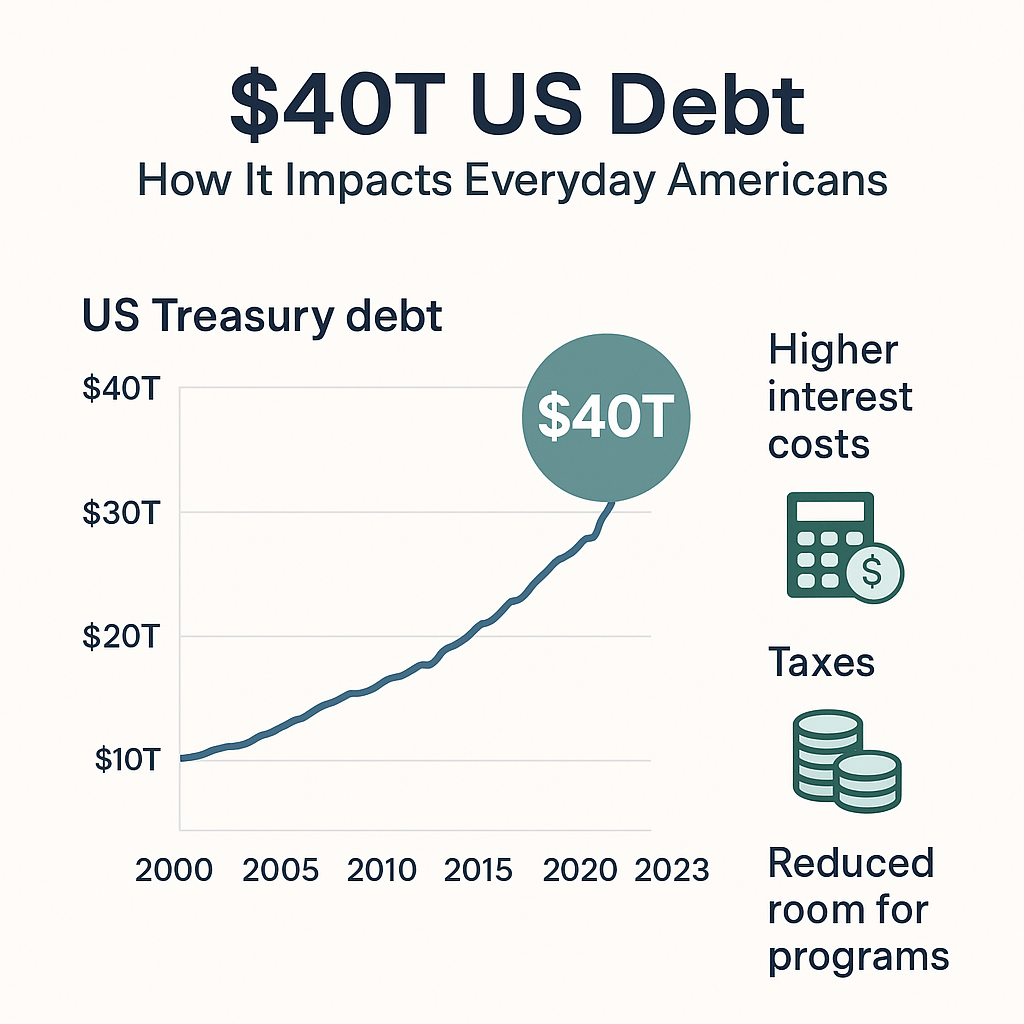
$40T is not abstract. It is interest, taxes, inflation pressure, and fewer good choices later. The United States has crossed a line that politicians keep pretending is temporary, but the math is stubborn: debt service is eating more of the budget, borrowing costs are high, and every household feels the consequences through slower growth, tighter credit, and weaker future fiscal options. Who pays? Ordinary workers, savers, and taxpayers.
Key Takeaways:
- The $40 trillion debt burden raises long-run borrowing costs and crowds out other priorities.
- Debt service can reduce room for tax relief, infrastructure, defense, and safety-net spending.
- Everyday Americans feel it through inflation risk, higher rates, and weaker wage growth.
- The problem is bipartisan; both tax cuts and spending increases have contributed.
- Households should respond with stronger savings, lower leverage, and disciplined portfolio planning.
What is the $40 trillion US debt crisis?
It is federal debt.
More specifically, it is the sum of Treasury securities and other federal obligations that the government has accumulated by spending more than it collects in revenue over many years, and now the balance has climbed past $40 trillion. That sounds like a Washington problem, which is exactly the excuse politicians love. It is not. It is a household problem, a business problem, and a capital markets problem, because Treasury borrowing affects interest rates, risk appetite, taxes, and the future budget mix.
I have analyzed enough fiscal cycles to know this: debt is not always evil, but debt without discipline becomes a tax on tomorrow. That is the plain truth. Used for productive investment, borrowing can support growth, war, or crisis response. Used to paper over chronic deficits, it becomes a bill that compounds. The Congressional Budget Office has repeatedly warned that rising deficits and interest costs will put the federal budget on a harder path, and the U.S. Treasury reports show the scale of debt financing required to keep the government operating.
Here’s the kicker. This is not just about the absolute number. It is about the speed of the climb and the cost of carrying it. The U.S. crossed $20 trillion not that long ago, and then doubled again in a blink by historical standards. That kind of acceleration changes expectations. Credit markets notice. Households notice. Businesses notice.
Most people think federal debt is paid by “the government,” as if that were a creature from another planet. Frankly, it is paid by people through taxes, inflation, reduced public services, or slower wage growth when the economy is burdened by higher rates and lower investment. A sound society should treat public money as stewardship, not a political slush fund. That older moral instinct is not quaint; it is necessary.
The debt also interacts with the Federal Reserve. When inflation runs hot, the Fed often raises rates, which pushes Treasury interest expense higher. That creates a nasty loop: more debt, more interest, more deficit pressure, more borrowing. The result is not immediate collapse. It is worse. It is a slow squeeze.
Core benefits/importance: why everyday Americans should care
This matters now.
The average family may not read Treasury auction schedules, but the effects show up in mortgage rates, car loans, business credit, and the tax debate that never seems to end. When the federal government borrows more, it competes for capital. When investors demand a higher yield, that cost can spill into consumer borrowing. That is the mechanism. Not magic. Not ideology.
- Higher interest rates over time: Heavy federal borrowing can keep upward pressure on Treasury yields, which matters because yields anchor borrowing costs across the economy. If you are shopping for a mortgage or refinancing debt, you already know rates are no joke.
- Less room for useful spending: When interest expense rises, less budget space remains for roads, research, defense readiness, and targeted support for families in need. The budget gets boxed in.
- Tax pressure later: Politicians often sell tax cuts today and “growth” tomorrow, but the bill does not disappear. It shows up later in a different form—higher taxes, more fees, or sneaky bracket creep.
- Inflation risk: Persistent deficits can make it harder to keep inflation contained, especially if the economy is already near capacity and the Fed is fighting price growth. People feel this in groceries and rent, not in policy memos.
- Weaker long-term growth: Crowding out private investment can slow productivity, and productivity is where real wage gains come from. No productivity, no real prosperity. Simple as that.
- Political distortion: Debt levels make the budget process more theatrical and less honest, because both parties can promise what the arithmetic cannot support. That is where cynicism breeds.
Everyone talks about government debt like it is a distant abstraction. It is not. It hits workers through paychecks, savers through returns, and retirees through the purchasing power of fixed income. I have seen too many investors ignore fiscal risk until it starts eating their portfolio assumptions.
For households, the importance is practical. A government with less fiscal room has less ability to cushion recessions without borrowing even more. That matters in layoffs, housing downturns, and market stress. The common good is not served by pretending there is always another fiscal rabbit to pull from the hat.
If you want a related read on managing your own balance sheet while Washington keeps making a mess, see personal budgeting basics and debt management strategies. The state of the federal ledger is a warning, not a license.
Step-by-step: how the debt problem reaches your wallet
It starts quietly.
Most Americans will not feel a debt crisis as a single dramatic event. They feel it through a chain of cause and effect, and each step looks boring until the damage piles up. Here is the chain, stripped of consultant nonsense.
- Federal deficits continue: Congress spends more than it takes in, often because tax cuts are popular and spending promises are even more popular. Both parties do this when convenient. Be honest about it.
- Treasury issues more debt: The government sells bonds and bills to finance the gap. Investors buy them because U.S. debt is still the deepest and most trusted market in the world. That trust is an asset. It is not guaranteed forever.
- Interest expense rises: As debt grows and rates stay elevated, the government pays more just to service old borrowing. That means more cash for bondholders and less flexibility for everything else.
- Budget tradeoffs get uglier: To cover interest and mandatory programs, policymakers must either raise taxes, cut programs, or borrow again. There is no free lunch. There never was.
- Household effects show up: Borrowing costs can stay high, wage growth can weaken if investment slows, and future taxes may rise. This is where the abstract becomes real.
- Long-run wealth building gets harder: High-rate debt at the federal level often coincides with higher private borrowing costs and lower confidence. That can reduce retirement savings, home affordability, and business expansion.
What actually works for families? I have looked at enough balance sheets to say this plainly: lower your own leverage, build a cash buffer, and keep your investment plan boring. Boring wins more often than dramatic. The market rewards patience, not theater.
Here is a practical sequence for households:
- Audit your debt: Know your rates, minimums, and payoff timeline.
- Protect liquidity: Keep 3-6 months of expenses in cash or short-term reserves.
- Favor quality assets: Use diversified portfolios, not hot tips.
- Watch rate sensitivity: If you hold bonds, know duration risk.
- Stress test your plan: Ask what happens if rates stay high longer than expected.
If you want a cleaner framework for building an actual portfolio instead of just hoping, read asset allocation guide and diversification explained. A household that manages money responsibly is practicing a small form of stewardship, and that matters more than pundits admit.
Comparison table: federal debt vs. fiscal restraint
Here is the simplest comparison. Not pretty, but honest.
| Feature |
Rising Federal Debt |
Fiscal Restraint |
| Short-term political appeal | High | Low |
| Interest cost over time | Rising | More controlled |
| Tax pressure later | Higher | Lower |
| Budget flexibility | Weaker | Stronger |
| Inflation risk | Higher if mismanaged | Lower, all else equal |
| Private investment crowding out | More likely | Less likely |
| Effect on mortgage/loan rates | Often negative through rate pressure | More stable |
| Moral discipline | Weak stewardship | Better stewardship |
The biggest competitor to honest fiscal discipline is not the other party. It is denial.
People compare federal debt to household debt, but that is only partly useful. A household can file bankruptcy, move, or slash spending fast. A sovereign state with a reserve currency can roll debt for a long time. That is why this problem grows in silence. It does not break loudly. It bends institutions slowly until choices get uglier.
The better comparison is between productive debt and consumptive debt. Productive debt builds capacity—roads, ports, energy systems, research, and institutions that support growth. Consumptive debt funds promises without matching future output. That is where trouble starts. Catholic social teaching has always understood that stewardship requires order, justice, and respect for the common good. Waste is not harmless just because it is popular.
If you care about markets, this comparison matters because Treasury supply affects rates, and rates affect valuation multiples, bond prices, and credit spreads. When I ran scenario work for client portfolios, the ugly case was rarely “debt equals instant crisis.” It was “debt keeps rates elevated and growth mediocre for years.” That is a slow bleed. The market hates it.
Common mistakes to avoid
Most advice is lazy.
The public conversation around federal debt is full of slogans and nearly empty of arithmetic. That is convenient for politicians and annoying for everyone else who has to live in the real economy. Let’s be real: if you hear a claim that sounds too clean, it probably is.
- Mistake 1: Thinking debt only matters at default
Default is not the only risk. You can get damage from higher rates, slower growth, and budget crowd-out long before any technical crisis.
- Mistake 2: Assuming tax cuts pay for themselves
Sometimes growth helps, but the record does not support magical full offset in most cases. Revenue losses usually matter. Pretending otherwise is wishful thinking with a spreadsheet.
- Mistake 3: Believing spending is always bad
Not true. Some spending is investment, some is insurance, and some is waste. The useful question is not “spend or not,” but “on what, for whom, and with what result?”
- Mistake 4: Ignoring interest expense
Interest is now a major budget item. If you ignore compounding, you misunderstand the problem. That is how fiscal plans fall apart.
- Mistake 5: Confusing nominal GDP growth with real progress
Inflation can make GDP look healthier than living standards really are. Households care about purchasing power, not headline math.
- Mistake 6: Treating the issue as partisan theater
Both parties have been guilty. One side prefers tax cuts without offsets. The other side prefers spending commitments that outgrow revenue. Same mess, different slogans.
For investors, the mistake is to assume government debt never affects asset selection. It does. It can shape duration risk, equity valuations, sector leadership, and the relative appeal of real assets versus nominal claims. If you want a broader framework, see risk management in investing and retirement planning strategy. Prudence is not fear. It is clarity.

Frequently asked questions
Will the $40 trillion debt cause a U.S. default?
Not by itself.
The U.S. can service debt in its own currency, and outright default is not the base case. But that does not mean the debt is harmless. High debt can still raise interest costs, constrain budgets, and weaken long-run economic flexibility. That is the real risk.
Does government debt automatically cause inflation?
No.
Inflation depends on many factors, including money supply, demand, supply shocks, labor markets, and Fed policy. Still, persistent deficits can contribute to inflationary pressure if they are financed in ways that strain the economy. The effect is indirect, not automatic.
How does federal debt affect mortgage rates?
Mostly through Treasury yields and broader rate expectations.
Mortgage rates are influenced by bond markets, inflation expectations, and central bank policy. When Treasury borrowing rises and yields move higher, mortgage rates often follow. Not perfectly, but close enough to matter when you are buying a house.
What can households do to protect themselves?
Keep your own books clean.
Reduce high-interest debt, maintain cash reserves, invest with diversification, and avoid plans that only work if borrowing costs stay low forever. If your plan only works when rates are low forever, it is not a plan. It is a wish.
Final thought
The debt problem is not some distant accounting footnote.
It is a measure of whether a country can tell the truth about what it owes, what it can afford, and what it owes its own citizens in future opportunity. That sounds grand, but it comes down to ordinary things: housing costs, wages, taxes, and the dignity of work. A government that borrows without restraint can postpone pain, but it cannot abolish arithmetic.
I do not think most Americans want a crisis. They want honest government, stable money, decent returns on savings, and a fair shot at building a life. Reasonable people can disagree on the size of government, but they should not disagree on the need for stewardship. Resources are limited. Choices have consequences. That is not a partisan slogan; it is the basic structure of reality.
The wise response is not panic. Panic is for people who have not done the math. The wise response is discipline: stronger household balance sheets, better portfolio construction, pressure on policymakers to stop pretending deficits are free, and a renewed respect for the common good. That is old-fashioned, yes. It is also the only thing that works.