Ten-year Treasury yields are back above 5%, and that matters because bond markets do not move like this for decoration. Higher long-term rates change discount...
10-Year Treasury Yields Above 5%: Are More Market Risks Surfacing?
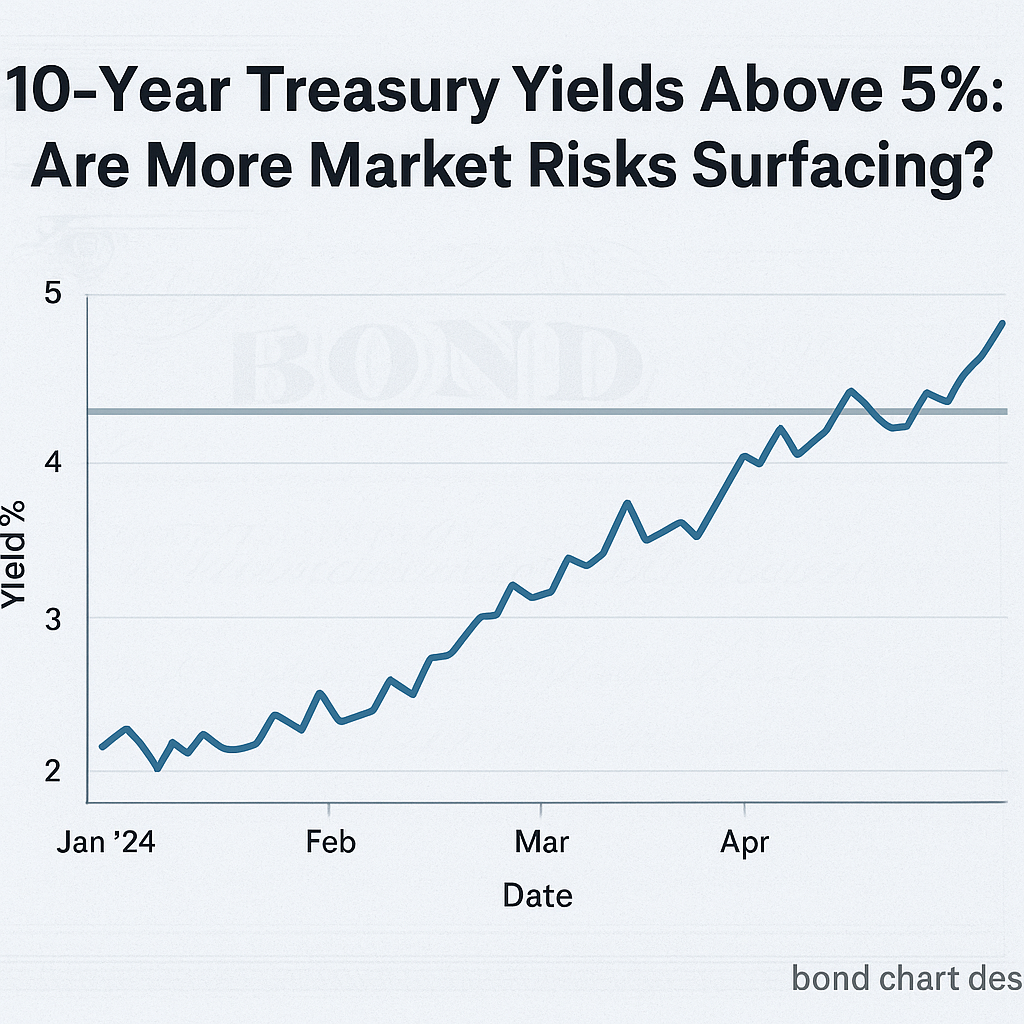
Ten-year Treasury yields are back above 5%, and that matters because bond markets do not move like this for decoration. Higher long-term rates change discount rates, pressure valuations, tighten financial conditions, and can expose weak spots in stocks, credit, real estate, and leveraged trades. The real question is whether this move is a warning flare or just another noisy market spike.
Key Takeaways:- 10-year Treasury yields above 5% raise the cost of capital across the market.
- Higher yields can hit growth stocks, housing, corporate credit, and rate-sensitive sectors.
- The Fed’s policy path matters, but the bond market often moves first.
- Risk shows up fastest where balance sheets are stretched and cash flows are thin.
- Stewardship matters: capital should be deployed with prudence, not swagger.
What are 10-Year Treasury Yields Above 5%?
The 10-year Treasury yield is the return investors demand to lend money to the U.S. government for a decade. When that yield rises above 5%, it signals that bond investors want more compensation for inflation, growth uncertainty, fiscal pressure, or simply less appetite for duration risk. That is not a small move.
Why should stock investors care? Because the 10-year Treasury sets the baseline for pricing nearly everything else. It influences mortgage rates, corporate borrowing costs, equity valuation models, and even the appeal of holding cash versus risk assets. If you have a portfolio full of long-duration assets, the math gets less friendly fast.
I have run enough scenarios to know that people love to treat Treasury yields like some abstract macro chart. They are not abstract. They are the gravity under the market. When I see the 10-year near or above 5%, I immediately look at asset allocation, duration exposure, and whether speculative positions are being carried by cheap money rather than real earnings power.
Frankly, that is where the trouble starts. Most commentators focus only on the Fed, but the bond market often does the harder work of repricing risk before policymakers move. The Fed may hike or hold, but if Treasury buyers are demanding more yield anyway, the market is already voting on inflation, supply, and fiscal strain. That is a bigger clue than the headlines admit.
The issue is not that 5% is magical. It is that many assumptions built during the low-rate era break once rates stay elevated. Companies that looked fine at 2% or 3% rates can look fragile at 5%. Households do not care about theoretical models; they care about mortgage payments, car loans, and credit-card bills. The same goes for businesses. Real work, real wages, real cash flow—that is what survives when easy money fades.
For a broader market context, it helps to compare how long rates interact with policy expectations and inflation data. The Federal Reserve’s own statement and projections matter, and so does the market’s read on them. You can review the Fed’s policy framework on the Federal Reserve FOMC calendar, while the Treasury market itself is tracked in detail by the U.S. Treasury yield data.
Core Benefits and Importance
The higher yield is a message. It tells investors the cost of money is no longer cheap, and that changes how every asset should be priced, financed, and judged.
Here’s the kicker.
- Better price discovery: When rates rise, markets stop pretending that every company deserves a rich multiple. That is healthy, even if it hurts.
- Cleaner capital allocation: Cheap money props up weak firms. Higher yields force a harder look at earnings quality, debt maturity, and actual return on invested capital.
- Stronger savings options: Cash, Treasuries, and short-duration bonds finally become usable again for conservative investors who do not need to chase risk.
- Pressure on inflated valuations: Growth stocks, especially those with profits far in the future, are more sensitive to discount rates. A move in the 10-year changes the present value of those cash flows.
- Signals stress in leveraged corners: Private equity, commercial real estate, and speculative credit can crack when refinancing gets expensive.
- Encourages stewardship: Capital should serve productive ends—business expansion, worker wages, prudent reserves—not just paper gains. That is basic moral common sense.
Most guides celebrate rising yields as a “healthy normalization.” Sometimes that is true. Sometimes it is just a polite phrase for tighter conditions and shrinking margins. The data matter more than the slogan.
I have looked at enough cycles to know that rate increases do not hit every sector equally. Banks can benefit at first from wider net interest margins, but if credit losses rise, the cheer fades. Utilities and REITs often struggle because their income streams are valued like bond substitutes. Tech can hold up if earnings are strong, but unprofitable names usually get punished first. So, no, this is not one simple trade.
The importance of the current move is also about timing. The market is not only reacting to today’s rate level; it is pricing how long rates stay high. If inflation proves sticky, the 10-year does not need to explode higher to keep pressure on risk assets. It just needs to stay elevated long enough to force repricing. That is the part people ignore while they chase the next headline.
For a clearer read on inflation and rates, I’d also recommend the U.S. CPI release from the Bureau of Labor Statistics and the Federal Reserve monetary policy page. Those sources do not provide hot takes. Better.
Step-by-Step Guide to Assessing the Risk
Start with the bond market. If the 10-year is telling one story and stocks are telling another, you need to figure out which price is lying.
- Check your duration exposure. Long-duration assets are the first to wobble when yields rise. That includes growth stocks, long-dated bonds, and businesses whose value depends on profits years from now. I usually ask: what happens to this portfolio if discount rates rise another 50 basis points?
- Review debt loads and refinancing dates. Companies with large maturities in the next 12 to 24 months are the ones I worry about most. If they need to refinance at a much higher rate, earnings can get clipped fast. This is especially true in lower-quality credit.
- Check earnings quality, not just earnings growth. Some firms can grow revenue while cash flow stays thin. That is not a good sign when money costs more. Real free cash flow, not adjusted optimism, is what matters.
- Look at housing and consumer credit. Mortgage rates tend to follow Treasury yields with a lag, and housing is often one of the first places strain shows up. If credit-card delinquencies, auto loan stress, or mortgage affordability worsen, risk is moving from theory to reality.
- Rebalance toward balance sheets that can breathe. Strong cash flow, low leverage, and pricing power are not sexy. They are useful, which is better. I would rather own a plain company that can survive than a flashy one that needs perfect conditions.
- Separate policy hope from market pricing. Wall Street loves to bet that the Fed will pivot. Sometimes it does. Sometimes inflation or labor data force rates higher for longer. Do not build a portfolio around a rumor.
- Keep some dry powder. High yields can create opportunities. When valuations reset, patient capital gets choices. That is where discipline pays.
When I ran stress tests on mixed portfolios under higher-rate assumptions, the same pattern kept showing up: quality beats leverage. That does not mean every high-multiple stock collapses or every bond rally fails. Markets are messy. But it does mean investors who own assets because they went up last year are usually the first to get embarrassed.
A lot of advisers say “stay diversified,” which is true but incomplete. Diversification only helps if the holdings are actually different in how they react to rates, inflation, and credit stress. Ten tech names that all depend on cheap capital are not diversified. They are coordinated risk with nicer branding.
If you want more on rate sensitivity and portfolio planning, see the SEC’s investor bulletins and the Investor.gov guide to asset allocation. Boring stuff. Very useful.
Comparison Table: Higher-Yield Treasuries vs. the Fed Pivot Trade
Higher yields are the current fact. The biggest competitor is the market’s favorite fiction, namely that the Fed will soon rescue every stretched valuation.
| Factor | 10-Year Treasury Yield Above 5% | Fed Pivot Trade |
|---|
| Main driver | Bond market pricing inflation, supply, and term premium | Expectation of rate cuts or easier policy |
| Effect on valuations | Pressures high-multiple stocks and leveraged assets | Can lift speculative assets temporarily |
| Impact on borrowing | Raises mortgage, corporate, and consumer borrowing costs | Suggests relief for refinancing and debt service |
| Portfolio behavior | Favors cash flow, quality, and shorter duration | Favors growth, cyclicals, and rate-sensitive names |
| Risk profile | Exposes weak balance sheets and poor cash generation | Often depends on data turning softer than expected |
| Time horizon | Can stay restrictive for months or longer | Often trades on short-term optimism |
The comparison is simple. A Fed pivot trade is hope priced as strategy, and hope can be expensive. A 10-year yield above 5% is the market saying: prove it.
That matters because the bond market usually has a better nose for inflation persistence than equity traders do. Investors who ignore that signal tend to assume all bad news is temporary and all policy pain is reversible. Sometimes it is. Often it is not.
The bond market also affects sectors differently. Banks, insurers, and some value stocks can cope better with higher yields than growth names with weak profits. But if credit spreads widen alongside Treasury yields, the market stops rewarding the “higher rates are good for financials” story. Then risk starts showing up in the places people thought were safe. That is the part nobody likes to mention at cocktail hour.
For official market data, Treasury yield curves and historical rates are available from the U.S. Department of the Treasury. If you want to understand the policy side, the FOMC calendar is the source, not the chatter.
Common Mistakes to Avoid
People make this harder than it is. Then they call it sophistication.
- Confusing a rate spike with a full regime change. One week of higher yields is not a new era. But pretending it means nothing is equally foolish. Watch the trend, not the applause.
- Assuming the Fed controls everything. The Fed matters, sure, but the bond market can tighten financial conditions on its own. That is not theory; it is price action.
- Treating duration risk as a bond-only problem. Growth equities, private assets, and even some dividend stocks carry duration-like risk through valuation. I keep seeing investors miss this because they only stare at bond funds.
- Buying “safe” yield without checking credit quality. High yield is not the same as good yield. Junk debt can look attractive until refinancing day arrives.
- Ignoring cash flow. Revenue growth is nice, but cash flow pays the bills. That has always been true. It is even more true when rates are high.
- Overreacting to every headline. Markets punish emotional trading. If you change your portfolio every time a strategist appears on TV, you are not managing risk; you are renting anxiety.
- Forgetting the human side of capital. The point of investing is not to worship a spreadsheet. It is to steward resources wisely, support productive enterprise, and preserve dignity through real economic activity. That sounds quaint until leverage breaks something.
The truth is, many investors keep one eye on their portfolios and one eye on the talking heads, and neither gives them a full picture. I would rather check balance sheets, maturity schedules, earnings quality, and the actual Treasury curve. Less drama. Better odds.
Also, don’t assume “rate sensitivity” only matters for bond funds and homebuilders. It shows up in everything from software multiples to commercial property valuations. If your asset only looks good when money is cheap, that is not a business model. That is a bet on someone else being reckless.
Frequently Asked Questions
What does it mean when the 10-year Treasury yield crosses 5%?
It means investors are demanding a higher return to hold long-term U.S. government debt, often because inflation, growth, or supply concerns are still in play. It also tends to raise borrowing costs across the economy.
Are higher Treasury yields always bad for stocks?
No. Some sectors, like financials, can benefit at first. But in general, higher yields pressure valuation multiples, especially for growth stocks and companies with weak cash flow.
Does a higher 10-year yield mean the Fed will hike again?
Not automatically. The Fed sets short-term policy rates, while the 10-year is set by market participants. Still, higher long rates can reflect expectations that policy will stay tight for longer.
How should investors react to 10-year yields above 5%?
Focus on portfolio quality: balance sheets, cash flow, duration exposure, and diversification across asset classes. Don’t chase every rally. That is how people end up buying the top and blaming “volatility.”
Final Thought
Higher Treasury yields are not just another macro headline. They are a reminder that money has a price, and that price eventually reaches every corner of the market, from equity valuations to mortgages to private credit. If investors want to do well in this environment, they need fewer slogans and more discipline, fewer guesses and more stewardship.
I have spent enough time around markets to know that the crowd usually celebrates easy money and complains when the bill arrives. The smarter move is to treat capital with care, favor businesses that create real value, and remember that not every sharp move is a disaster—but every sharp move is a clue. The bond market is talking. The wise investor listens.